Every Australian state and territory lets you appoint more than one person under its financial, medical, and lifestyle decision-making arrangements. Your choice is to make the people you appoint act separately or unanimously.
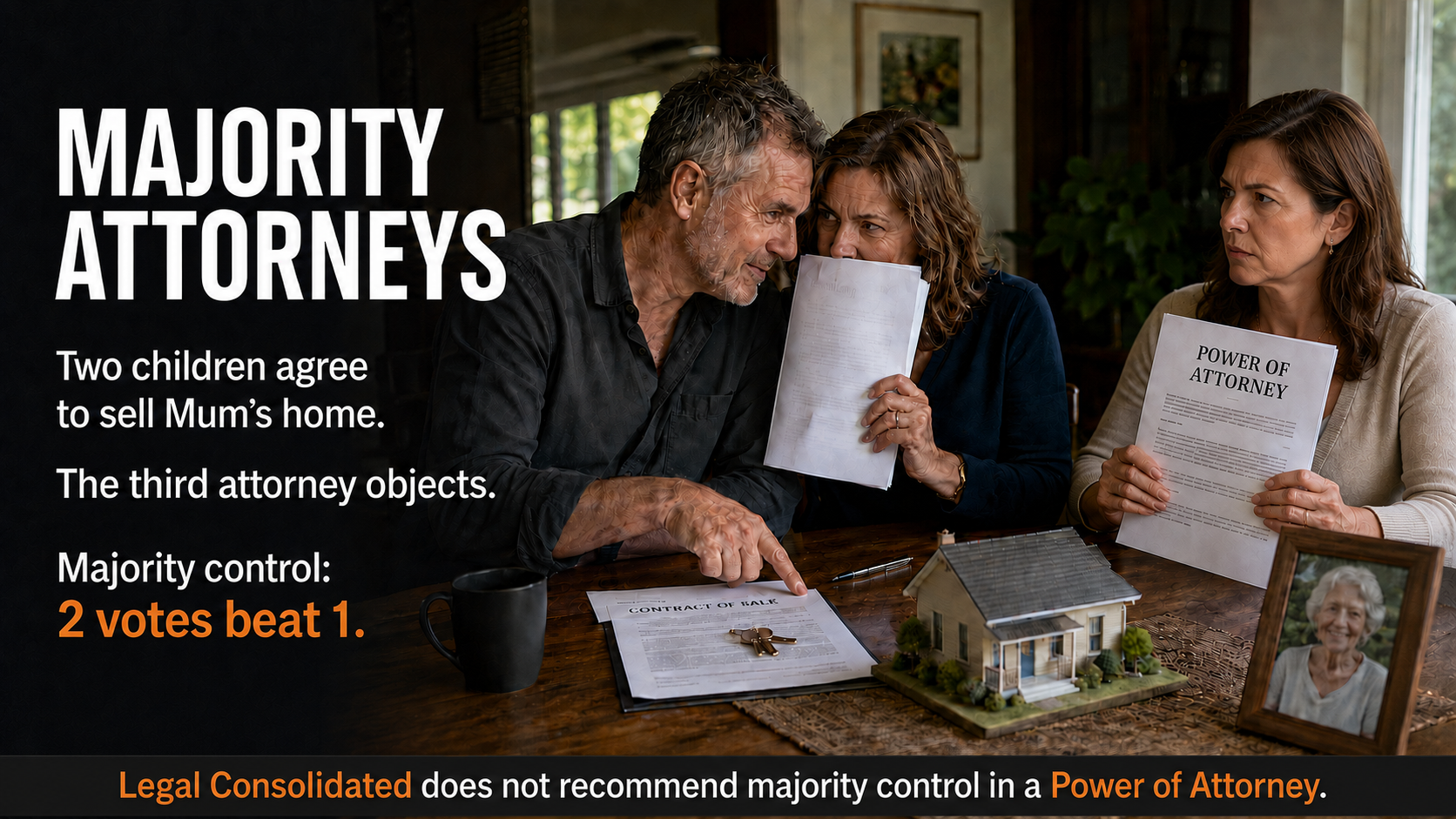
However, two States add a third choice: Queensland and Victoria. They allow majority attorneys. If Mum appoints three children, two can outvote the third.
Legal Consolidated does not permit majority attorneys in its Australian Powers of Attorney. This is deliberate.
Majority control gives two children the machinery to shut out the third and deal with Mum’s home and life savings. A majority vote settles the family vote. It does not prove that the transaction is sensible, properly authorised or faithful to Mum’s wishes and interests. It does not release any attorney from personal responsibility.
This article explains why Legal Consolidated rejects majority control. It also explains the heavy personal risk each attorney accepts and how written advice from Mum’s financial planner and accountant reduces that risk.
What are majority attorneys in a Power of Attorney?
When more than one person holds financial authority, the terms vary across Australia. In substance:
-
Jointly: all attorneys act together. The decision is unanimous.
-
Severally: each attorney acts alone.
-
Jointly and severally: the attorneys act together or one acts alone.
-
By majority: more than half decide. With three attorneys, two control the decision.
Majority control is not a compromise between joint and several authority. It is its own structure. It expressly lets the larger faction defeat the smaller one.
Who should act first under a Power of Attorney?
Legal Consolidated has prepared Powers of Attorney and medical appointment documents throughout Australia since 1988. Nearly 100 per cent of our clients with a spouse or partner appoint that person to act alone. The spouse or partner is the primary attorney and medical decision-maker.
The real choice arises after that spouse or partner dies or loses decision-making capacity. About 75 per cent of those clients appoint their children or other trusted people to act separately or severally, where the law and document permit. This keeps the appointment workable. One child pays a bill or deals with the bank without collecting every other signature.
Choose separate authority only if you trust each appointee with the entire power. If you do not, require them to act together. They must all agree before acting. It is less convenient. It gives each appointee a veto.
Which Australian states allow majority attorneys?
Only Queensland and Victoria expressly provide majority control for financial enduring appointments.
Victoria says it directly. Section 30 of the Powers of Attorney Act 2014 (Vic) allows attorneys to act jointly, severally, jointly and severally or by majority.
Section 43(2)(g) of the Powers of Attorney Act 1998 (Qld) allows the principal to authorise a stated number of joint attorneys, smaller than the full group, to exercise the power. This is the legislative machinery for the majority option.
|
State |
Power of Attorny |
Allow majority to rule? |
|---|---|---|
|
• Jointly • Severally • Jointly and severally • By majority • Successively or alternatively |
Yes | |
|
• Jointly • Severally • Jointly and severally • By majority |
Yes | |
|
ACT |
• Together • Separately • Another stated combination |
No labelled majority choice |
|
NSW |
• Jointly • Jointly and severally |
No |
|
NT |
• Jointly • Severally • Jointly and severally |
No |
|
SA |
• Jointly • Joint and several |
No |
|
Tasmania |
• Jointly • Jointly and severally |
No |
|
WA |
• Jointly • Jointly and severally |
No |
Can medical and lifestyle decision-makers act by majority?
Medical and lifestyle appointments do not follow one national rule. The legislation uses different document names, decision-maker titles and appointment structures. Three models appear: choice, compulsory unanimity and priority.
|
State |
How multiple medical and lifestyle decision-makers act |
Allow majority to rule? |
|---|---|---|
|
ACT |
• Together • Separately • Another stated combination |
No labelled majority choice |
|
NSW |
• Jointly • Severally • Jointly and severally |
No |
|
NT |
• Jointly • Severally • Jointly and severally |
No |
|
Queensland |
• Jointly • Severally • Jointly and severally • By majority • Successively or alternatively |
Yes |
|
SA |
• Separately or together • Subject to any stated precedence, allocation or alternative appointment |
No standard majority choice |
|
Tasmania |
• Jointly • All enduring guardians must agree |
No |
|
Victoria |
• Personal and lifestyle attorneys: jointly, severally, jointly and severally or by majority • Medical treatment decision-makers: priority order; one acts at a time |
Yes for personal matters. No medical vote. |
|
WA |
• Jointly • All enduring guardians must agree |
No |
Queensland expressly permits majority control for personal matters, including health matters: Powers of Attorney Act 1998 (Qld) s 43. Victoria permits majority control for personal matters: Powers of Attorney Act 2014 (Vic) s 30. But Victoria’s medical treatment decision-makers are appointed in priority order. The first listed person who is reasonably available, willing and able acts. There is no family vote: Office of the Public Advocate (Victoria), Medical treatment decision makers.
Western Australia and Tasmania take the opposite approach for enduring guardians. Multiple enduring guardians act jointly and must agree. One cannot act alone. Two cannot outvote the third: Office of the Public Advocate (WA), Enduring Power of Guardianship; Office of the Public Guardian (Tasmania), Enduring guardianship.
Legal Consolidated does not offer majority control. Where legislation requires joint action or priority, our document follows that law. Where legislation gives a choice, our online building process selects the correct document, terminology and a workable appointment structure without giving one family faction the machinery to defeat another.
Why Legal Consolidated rejects majority attorneys
More than 4,600 accountants, financial planners, lawyers and other advisers build legal documents on our website. They report back. We are repeatedly told what happens after a parent loses capacity:
-
two children vote to sell Mum’s home over the third child’s objection;
-
two decide that Mum’s rental properties are too much work and sell without testing the financial strategy;
-
two approve payments to a family member who benefits from the decision; or
-
the attorney asking sensible questions is labelled “difficult” and outvoted.
Where the client chooses joint authority, unanimity changes the failure point. If the attorneys agree, they act. If they disagree about a major, non-urgent and irreversible transaction, the transaction stops before the asset is gone.
That deadlock is useful. It forces the attorneys to obtain a written recommendation from Mum’s financial planner and written tax and accounting advice from her accountant. If the disagreement remains, the relevant tribunal or court decides.
Attorneys should continue paying essential bills and taking urgent steps where the document permits. It is the disputed transaction that stops.
Majority attorneys in Australian court cases
Pickersgill: majority control and an ‘unseemly battle’
In Pickersgill v Pickersgill [2019] QSC 268, an 85-year-old mother had six children: four sons and two daughters. Her 2013 Enduring Power of Attorney appointed one son and both daughters. It began when she lost capacity. Decisions were by majority. The two daughters could therefore act without the son.
Large sums were then paid by cheque from Mum’s bank accounts to the daughters and people associated with them. Davis J did not decide whether the payments were proper. But the medical evidence raised questions about whether Mum had capacity to make uninfluenced decisions about that money.
The family split four brothers against two sisters. Later Powers of Attorney and Wills swung control and gifts from one camp to the other. By the time of the proceeding, Mum had ‘moderate cognitive impairment’ and lacked capacity to give instructions. Davis J described an ‘unseemly battle’ over Mum’s finances and Mum herself. His Honour inferred that the proceeding was really a fight between the brothers and sisters over Mum’s assets.
The Court revoked the later Powers of Attorney, removed all three family attorneys under the 2013 document and appointed two independent accountants to act severally. Davis J said it was ‘abundantly evident’ that Mum’s affairs needed independent control.
The judgment dealt with costs. The orders were sought by the parties who appeared. It did not hold that majority appointments are invalid, that the daughters authorised the payments or that majority control caused the litigation. Legal Consolidated’s conclusion is blunt: majority control helped fuel the fight. It left two attorneys able to act over the third attorney’s objection after Mum lost capacity. The fight ended with every child losing control.

KZV: a majority Power of Attorney that still ended in court
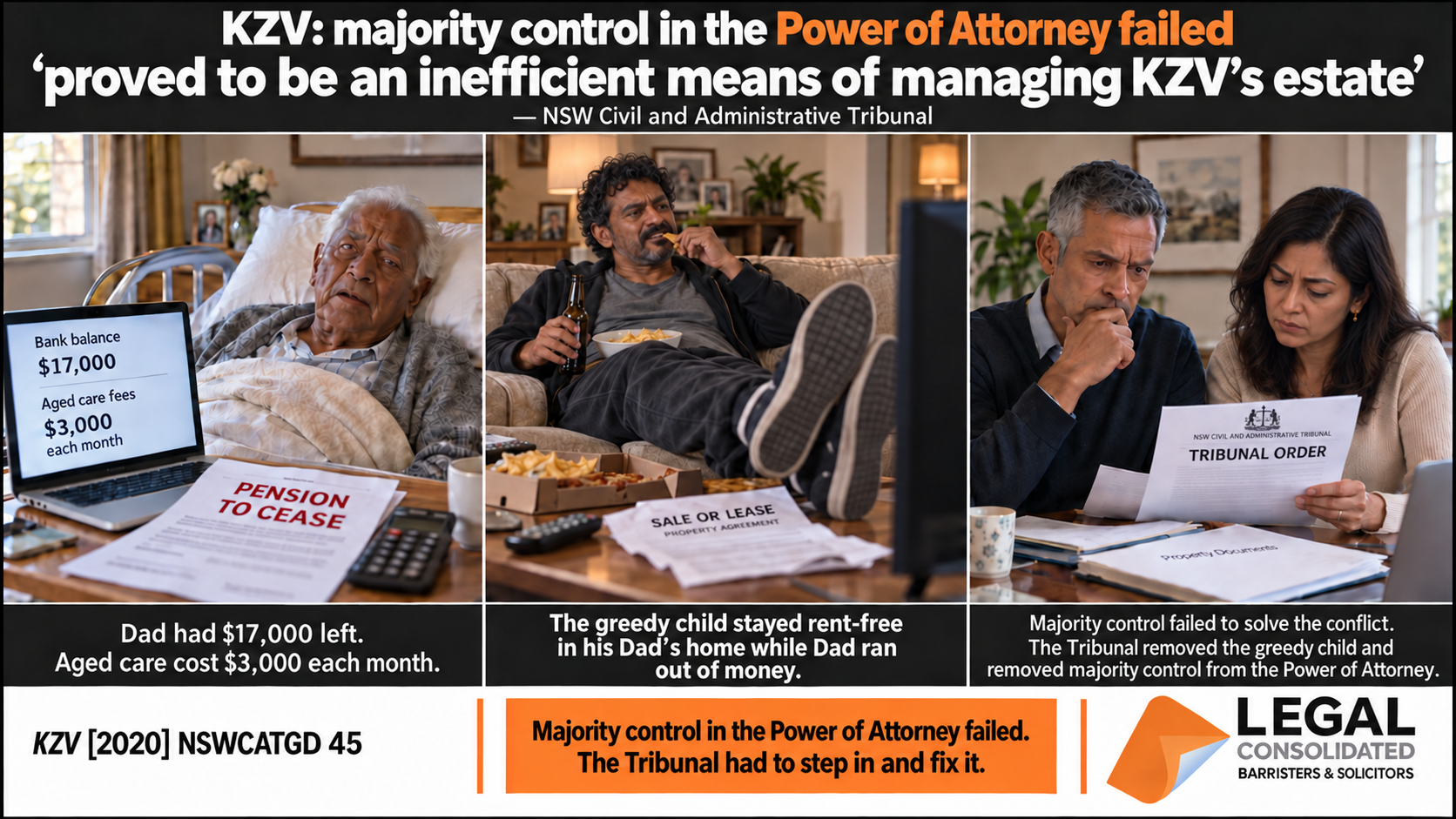
In KZV [2020] NSWCATGD 45, an 83-year-old man living in aged care had appointed his two sons and a daughter-in-law as attorneys. Three attorneys could decide by simple majority; two had to decide unanimously. At the hearing, KZV could not remember where he lived. The Tribunal found that he could not effectively participate in the dispute about his care, home and finances.
One son, EDU, remained in KZV’s property without paying rent. The other two attorneys resolved by majority to sell or let it. They told NCAT that KZV had about $17,000 in the bank against aged-care fees of $3,000 a month. NCAT accepted that his resources were seriously depleted and action was required. EDU resisted leaving and said he had been excluded. The Tribunal reduced the weight of that claim: he had been invited to collaborate, could obtain records himself and had not taken steps open to him.
NCAT said the majority clause supplied ‘the machinery for it to work’. But decisions by two attorneys were resisted by the third, and repeated Tribunal and Supreme Court proceedings followed. NCAT found that the Power of Attorney had ‘proved to be an inefficient means of managing KZV’s estate’. The decisive problem was EDU’s conflict: he wanted to remain in the house, faced a costs order in KZV’s favour and contemplated an appeal. NCAT removed him. The two remaining attorneys then had to decide unanimously.
Legal Consolidated does not suggest that the majority decisions were improper. NCAT found no problematic financial dealing and said the evidence did not establish that the other two attorneys had acted other than in KZV’s best interests. The warning is structural. The majority clause let two attorneys act over the third, but it did not resolve the underlying conflict or keep the family out of court. NCAT ultimately adopted the cleaner solution: remove the conflicted attorney and require the remaining attorneys to act unanimously.
Neither decision outlaws majority control. Pickersgill shows how two attorneys can act over the third after the principal loses capacity. KZV shows that majority voting can outvote an attorney without resolving mistrust, conflict or litigation. Australian research identifies family conflict, poor understanding of the attorney’s role and weak preparation for financial decisions as recurring risks. Written records and professional advice strengthen accountability.
Should attorneys act jointly or severally under a Power of Attorney?
Legal Consolidated supports both structures. The problem is majority control, not joint or several authority.
-
‘Severally’ means separately. Each attorney may exercise the authority alone. There is no family vote. There is no two-attorney faction that defeats the third.
-
‘Jointly’ means every attorney must agree and act. This provides a stronger check against fraud and elder abuse because one attorney cannot act alone. The price is friction. Every signature must be collected. One unavailable attorney stops the transaction. The death of one joint attorney, or the loss of that attorney’s mental capacity, often stops the Power of Attorney from operating.
Majority authority is different. It removes the protection of unanimity while encouraging factions. Two attorneys can impose their decision on the third. Legal Consolidated rejects majority voting.
If attorneys acting severally disagree about a major, non-urgent and irreversible transaction, they should not race to sign. Stop. Obtain written advice from Mum’s financial planner and accountant. If the dispute remains, seek directions from the tribunal or court.
Majority approval does not protect an attorney
Accepting appointment as an attorney is a heavy burden dressed up as a family honour. The attorney controls another person’s money after that person loses the ability to supervise what the attorney does.
The relationship is fiduciary. It demands loyalty and utmost good faith. The statutes use different language, but the core duties are familiar:
-
act within the signed Power of Attorney;
-
follow Mum’s will, preferences and interests under the law that applies;
-
act honestly, diligently and with reasonable care;
-
avoid unauthorised conflicts and personal benefits; and
-
keep Mum’s property separate and keep complete records.
Queensland requires an attorney to act honestly and with reasonable diligence to protect the principal’s interests: Powers of Attorney Act 1998 (Qld) s 66. Victoria requires honesty, diligence, good faith, reasonable skill and care: Powers of Attorney Act 2014 (Vic) s 63.
The consequences are real. In Cohen v Cohen [2016] NSWSC 336, a son used his mother’s Power of Attorney to transfer her only substantial asset, her unit, to himself for $1. The Supreme Court ordered him to transfer it back. A wide power did not excuse its abuse.
‘The other attorney agreed’ is not a defence. Each attorney in the majority owns the decision.
The 24 per cent Power of Attorney hindsight trap
We have seen two children sell Mum’s home for legitimate care and financial reasons. Property prices then rose by more than 24 per cent over the following 18 months.
The third child alleged that the attorneys had cost Mum the increase and threatened to go to the police. Without fraud or elder abuse, a genuine disagreement about investment judgment is not a police matter. The threat still put the fear of God into the two attorneys. They eventually tipped in money towards the supposed shortfall.
A written report from Mum’s financial planner recommending the sale, supported by the accountant’s written tax and accounting advice, would have given the attorneys their best protection against hindsight. It would have recorded the alternatives, assumptions and reasons existing when they acted.
Attorneys do not control property markets. They control the quality of their process and evidence.
The financial planner recommends whether Mum’s asset should be sold
The central question is not merely: “What price does the property fetch?” The financial planner advises on the real question: “Should Mum retain, lease or sell the property?”
The financial planner considers:
-
the cost and timing of residential aged care;
-
Mum’s cash flow, liquidity and life expectancy assumptions;
-
whether Mum has a realistic prospect of returning home;
-
rental income, expenses, maintenance and management burden;
-
concentration risk and the rest of Mum’s investments; and
-
Mum’s known wishes and standard of living.
The financial planner’s report must make a recommendation. A list of alternatives leaves the hard work with the unqualified attorneys.
The accountant measures tax and the cash left for Mum
The accountant tests the planner’s strategy against:
-
capital gains tax and the main residence rules;
-
rental income, deductions and land tax;
-
ownership structures and carried-forward losses;
-
missing cost base or transaction records;
-
payments or reimbursements involving family members; and
-
the cash remaining after tax and costs.
The financial planner recommends the strategy. The accountant exposes its tax and accounting consequences. The attorneys then make an informed decision and keep both reports.
Attorneys are not accountants or professional money managers. They have natural biases. Written reports bring knowledge, independence and a record made before the outcome is known.
Which attorney decisions need written sign-off?
Large, irreversible or conflicted decisions need written reports. Obtain the financial planner’s and accountant’s written sign-off before:
-
selling, retaining or leasing Mum’s home to fund aged care;
-
selling a rental property because it takes too much effort to manage;
-
liquidating a substantial share or investment portfolio;
-
selling a farm, business or other income-producing asset;
-
borrowing, refinancing, mortgaging or giving a guarantee;
-
paying a family member for care, accommodation or services;
-
making a gift, loan or “early inheritance”; or
-
improving property owned by an attorney or another relative.
What should attorneys do when they disagree?
-
Stop the disputed, non-urgent and irreversible transaction.
-
Record each attorney’s position and Mum’s known wishes.
-
Ask Mum’s financial planner for a written recommendation.
-
Ask Mum’s accountant for written tax and accounting advice.
-
Read the Legal Consolidated covering letter and contact us for free guidance on using our document.
-
If the deadlock remains, seek directions from the tribunal or court for that jurisdiction.
A disagreement is not the disaster. Acting after the warning, without proper reports, is the disaster.
Build an Australian Power of Attorney with lifetime support
Legal Consolidated builds the correct financial Power of Attorney and medical or lifestyle appointment for the ACT, New South Wales, Northern Territory, Queensland, South Australia, Tasmania, Victoria and Western Australia.
Our online building process does not offer majority control. Every document comes with a Legal Consolidated law firm covering letter. The covering letter confirms that Legal Consolidated authored and accepts responsibility for the document. We are not a template reseller.
The covering letter explains how to sign and use the Power of Attorney. You receive free updates while you have mental capacity. You and your advisers receive free guidance before incapacity. After incapacity, your attorneys and loved ones still receive free guidance on using the Legal Consolidated document. They are not left alone with Mum’s home, money and legal duties.
Build your Enduring Power of Attorney on the Legal Consolidated website. Start the online building process for free.
General information only. Powers of Attorney and substitute decision-making laws differ between jurisdictions and depend on the signed document.