Legal Consolidated 3-Generation Testamentary Trust Wills are drafted so your executors can apply for a Grant of Probate themselves. Your executors do this with the help of your accountant and financial adviser.
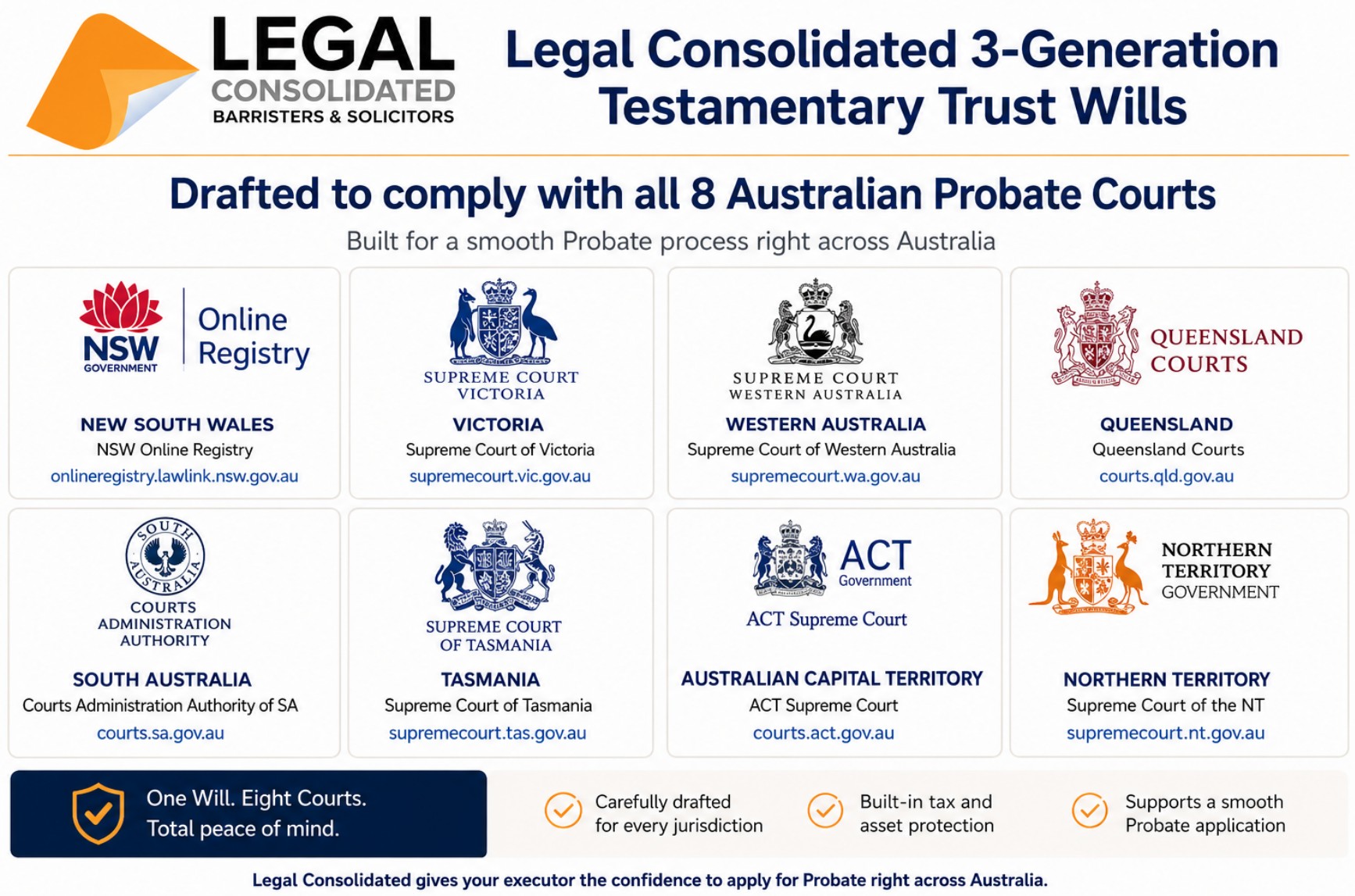
You can apply online in all Australian states and territories. The links are below. The Legal Consolidated 3-Generation Testamentary Trust Will has been carefully drafted to comply with each state's Wills Act. Our Wills incorporate specific statutory forms and precise attestation clauses to satisfy the requirements of each jurisdiction.
This free practical guide explains how to get Probate and activate the tax and asset protection benefits inside a Legal Consolidated 3-Generation Testamentary Trust Will.
3-Generation Testamentary Trust Wills come with free advice after you are dead
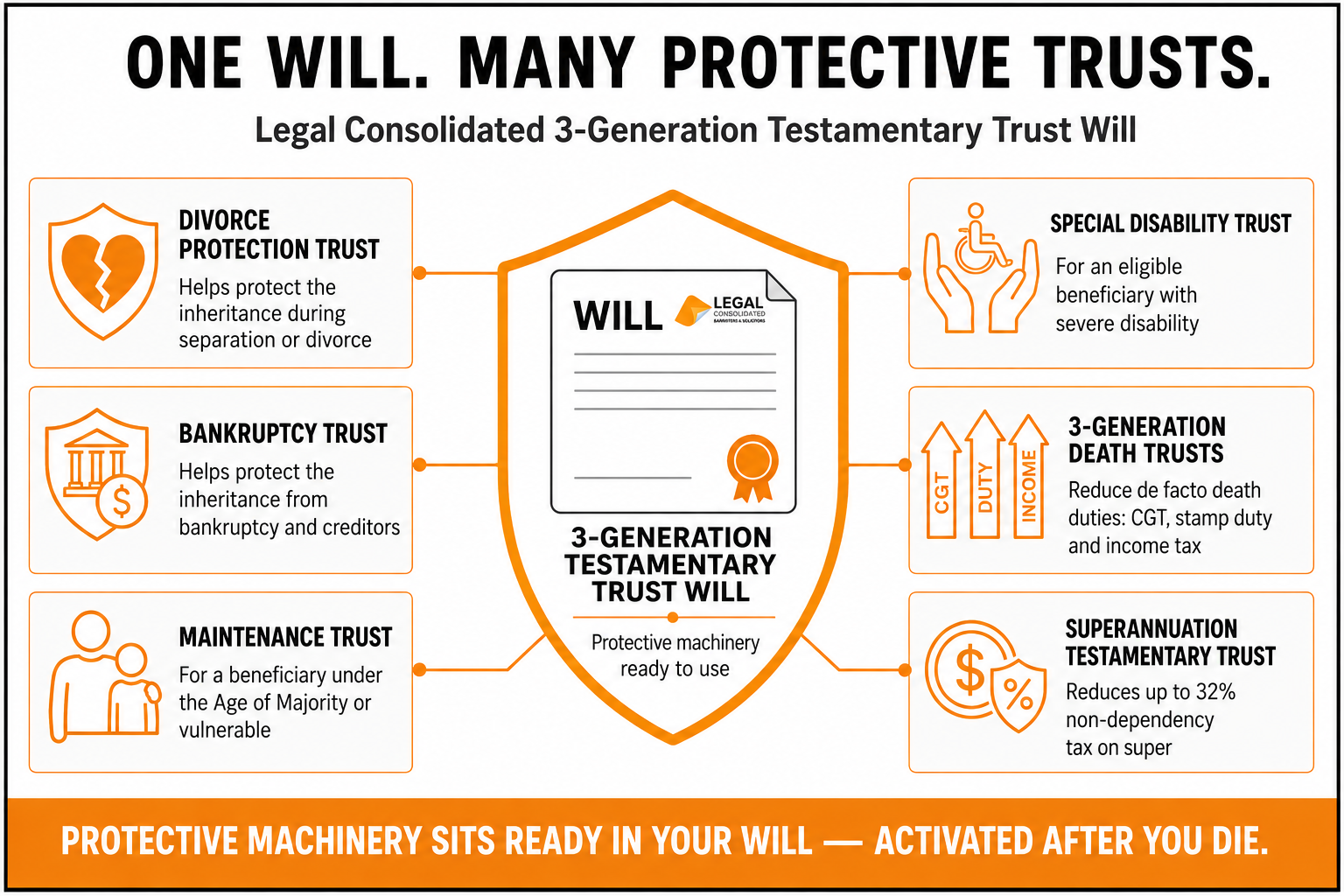
The cost of building a Will on our website includes free advice on how you and your advisers can benefit from and set up the many trusts in the 3-Generation Testamentary Trust. These include:
- Divorce Protection Trust
- Bankruptcy Trust
- Vulnerable Beneficiary Trust
- Under the Age of Majority Trust
- Special Disability Trust
- Superannuation Testamentary Trust to reduce the 32% tax on super
- De facto death tax reduction trusts
Do I need a Grant of Probate?
Check if you actually need to go through the process of getting a Grant of Probate. You may be able to escape having to apply for Probate in these situations:
- The estate is small: Banks and other asset holders sometimes release smaller balances without Probate. Ask each asset holder what it requires.
- Assets are held as Joint Tenants: The family home or joint bank accounts held as "joint tenants" automatically pass to the surviving owner. You merely lodge the Death Certificate and the Survivorship Application form with the Titles Office.
However, you apply for a Grant of Probate if someone is refusing to hand over or transfer an asset. For example, a bank or the land titles office may refuse to hand over or transfer assets to the executor.
Queensland land is different: Uniquely, the Queensland Titles office has a process that sometimes avoids Probate for certain sales and transfers of land. Check Titles Queensland before paying the Probate filing fee.
Superannuation is different:
Your accountant and financial adviser will work out whether your super can be paid into your Will. This is important because superannuation does not automatically form part of your estate.
A Legal Consolidated 3-Generation Testamentary Trust Will contains a specialised Superannuation Testamentary Trust. Where appropriate, your advisers arrange for your superannuation death benefit to be paid to your executor and into your estate. The benefit can then be managed under your Will using every available tax concession.
The tax treatment depends on who benefits. A lump-sum death benefit for a tax dependant is tax-free. If a non-tax dependant benefits, the taxed element is taxed at up to 15% and the untaxed element at up to 30%, plus the 2% Medicare levy. An adult child is a non-tax dependant unless they were financially dependent on you or satisfy the interdependency test.
Paying superannuation into your estate does not, by itself, remove the tax. Your accountant and financial adviser review the fund rules, beneficiary nomination, tax components and intended beneficiaries to determine the best structure.
1. How to start the Probate process yourself
Probate is the Supreme Court’s formal confirmation that the Will is valid and the executor is entitled to administer the estate. Before Probate, the executor relies on the Will and politely asks each asset holder to act. An asset holder who requires Probate refuses to release or transfer the asset. Once the Court issues the Grant, the executor presents it as Court-backed proof of authority to collect, transfer and deal with the estate assets.
The Supreme Court process requires attention to detail. Starting with a robust Legal Consolidated 3-Generation Testamentary Trust Will is a good start.
Protect the physical Will: Never remove the staples or bindings from the original Will to photocopy it. Removing staples suggests that pages were removed or substituted.
Money for burial and cremation before Probate: A bank releases estate money for funeral expenses and Probate filing fees. Show the bank the Death Certiciate, Will and the invoice or receipt.
2. Apply for the Grant of Probate online
Every Supreme Court provides its Probate information and forms online.
What documents do I need to get Probate?
An application for a Grant of Probate usually requires five documents:
- A Motion or Application for a Grant of Probate.
- The Executor’s Affidavit.
- A Statement of Assets and Liabilities (QLD does not require this).
- The original Will.
- The Death Certificate.
Free links to the Probate Offices throughout Australia
Each state and territory has an online Probate application service:
- New South Wales: NSW Online Registry
- Victoria: Supreme Court of Victoria
- Western Australia: Supreme Court of WA
- Queensland: Queensland Courts
- South Australia: Courts Administration Authority of SA
- Tasmania: Supreme Court of Tasmania
- Australian Capital Territory: ACT Supreme Court
- Northern Territory: Supreme Court of the NT
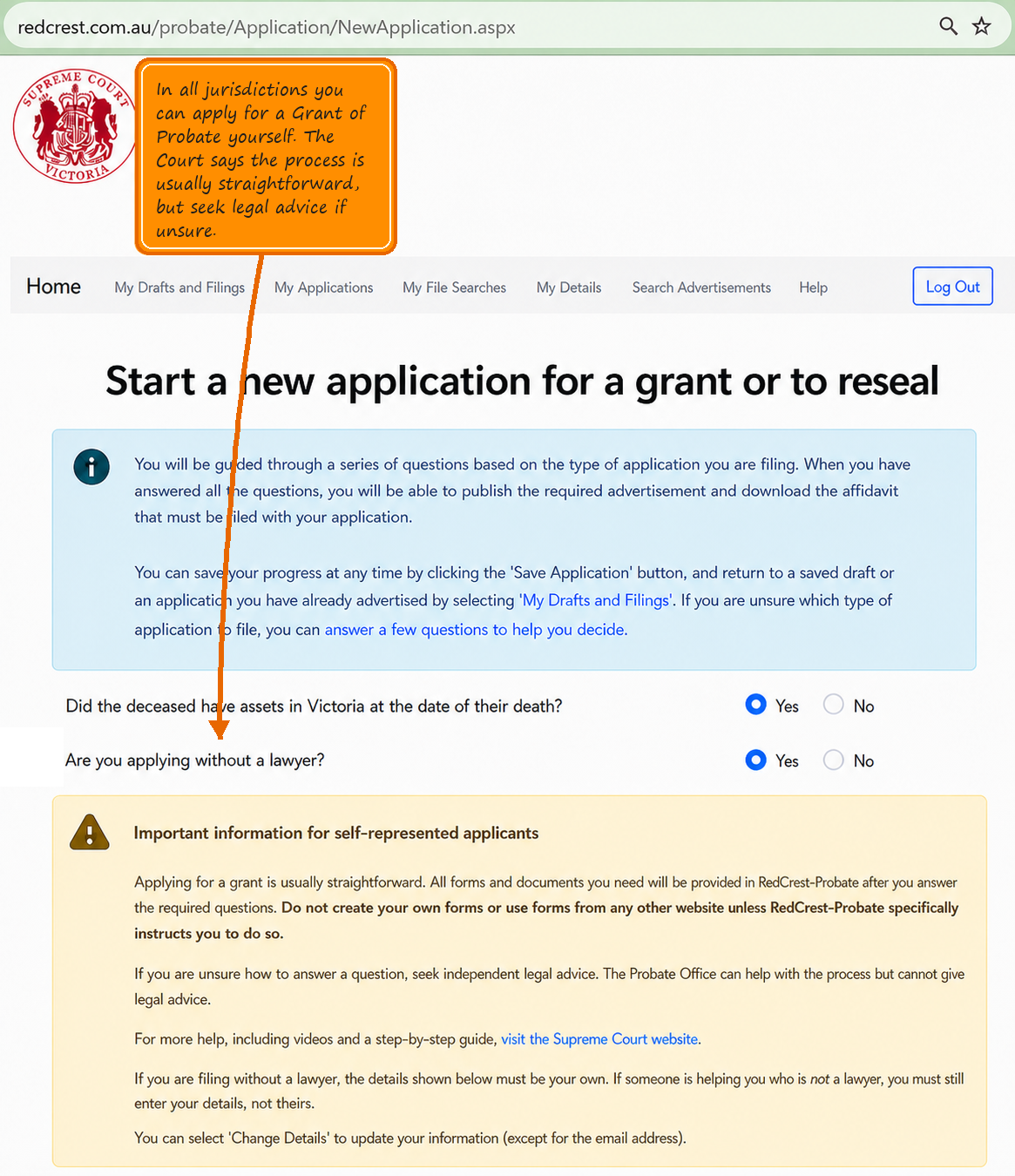
Do the courts allow non-lawyers to apply for a Grant of Probate?
Yes, all courts allow a non-lawyer to apply for a Grant of Probate. The process can be done online.
3. After Probate: Your Accountant and Financial Adviser
Probate is the doorway — not the distribution. The executor presents the Grant to the person holding or controlling the dead person's assets, collects the estate assets, and pays funeral and administration expenses, debts and taxes. The accountant completes the Will-maker’s final tax return and any required deceased estate return. The executor does not distribute the estate assets until debts, taxes, and the applicable estate-claim period are dealt with. The inheritance is transferred to the beneficiary or into one of the trusts selected with the accountant and financial planner.
Setting up a trust from a Legal Consolidated 3-Generation Testamentary Trust is straightforward. You do not buy another trust deed. The trust machinery is already inside the Legal Consolidated Will. Your accountant prepares the appropriate trustee minute, identifies the trust and obtains its TFN. An ABN is obtained where required.
Once you get the Grant of Probate, your financial professionals help you:
- Open Bank Accounts: Open separate bank accounts in the names of the specific trusts.
- Use the section 102AG tax concessions: Qualifying income distributed from the Testamentary Trust to children under 18 is treated as "excepted trust income" under section 102AG of the Income Tax Assessment Act 1936 (Cth). Instead of the punitive tax rates applying to ordinary unearned income of minors, the normal individual tax rates apply. This gives your accountant valuable income-distribution opportunities for children and grandchildren.
- Strategic Asset Allocation: Beneficiaries work with their advisers to structure the inheritance. A beneficiary might take the main residence in their own name to preserve the capital gains tax-free window, while placing high-income-producing assets into the Testamentary Trust.
4. Working With Your Professional Team
A deceased estate lawyer deals with contested or difficult Probate administration. Your accountant and financial adviser help implement the tax and investment strategy. Legal Consolidated supports them with the tax, superannuation and testamentary trust machinery already built into your 3-Generation Testamentary Trust Will.
Legal Consolidated is a specialist tax and superannuation law firm and does not provide deceased estate administration advice. However, you and your advisers are welcome to contact us for advice on how to correctly establish the trusts within the Will as part of your broader estate plan.
Practical Probate checklist — what to gather before applying
A Probate application is an exercise in gathering accurate information. The Will identifies the executor. The executor then gets to work to provide the Supreme Court with the required information.
The executor remains in control. The accountant helps with tax and date-of-death figures. The financial planner identifies investments, superannuation and insurance.
1. Prepare a date-of-death asset list
With the help of your accountant, document the assets owned by the Will maker as at the date of death. This includes:
- bank accounts and term deposits;
- shares, managed funds and other investments;
- real estate;
- vehicles, furniture and personal possessions;
- business, company and trust interests;
- money owed to the Will maker;
- unpaid salary, leave and other entitlements; and
- superannuation and life insurance payable to the estate.
For each asset, record the owner, account or identifying number, location and value as of the date of death. Ask the bank, share registry, accountant or financial institution for written confirmation.
Record the gross value of an asset. List any mortgage or secured loan separately as a liability. Also record whether property was owned solely, as a joint tenant or as a tenant in common. Jointly owned property does not generally form part of the Probate estate.
Money earned after death, such as later interest or rent, belongs in the estate accounts rather than the date-of-death snapshot for Probate. However, an entitlement that already existed at death remains an estate asset even if it is paid later.
Exception — Queensland: Queensland does not require a Statement of Assets and Liabilities as part of the standard Probate application. Still prepare a private estate schedule. The executor, beneficiaries, accountant, Australian Taxation Office and financial institutions all need this information.
2. Separate liabilities from later estate expenses
List debts incurred by the Will maker before death. Common examples include mortgages, credit cards, personal loans, tax debts, medical expenses, and unpaid household accounts such as electricity.
Funeral costs, Probate filing fees and later legal, accounting and administration costs are not normally liabilities of the Will maker at death. They are not required for Probate. However, keep them in a separate estate-expenses schedule.
Note — funeral expenses: Normally, the Probate courts wants to see assets and debts as per the day of death. However, the Supreme Courts of Tasmania, Western Australia and the Northern Territory require funeral expenses to be included in the application for a Grant of Probate.
3. Protect the original Will
Before lodging the original Will, make a full-colour copy and photograph its condition, including its staples, bindings, marks and attachments.
Do not:
- remove or replace staples;
- add paper clips or new fastenings;
- write on the Will;
- repair tears with adhesive tape; or
- laminate the Will.
The Supreme Court keeps the original Will as part of the Probate file. After Probate is granted, the Will and Grant become Court records available through the Court’s search and copy procedures.
Access to the other documents varies by state. Do not assume that every affidavit or financial statement is private.
NSW Court access: In NSW, any person, including the press, can obtain a copy of the Will after Probate. Access to the inventory of property and the Executor’s Affidavit is restricted. Give the Court all required information, but do not add unnecessary private family or financial material.
4. Apply to the correct Supreme Court
Do not select a Court solely because that is where the Will maker died. Before paying the filing fee, confirm that the estate has the required connection with that state or territory.
Prepare a list showing where each asset is located. Ask banks and financial institutions which Grant they require before lodging the application.
Note — NSW jurisdiction: Dying in Sydney does not, by itself, give the NSW Supreme Court jurisdiction. The estate needs genuine property in NSW. Furniture and personal possessions physically located in NSW provide that connection if they were owned by the Will maker. Do not omit them merely because they have a modest value, and never invent an asset.If the only substantial asset is a bank account, ask the bank’s deceased estates team which state it treats as relevant and which Grant it accepts. The branch, BSB or location of the bank’s head office does not safely answer that question.
5. Check the application before lodging it
Before submitting the Probate application, confirm that:
- the names and dates match the Will and Death Certificate;
- every change of name, alias or spelling difference is explained;
- every executor named in the Will is accounted for;
- all Codicils are included;
- any damage, markings or changes to the Will’s staples are explained;
- the required Probate notice was published and the waiting period has expired;
- asset descriptions and date-of-death values are consistent;
- the Court has the required jurisdictional connection; and
- every affidavit is signed and witnessed correctly.
A Court requisition delays the Grant and creates more work. A careful final check avoids most routine requisitions.
When Probate is too complicated to do yourself — seven reasons to get a deceased estate lawyer
Stop and get advice from a local deceased estate lawyer if:
- the original Will is lost, incomplete, damaged, marked or altered;
- more than one document appears to be the final Will;
- someone claims the Will maker did not understand the Will, was improperly pressured into signing it or the Will is invalid;
- someone has lodged a caveat to stop the Grant or threatens a claim against the estate;
- the estate cannot pay its debts;
- it is unclear which Supreme Court should deal with the application; or
- an executor has died, refuses to act or cannot be found.
If your accountant or financial planner cannot suggest a deceased estate lawyer, please contact Legal Consolidated, and we may be able to recommend a law firm.

Getting Probate outside of Australia
What if the Will maker had assets overseas? The Legal Consolidated 3-Generation Testamentary Trust Will is drafted to include worldwide assets. Under the Hague Conference on Private International Law, 83 countries automatically honour Wills prepared by Legal Consolidated. Because these Wills are expressly drafted to satisfy the Hague Convention, you possess a significant advantage when managing overseas assets.
Speak to your overseas lawyer. Often the process is:
- You first obtain Probate in Australia, which proves the Will is valid and allows the executor to manage the estate.
- Once you have Australian Probate, you can get it resealed in the country where the estate holds assets.
- This resealing process validates the Australian Probate in that overseas jurisdiction.
Free executor resource
Executor’s Death Kit — Probate, trusts and assets after death
Legal Consolidated 3-Generation Testamentary Trust Wills include free help for your executor, accountant and financial adviser after you die. These practical guides explain what happens next.
Get Probate
- How do I apply for a Grant of Probate myself?
- How do I get probate of a Legal Consolidated Will for non-Australian assets?
Put the Will’s protective trusts to work
- How do I operate a 3-Generation Testamentary Trust after the Will maker dies?
- Can I amend a Testamentary Trust after the Will maker dies?
- How do I reduce the 32% superannuation death tax paid by adult children?
- Can a company act as Trustee or bucket company of a Testamentary Trust?
Practical issues after death
- What happens to mortgages after death?
- Who controls a Family Trust after the Appointor dies?
- Who controls a company after a director dies?
- Are funeral wishes in a Will legally binding?