Loan Agreement — protect your right to repayment

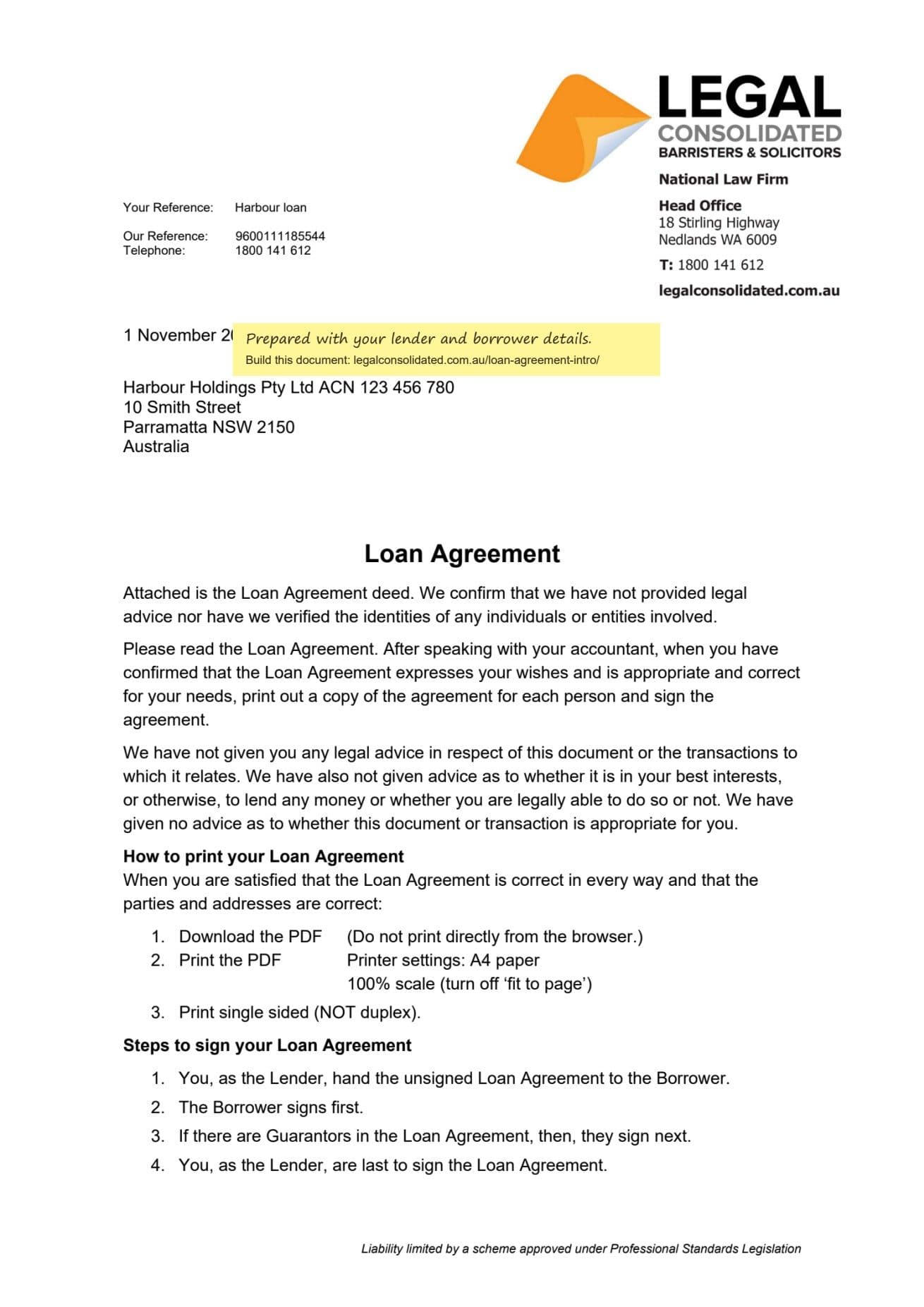
Loan Agreement and Legal Consolidated cover letter for Harbour Holdings Pty Ltd
  • Loan Agreement

  • $683 includes GST

Have our national law firm prepare your Loan Agreement before you lend.

Includes:

  • Law firm’s cover letter and instructions
  • Loan Agreement prepared from your answers
  • Your selected interest and repayment terms
  • Guarantee provisions where selected

You lend the money. Protect your right to get it back.

You transfer money to a person, a company or a Family Trust. Everyone agrees it is a loan. Then repayments stop. The borrower says it was a gift. Or the company fails and its liquidator asks you to prove the debt.

Put your Legal Consolidated Loan Agreement in place before you transfer the money. Our national law firm prepares your finished agreement from your answers. It records the obligation to repay and the rights you exercise if the borrower defaults.

Build your Loan Agreement directly with our national law firm

More than 4,600 accountants, financial planners and lawyers build legal documents on Legal Consolidated’s website. We have provided Loan Agreements since 1988. Our questions and hints guide you through the lender, borrower, loan terms and guarantors.

You receive your Loan Agreement with our law firm’s cover letter and instructions. Start for free. Read the hints, save your answers and return later. Contact us for help answering the building questions.

Who lends the money and who must repay it?

The lender advances the money. The borrower receives it and promises to repay it. Either party might be a human or a company. A trustee might lend or borrow for a Family Trust or Unit Trust.

Name the actual parties. If a company acts as trustee, include its full company name, ACN and trustee capacity. Our building questions collect the trust details separately. A trust’s name or ABN alone does not identify the person signing the agreement.

For example, Harbour Finance Pty Ltd lends money to Banksia Enterprises Pty Ltd as trustee for the Banksia Investment Trust. The companies sign in their stated capacities. The agreement records who owes the debt.

Set the loan terms before the money moves

Your Legal Consolidated Loan Agreement records:

  • The amount — a fixed advance or money lent from time to time.
  • Repayment — a specified date, instalments or repayment on demand, according to your selection.
  • Interest — the agreed rate or method for setting it, including no interest where appropriate.
  • Default — the borrower’s obligations and the lender’s contractual rights.
  • Guarantors — additional promises to meet the obligations covered by the guarantee, where selected.
  • Security provisions — rights relating to security over the borrower’s assets, with separate documents and registration where required.

Do not know the total amount yet? The building process accommodates advances over time. Want repayment on demand? Select terms that reflect the arrangement you actually agree. Your accountant advises on the tax treatment.

He called it a loan. The ATO challenged him.

Bruce Rowntree received substantial payments from companies he controlled. He said they were loans. The dispute exposed the absence of contemporaneous records establishing an obligation to repay the disputed payments.

In Rowntree v Commissioner of Taxation [2018] FCA 182, the Federal Court examined the evidence of the alleged loans. A belief that money was borrowed did not establish the necessary agreement.

Give your accountant the signed Loan Agreement before the transactions need explaining. Keep the bank transfers and repayment records with it. An accounting entry records a transaction; it does not, by itself, establish all the terms of your loan.

Lending to a company or Family Trust

You borrow from a bank and lend the money to your company or Family Trust. The bank loan records what you owe the bank. It does not record what the company or trustee owes you. Use a separate Loan Agreement for that second transaction.

Keep each movement of money clear. Record the lender, borrower, interest and repayment obligation. Your accountant needs the actual arrangement to assess interest deductions and other tax consequences. Signing an agreement does not, by itself, create a tax deduction.

The ATO discusses interest on trust borrowings used to pay beneficiaries in Taxation Ruling TR 2005/12. The purpose and use of the borrowing matter. If a private company lends to a shareholder or associate, ask your accountant whether you need our Division 7A Loan Deed.


What happens when the borrower does not pay?

The borrower misses a payment. You need an enforceable obligation, clear terms and evidence of what remains outstanding. Your Legal Consolidated Loan Agreement sets out the contractual rights you agreed before the dispute.

A guarantee adds another person’s promise to meet the obligations covered by it. It does not make an insolvent guarantor wealthy. Check the borrower’s and guarantor’s ability to pay before lending. Each guarantor obtains independent legal advice.

A signed agreement also gives your advisers evidence when a debt arises in a bankruptcy, estate dispute or family law proceeding. Courts examine the facts and the parties’ conduct. Keep repayment records consistent with the agreement.

Want extra security over the borrower’s assets?

Your Loan Agreement includes provisions supporting security over the borrower’s assets. If you choose additional security, arrange the appropriate documents and any registration needed to make it effective. Signing the agreement does not itself register a mortgage, caveat or security interest.

The Personal Property Securities Register deals with security interests in personal property. Land security involves the relevant state or territory land system. Your securities lawyer or conveyancer handles the additional work you select.

Sign before you lend

Settle the terms and obtain the required signatures before advancing the money. Give each party a copy. Keep the signed agreement with evidence of each advance, interest calculation and repayment.

Already advanced the money? Record what actually happened. Do not backdate a document. Our Recognition of Loan Deed addresses existing loans; check its instructions and the applicable limitation rules.

This agreement serves private lending arrangements. If you lend in the course of a credit business, or your transaction attracts consumer credit laws, obtain advice on the required documents and licensing before proceeding. The ASIC credit guidance explains the distinction.

Build your Loan Agreement with help at each step

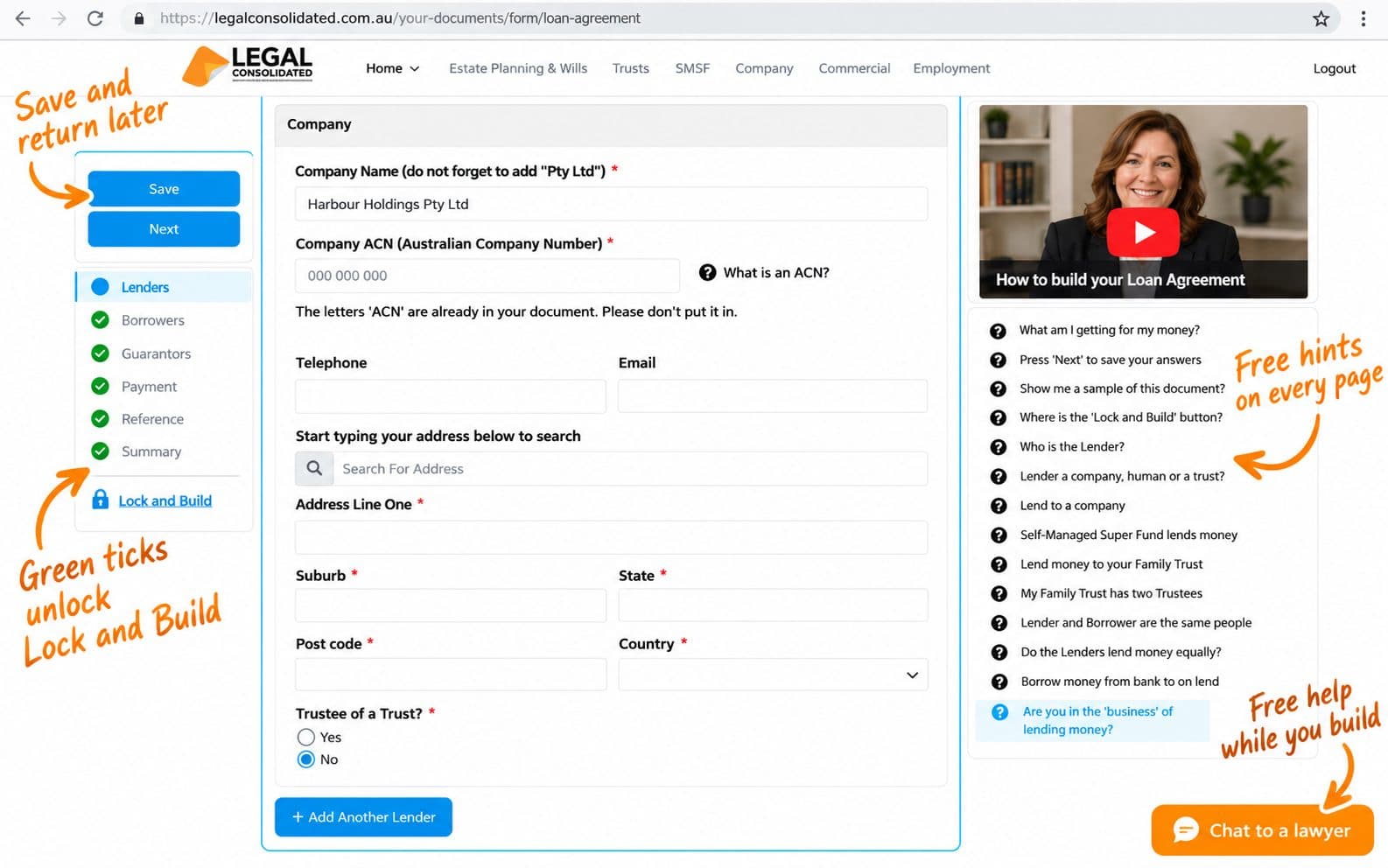
Answer the questions about your parties, loan terms and any guarantors. Read the free hints beside the questions. Save your work and return when you are ready.

Complete the required sections. Green ticks show your progress. The Lock and Build option appears when the required answers are complete. Telephone, email or use Chat to a lawyer for help with the building questions.

START BUILDING FOR FREE

Build your Loan Agreement with free hints, videos, save and return, and help from a lawyer

Choose the Loan Agreement page for your circumstances

The same Legal Consolidated Loan Agreement supports different private lending arrangements. These pages explain the issues for each:

If you intend a gift, use a Deed of Gift. If you intend to release a debt, see our Forgive a Debt Agreement.