
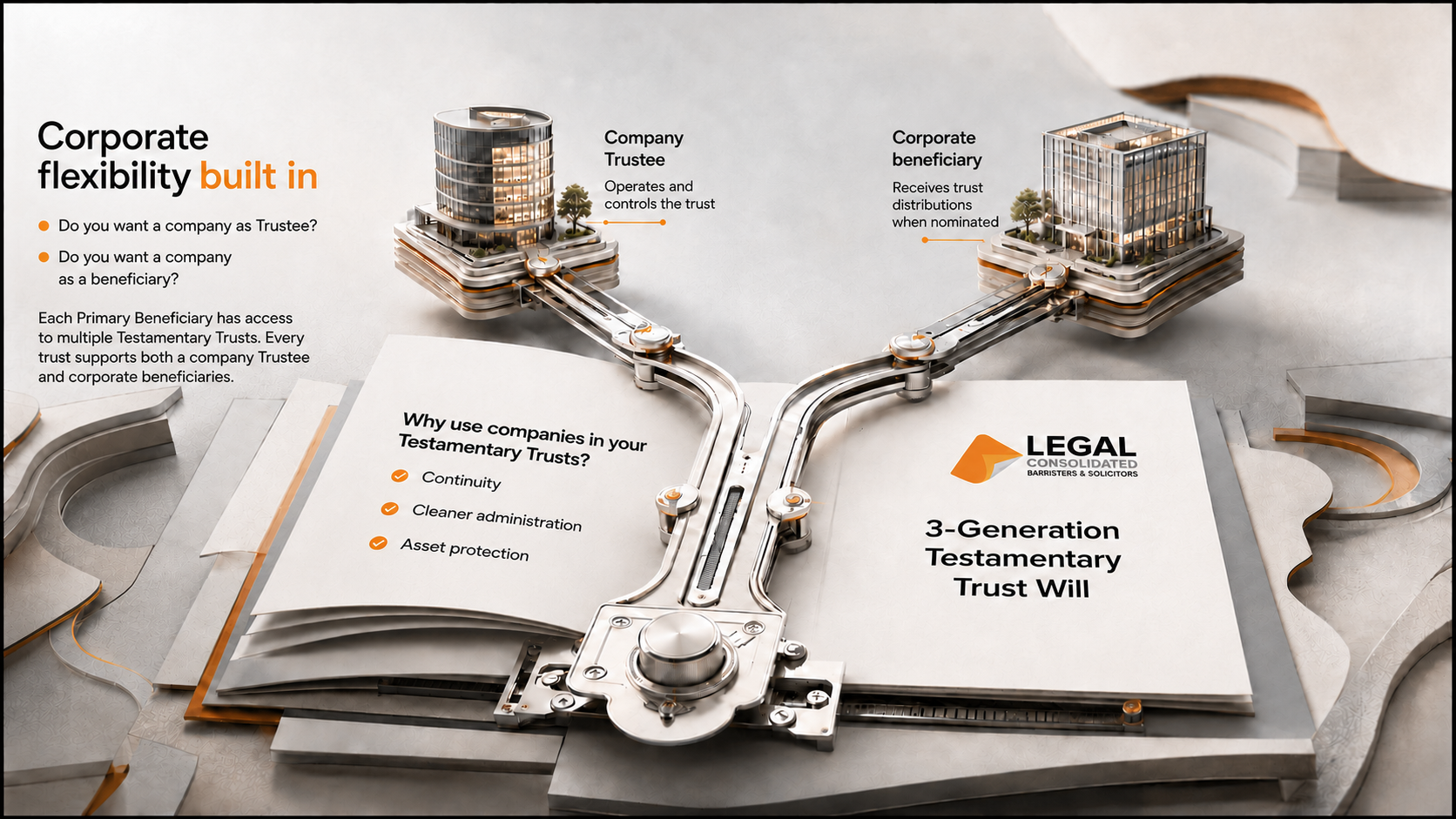
A testamentary trust does not run itself. A human or company must act as a trustee. Many clients prefer a dedicated company as a corporate Trustee. It provides continuity, cleaner administration and asset protection.
Despite ongoing attacks on bucket companies, you may wish to include a company as a beneficiary of the testamentary trust. This separate company performs a different job from that of a trustee. It acts as a bucket company and receives trust distributions in its own right.
A Testamentary Trust operates for decades, perhaps forever, so you want flexibility for both.
Legal Consolidated carefully drafts its 3-Generation Testamentary Trust Will to preserve both options. The 3-Generation Testamentary Will permits a company to act as Trustee. It also provides a controlled mechanism for another company to enter the General Beneficiary class. This article explains both roles, why nomination does not resettle the trust and why asset protection requires that you keep the two companies separate.
Can a Company Act as Trustee or Bucket Company of a 3-Generation Testamentary Trust?
A Legal Consolidated 3-Generation Testamentary Trust Will allows a company to act as Trustee. It also allows a separate company to act as a bucket company.
But do not make the same company wear both hats.
The best asset-protection structure uses one clean company as corporate Trustee and a different company as the bucket company. Legal Consolidated carefully drafted the Will to support this separation.
Does a Legal Consolidated 3-Generation Testamentary Trust allow a company to act as Trustee?
Yes.
Legal Consolidated carefully drafted its 3-Generation Testamentary Trust Will to give each family the option of a dedicated corporate Trustee for each trust established under the Will.
A corporate Trustee provides continuity and cleaner administration. Directors and shareholders change without transferring every trust asset to a new individual Trustee. The company holds and administers the trust property in one continuing legal name. This strengthens the evidence that trust assets are separate from personal assets.
The Will states:
‘Subject to this Will, the Trustee and Appointor of each specific trust may comprise one or more individuals, one or more companies, or any combination of them.’
The corporate Trustee holds and administers the trust property. It signs documents, opens bank accounts, buys investments and carries out the Trustee’s decisions.
The company does not need to be a General Beneficiary merely because it acts as Trustee. Trusteeship and beneficiary status are separate legal roles.
Legal Consolidated’s drafting complies with, and deliberately preserves, the distinction recognised by the High Court in Montevento Holdings Pty Ltd v Scaffidi (2012) 246 CLR 325, 332 [25]. The company is a separate legal person from its directors and shareholders. The trust deed determines the company’s role.
We did not leave this distinction to implication. Our Will expressly permits a company to hold the office of Trustee. It then separately defines when a company enters the class of General Beneficiaries. These are deliberate and separate control gates.
Is a company allowed to be a bucket company?
Yes.
A ‘bucket company’ is an ordinary company used as a discretionary beneficiary. The Trustee distributes trust income to the company. The company receives that distribution in its own right and pays tax under the company tax rules.
The Legal Consolidated Will includes within the definition of ‘General Beneficiaries’:
‘any company:
of which a general beneficiary is a member (equitable, legal or otherwise), director or secretary; and
which has been nominated by the Trustee as a general beneficiary’
The company must satisfy both requirements. A General Beneficiary must have the required connection with the company. The Trustee must also nominate the company as a General Beneficiary.
These two requirements are deliberate. We did not automatically sweep every company connected with the family into the beneficiary class. A qualifying company only enters that class after the Trustee positively nominates it.
This nomination gate puts control in the Trustee’s hands. It reduces the risk of an unintended company contaminating the trust’s asset-protection, foreign-person or transfer-duty position. It also gives the family’s accountant and financial planner the legal machinery needed to implement the tax strategy at the correct time.
Nomination only makes the company eligible for consideration. It does not give the company a vested entitlement or an automatic distribution. A separate Trustee resolution determines whether the company receives trust income.
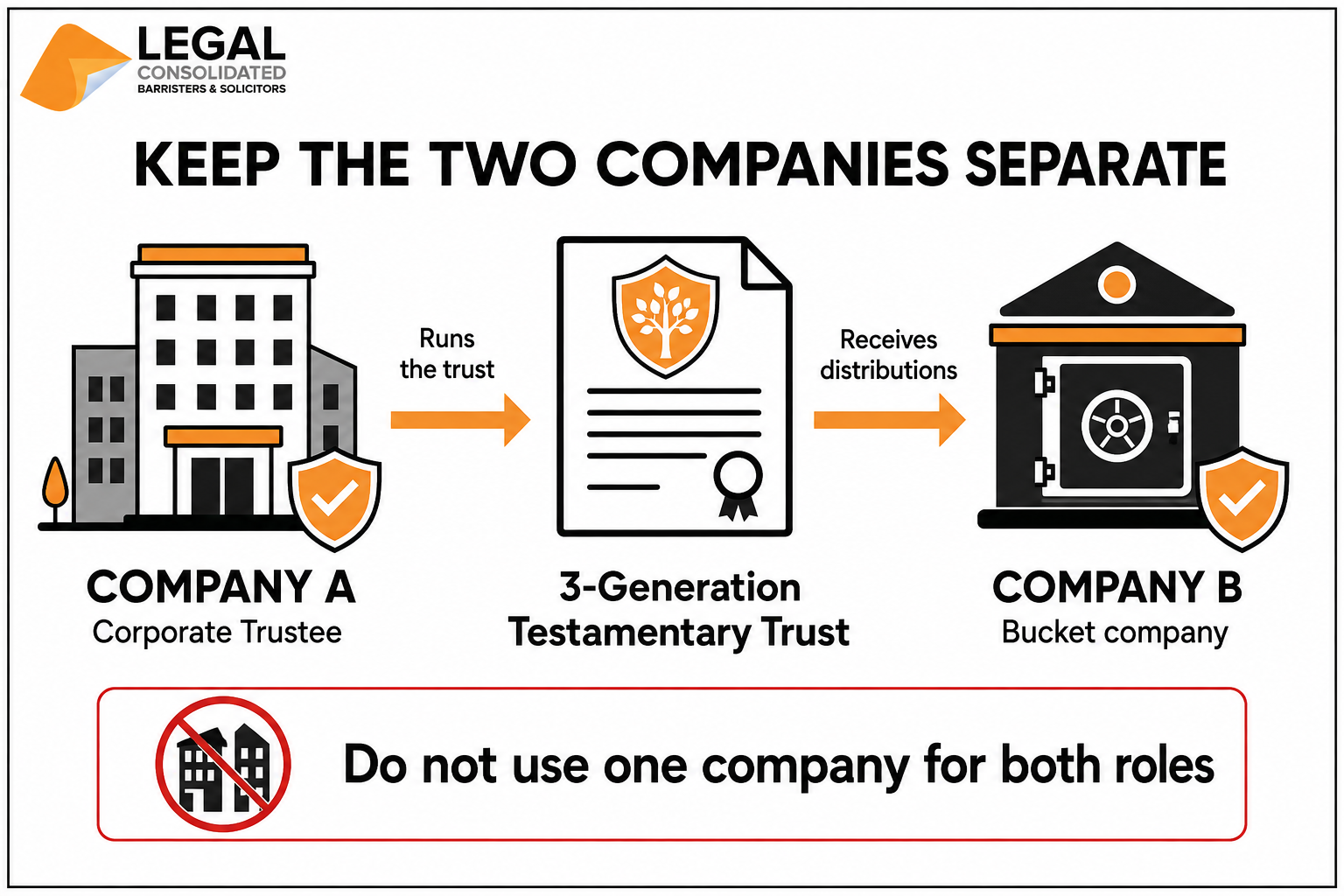
Do not use the same company as Trustee and bucket company
The Will permits the same company to act as Trustee and General Beneficiary. However, this is poor asset-protection practice.
Use two companies.
| Company | Role | Best-practice function |
|---|---|---|
| Company A | Corporate Trustee | Administers the trust and holds trust property solely in its Trustee capacity |
| Company B | Bucket company | Receives distributions beneficially and does not act as Trustee |
A corporate Trustee enters contracts, incurs liabilities and faces claims arising from administering the trust. Keep that company free of valuable assets in its own right.
A bucket company owns the distributions it receives. Those distributions become company assets. If the same company also acts as Trustee, its valuable bucket-company assets sit in the firing line when a creditor sues the Trustee company.
The arrangement also blurs the company’s two capacities. Which money does it hold as Trustee? Which money does it own beneficially? A bitter family member, liquidator or creditor uses poor records and confused capacities as litigation bait.
Corporate Trustee insolvency is not academic. Carter Holt Harvey Woodproducts Australia Pty Ltd v Commonwealth (2019) 268 CLR 524 examined an insolvent corporate Trustee and the interaction between trust liabilities, trust assets and the Trustee’s right of indemnity. Keep the structure clean before trouble starts.
Using separate companies also avoids the corporate Trustee deciding whether to distribute trust income to itself. The Trustee’s fiduciary duties continue despite its absolute discretion. Separate roles reduce conflict arguments and strengthen the evidence that each company acts for its proper purpose.
How does the two-company structure work?
The asset-protection structure is straightforward:
- Company A is appointed as corporate Trustee.
- Company A holds and administers the trust property in its Trustee capacity.
- Company B remains separate from the Trustee’s contracts and liabilities.
- The Trustee nominates Company B as a General Beneficiary.
- A separate annual resolution determines whether Company B receives trust income.
- Each company maintains separate records, accounts and bank arrangements.
The family retains control. But the legal roles remain clean.
The family’s accountant determines whether a distribution to the bucket company supports the tax strategy. This includes company tax, unpaid present entitlements and Division 7A. The ATO confirms that Division 7A applies where a private company beneficiary becomes presently entitled to trust income and that entitlement remains unpaid: ATO — Division 7A and trusts.
Legal Consolidated provides the legal machinery. The accountant and financial planner put that machinery to work.
Does nominating the bucket company resettle the trust?
No.
The class of General Beneficiaries is open from the start. More importantly, the Will maker has already placed the company-nomination machinery into the Will.
The Trustee is exercising an existing control lever. The Trustee is not amending the Will, replacing the trust or declaring a new trust over its assets.
This is similar to the machinery in a Family Discretionary Trust. The deed establishes an open beneficiary class and gives the Trustee power to admit qualifying companies. When the Trustee exercises that power, the company enters the existing class. The trust continues.
The ATO considers an even stronger example in Taxation Determination TD 2012/21. The trustee excluded a corporate beneficiary and added spouses, trusts and companies under an existing deed power. The ATO states that:
‘a valid exercise of a power of variation contained within the trust deed … does not give rise to … CGT event E1.’
See Australian Taxation Office, Taxation Determination TD 2012/21 (24 October 2012) Example 1 [10F].
The Legal Consolidated position is stronger. The Trustee does not vary the Will. The Trustee applies the definition already written into it.
Accordingly, nomination alone does not resettle the trust for capital gains tax purposes. Nor does nomination itself transfer dutiable property or declare a new trust over it. State and Territory transfer duty and foreign-person surcharge rules remain separate and require checking against the trust assets and the nominated company’s status.
Careful drafting keeps the two companies separate
Legal Consolidated did not bolt generic trust wording onto a Will. We worked through Trustee eligibility, corporate succession, beneficiary eligibility, nomination and distribution as separate legal steps.
That careful drafting supports the preferred asset-protection structure:
- one dedicated company acts as corporate Trustee; and
- a different company acts as the bucket company.
The corporate Trustee provides continuity, clean administration and separation from personal ownership. The bucket company receives distributions in its own right. Keeping them separate prevents valuable bucket-company assets from sitting inside the company exposed to claims arising from its work as Trustee.
The Will provides both roles. It does not force one company to wear both hats. It also prevents every connected company from automatically becoming a General Beneficiary. These control levers strengthen asset protection while supporting the tax strategies developed by the family’s trusted accountant and financial planner.
Legal Consolidated authors the Will and accepts responsibility for it. We are a national Australian law firm serving Western Australia, the Northern Territory, South Australia, Queensland, New South Wales, Victoria, Tasmania and the Australian Capital Territory. This is careful law-firm drafting — not a brittle document sold by a website pretending to be a law firm.