

Dead Zopito Di Cesare left everything to charity. His son, Ivano Ferrante filed a Supreme Court writ against the charities.
Usually, a son argues that he was not getting enough out of his Dad’s Will and asks the court to rewrite the Will.
However, the son took a novel approach, which is a warning to all professionals.
Dead Dad wanted to help children — but not his own son
In making his Will, Dad asked his lawyer to find charities that “only” benefit disadvantaged disabled children. But, according to the son’s writ, the chosen charities had wider “objects”. The charities also supported Aboriginals, ethnic groups and people with chronic illnesses.
Most charities' objects are couched in similarly wide terms.
In these circumstances, if you are successful in your court proceedings, the Will remains valid but that gift fails and falls into the clutches of the next of kin – the son.
The son had a second attack up his sleeve. The son claims his Dad did not sufficiently understand English. If successful, the Will is totally thrown out and an older Will or Government imposed Will then applies.
Five questions that expose a vulnerable Will
These are the five questions on our website to ask to reduce the risk of your Will being attacked:
- Have you suffered a stroke or depression?
- Do you have any children outside the marriage?
- Where were you born?
- What is your native language?
- Can you read and write English fluently?
Who can challenge a Will?
Family provision claims
Courts are generally reluctant to interfere with the deceased’s intentions expressed in a Will. However, legislation exists in all Australian States and Territories that enables specified people to apply to the court for provision, or further provision, from the estate of a deceased person. Changes are only made where the provisions of a Will or the intestacy rules, or a combination of the two, fail to make adequate provision for the proper maintenance and support of the applicant.
In most Australian states and territories these people can challenge a Will:
- legal spouse
- divorced spouse (especially if still getting maintenance)
- de facto spouses
- Courts examine the circumstances of each case. They take into account evidence of a relationship, including whether the de facto is 'maintained', whether the de facto is considered part of the deceased's household and whether the deceased has a 'moral responsibility' for that person.
- dead person's children including stepchildren especially if the stepchildren are in the same home or being 'maintained'.
- dead person's grandchildren (especially if their parent is dead)
Why one child wins and another loses
The courts have substantial powers to alter a Will’s original distribution after considering the individual circumstances of each applicant. The court decides whether a distribution failed to make adequate provision for the proper maintenance, support, education or advancement of the applicant.
Consider the “moral duty” in these 2 cases, Vigolo v Bostin (2005) 79 ALJR 731 and Lloyd-Williams v Mayfield [2005] NSWCA 189.
1. Moral duty in Vigolo v Bostin
In Vigolo v Bostin, Vigolo was the son of a wealthy farmer. After a dispute, Vigolo and his father signed a deed in which Vigolo was compensated for the value he had added to the farm. The father died. The father’s Will made no further provisions for Vigolo. Vigolo challenged the Will under the relevant State Act. It contained no Considered Person Clause.
The son contended that Dad had a “moral claim” arising from previous business and family dealings. Vigolo and his wife already owned substantial assets. The son's claim was considered in light of the obligations and bequests his father had made to Vigolo’s four siblings. The High Court held that Mr Vigolo was left with adequate provision for his proper maintenance and advancement in life, and the challenge was rejected.
![Vigolo v Bostin and Lloyd-Williams v Mayfield [2005] NSWCA 189 stop will being challenged](/_next/image?url=https%3A%2F%2Fxk8oczi9hsletn92.public.blob.vercel-storage.com%2Fwp-import%2Fcharity-v-son-fathers-will-challenged%2FVigolo-v-Bostin.png&w=1920&q=75)
2. Challenging a Will using Lloyd-Williams v Mayfield
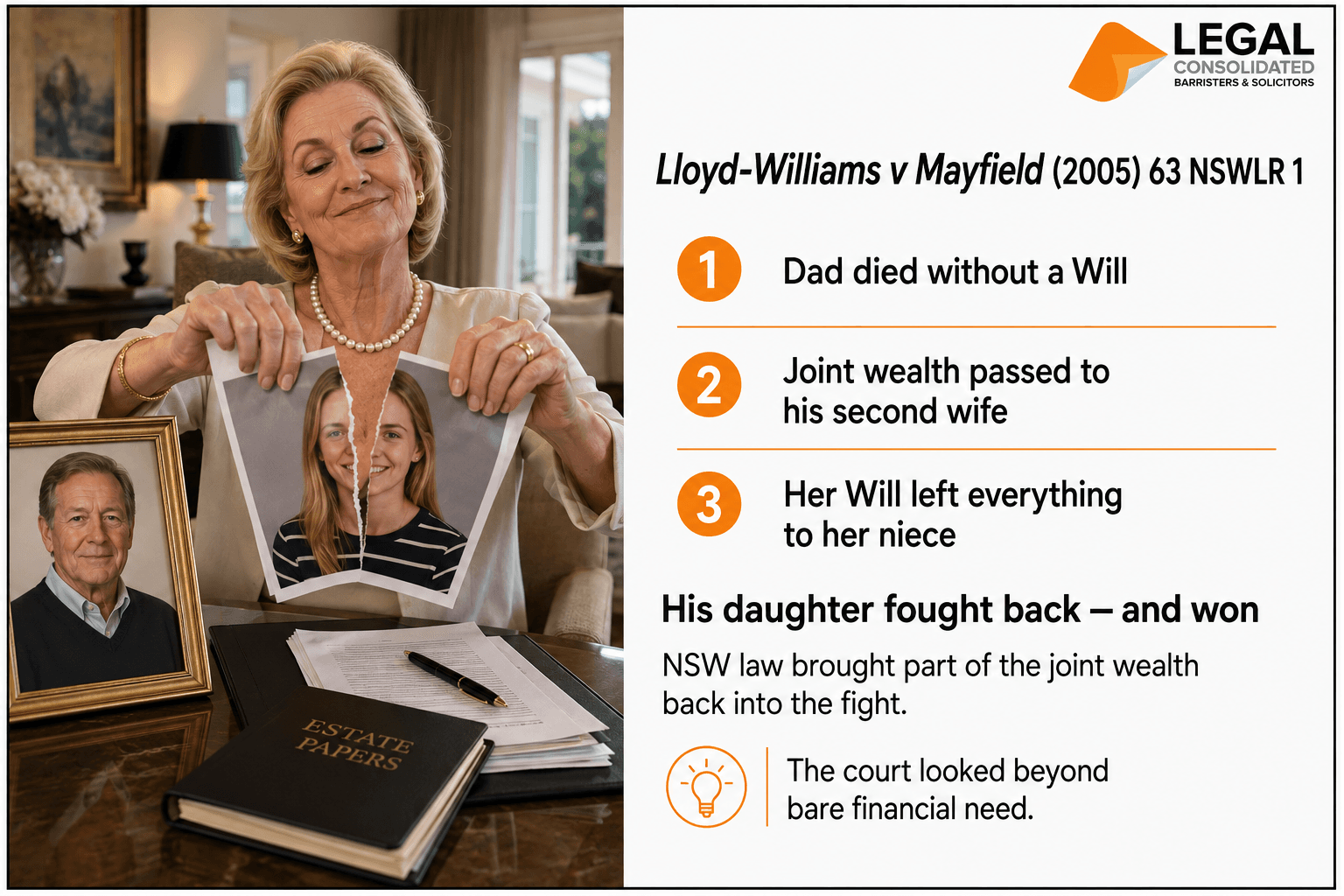
In Lloyd-Williams v Mayfield (2005) 63 NSWLR 1, Ms Mayfield was the daughter of Mr Stewart. Mr Stewart died without leaving a Will. Ms Mayfield was entitled to a percentage of her father’s estate under the intestacy laws. However, most of Mr Stewart’s wealth was in assets jointly owned (see [15 305]) with his second wife. Ms Mayfield received only a few thousand dollars, while the wife received all the jointly owned assets.
The second wife died shortly afterwards. Cruelly, she left everything only to her niece (Ms Lloyd-Williams). The estate was worth over $8 million. Ms Mayfield challenged the second wife’s Will, claiming that she was entitled to some of the jointly owned property. At trial and on appeal, the court agreed and awarded Ms Mayfield $850,000.
Why Vigolo and Mayfield differ
In Vigolo, the court held that the applicant had already received a fair provision during the Will-maker's lifetime. Further, although the deceased's estate was substantial, the competing beneficiaries' assets outweighed Vigolo's needs.
In Mayfield, although no testamentary promises were made, the estate was large and the only competing beneficiary received a considerable proportion of the estate.
What does the court consider?
Should a court resolve to vary a Will, the judge must then decide the size of the provision that should be made. In making a determination, consideration is given to:
- estrangement from, or poor relationship between, the applicant and the deceased;
- the conduct of the applicant towards the deceased;
- the overall size of the estate; and
- the age and circumstances of the applicant.
The area that is the most contentious in the area of family provision is that of adult children. Court decisions vary between amending a will simply because the relationship exists, to varying a will only where a special need is demonstrated.
What should an executor do?
If an executor becomes aware that a Will may be challenged, he or she should postpone distribution of the estate. Reasonable periods of postponement are set out in each particular jurisdiction in Australia.
If there is no probate, some states have a 6-month window after death to challenge a Will automatically. After that, you need to seek leave of the court for permission to challenge the Will or the distribution of the estate if there is no Will. If there is probate, then 6 months after probate
If the executor has obtained a grant of Probate, the executor is entitled to call in the assets and pay debts. If the Will is successfully challenged, the Supreme Court does not render it null and void. It exercises its power to apportion the estate differently from the terms set out in the Will.
Child loan to parent (including aged care) - Child lending money to parents
Related Legal Consolidated guides
Free resources for young and vulnerable children
Free resources to help protect young and vulnerable children:
- A second example of a Statutory Will: Disabled dad has $9m, two children and no Will
- Vulnerable children in Wills - watch the training course
- Loans to children - in case they divorce or go bankrupt
- Divorce Protection Trusts in Wills - in case a beneficiary, child or grandchild separates
- Making Wills for your children
- Special Disability Trusts - for disabled children
- Elder Abuse - protecting the children as well
- Life Estates do NOT protect children
- Child renounces a gift or Family Trust distribution for Centrelink and stops Trustee-in-Bankruptcy
- Children paying 32% on your super when you die
- Only disabled children can take your SMSF Reversionary Pension
- A parent dies child pays 66% tax
- Son loses the farm to his two sisters
Your 3-Generation Testamentary Trust Will can be updated for free while you are alive and of sound mind. Your Will includes free help for your executor, accountant and financial adviser after you die. These resources help them after you are gone.
Get Probate
|
 |
Put the Will’s protective trusts to work
|
 |
Deal with assets, control and final wishes
|
 |