
Centrelink continually looks at your income and assets. The more money you have, the less Centrelink pays you. But what if you need a helping hand? Perhaps your children want to help you enter retirement accommodation. Perhaps your parents want to help you buy a home.
Should your family give you the money outright? If they do, Centrelink sees more money in your hands. In contrast, Centrelink does not treat a genuine loan as income. This is because you must repay it.
Centrelink’s own Guide says:
“Bona fide borrowings (loans) are not income.”
Even when the money comes from your family or your children’s family trust, Centrelink treats it as a gift from the outset. To prove it was instead a loan, you need a legally binding loan agreement. Calling it a ‘loan’ on the bank statement or an IOU is not enough. Centrelink demands that you prove it.

Why does Centrelink care about money from your family?
Money lands in your bank account. Centrelink is interested. Centrelink was not at the family meeting. It does not know whether your child is being generous or expects repayment. Centrelink sees the deposit and writes its own version of the story.
The Social Security Act 1991 (Cth) gives Centrelink a wide net. Under s 8, income includes:
“a periodical payment by way of gift or allowance”; or
“a periodical benefit by way of gift or allowance”.
Happily, section (8)(z) excludes a periodical gift or allowance from a parent, child, brother or sister. Do not celebrate yet. That is not a blank cheque for every family payment. You win on the means-testing income test. But Centrelink has another attack: the asset test.
Centrelink’s asset test when a family member gifts you money
For the asset test, Parliament forces Centrelink to obey these rules:
- A gift belongs to you.
- A loan is money that you must repay.
The distinction hinges on the effectiveness of the Loan Deed. It does not rest on the description entered in a bank transfer or minutes. A proper Loan Deed puts the evidence in your hands before Centrelink writes its version of the story.
What is the value of a Loan Deed for Centrelink asset testing?
So you won on the income. But the money in your bank account is caught under Centrelink’s asset means-testing. The Loan Deed is critical for defending yourself. It helps prove that the deposit is a borrowing.
Why does Centrelink reject many Loan Agreements?
Centrelink does not bow to a document merely because its heading says ‘Loan Agreement’. It looks under the bonnet. The money must move from the Lender to the Borrower. At the same time, the Borrower must have a binding obligation to repay it.
Centrelink defines a loan as an actual lending of money or an asset, together with a clear intention to repay. Do not leave Centrelink to hunt for an implied promise. Put the obligation in a Loan Deed.
The Federal Court supports that position. In Commissioner of Taxation v Rawson Finances Pty Ltd [2012] FCA 753, [20], Edmonds J stated:
“the essence of a loan of money from A to B is [an] obligation on the part of B to repay”.
Rawson Finances called $4.75 million received through an Israeli bank a loan. The ATO asked the same question Centrelink asks: where was the legal obligation to repay? At [23], Edmonds J stated that later payments do not prove that the original transfer was a loan. The obligation is proved by the contract.
One Loan Agreement. Four hostile audiences.
Centrelink is only the first reader. The same Loan Agreement gives the ATO evidence that a company loan is debt rather than equity. In the Family Court, it helps answer the former spouse who says Mum and Dad made a gift. In bankruptcy, it proves that the Lender is a creditor rather than a relative with a story.
The Legal Consolidated Loan Agreement is prepared for all four audiences. Its repayment, demand, default, acceleration and enforcement clauses work together. It builds evidence of a real debt before the first dollar moves.
What does Centrelink want your Loan Deed to prove?
Centrelink wants evidence that the loan is genuine. The strongest evidence is a commercially prepared Loan Deed signed by the lender and borrower. It is the same robust and commercially sound Loan Agreement that a lender requires when lending money to a stranger. It shows Centrelink the debt and your legally enforceable obligation to repay it.
Does a bank statement marked ‘loan’ prove a Centrelink loan?
No. A bank statement proves only that money moved. Writing ‘loan’ in the payment reference is your family’s label. It does not create a debt or make the borrower repay.
Centrelink wants a genuine and enforceable Loan Deed. Emails, spreadsheets and private notes may support that Deed. They do not replace its repayment, demand, default and enforcement rights. Without that legal machinery, Centrelink sees a gift wearing a ‘loan’ label.
Does a Loan Schedule prove your Centrelink loan?
No. The Martin family kept a running schedule for years. It reached $166,361.58. They thought they were safe. Centrelink kept digging.
In Martin; Secretary, Department of Social Services and (Social services second review) [2022] AATA 406, [26]–[32], Services Australia obtained records from the University of Newcastle and the Commonwealth Bank. Six disputed payments totalled $105,311.40. Dr Martin also relied on a signed 1999 document and the running schedule.
The document said that the advances would come out of Dr Martin’s inheritance. That is not an obligation to repay. The Tribunal could not find the essential terms. It could not tell who was owed the money, when repayment was due or how it was to be made. The six payments were not accepted as loans.
The schedule counted the money. It did not build a debt. A bank entry, an email and a spreadsheet may support a real Loan Deed. They cannot supply the missing legal machinery.
Schedules are an obsolete drafting habit from the typewriter era. Modern word processing puts the parties, dates and transaction details into the operative clauses. Read why lawyers no longer use Schedules. Centrelink needs the law, not old stationery.
A Legal Consolidated Loan Agreement places the parties, amount, repayment obligation and enforcement machinery in the operative clauses. Centrelink reads the Deed, not the family’s arithmetic.
Does Centrelink look behind the words ‘Loan Agreement’?
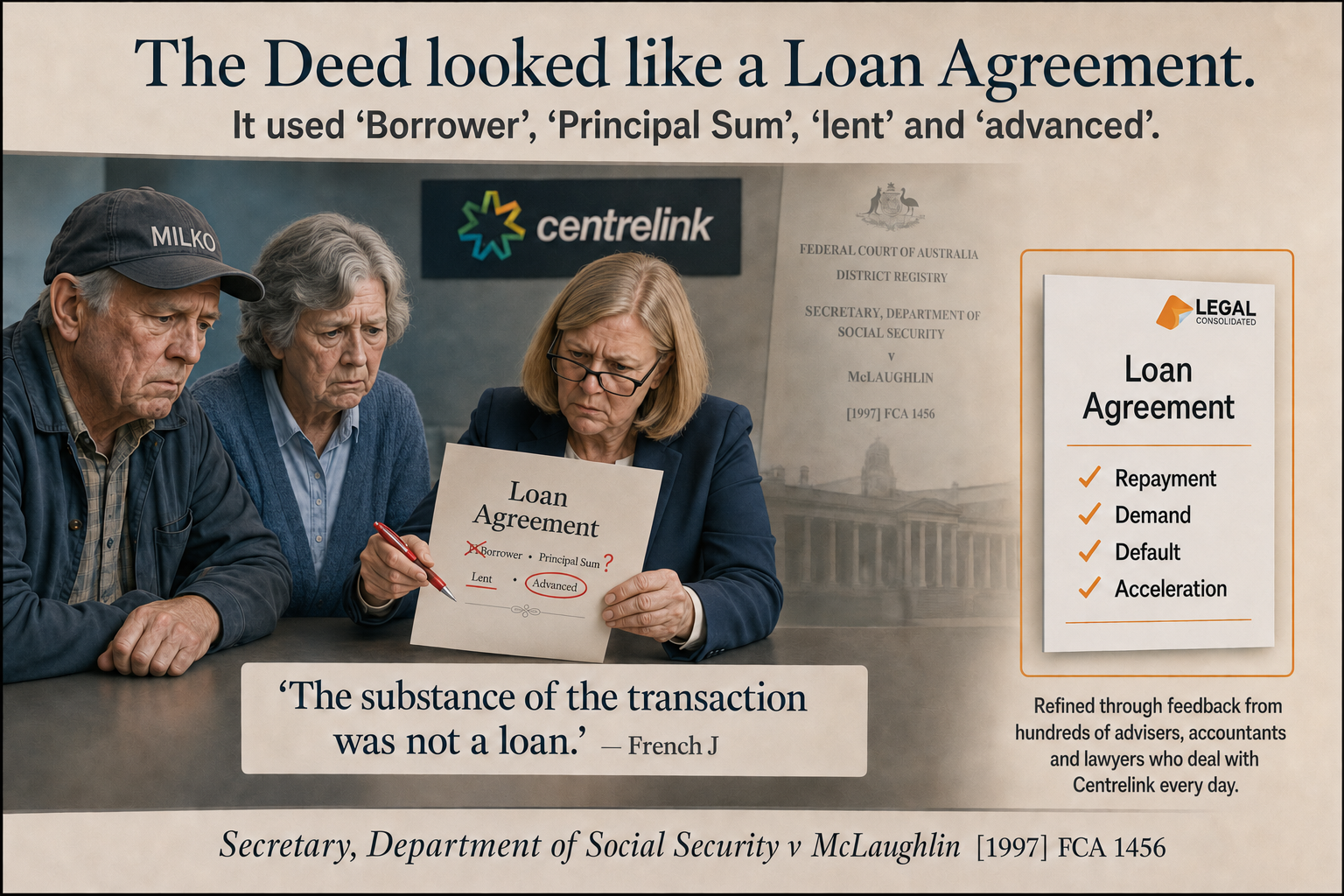
Yes. It is not enough to put together something that looks and sounds like a Loan Agreement. That is what happened in Secretary, Department of Social Security v McLaughlin [1997] FCA 1456. French J stated that a bona fide loan sits outside Centrelink income. He then supplied the test:
‘an intention to repay is an essential attribute of a loan of money’
There is the answer. The Loan Agreement must create a real debt that the Borrower intends to repay.
The McLaughlins’ document looked formidable. This was not a $50 internet template. It was an official Deed from the Dairy Industry Authority. It referred to the couple as the ‘Borrower’. It defined the $121,950 as the ‘Principal Sum’. It said that the money was ‘lent’ and ‘advanced’. It dealt with interest, demand and legal costs.
Centrelink still won. Ordinary repayment was never intended. The money was paid to get the McLaughlins out of the milk vending industry. It became repayable only if they broke their promise to stay out of that industry and the Authority demanded the money within three years. If they kept their promise, the supposed debt disappeared. French J looked past the impressive words. The substance was a payment, not a loan. The Court held that the money was income.
If a government authority’s formal Deed can fail, what chance does a cheap non-lawyer template have? A non-law firm can scatter ‘Borrower’, ‘Principal Sum’ and ‘interest’ across a page. It cannot turn those labels into a real debt.
The Legal Consolidated Loan Agreement does not merely sound legal. Its repayment, demand, default, acceleration and enforcement provisions operate together to build a genuine debt. It is refined through feedback from hundreds of advisers, accountants and lawyers who deal with Centrelink every day. The parties must still mean it and follow it. The Court supplies the warning. Legal Consolidated supplies the legal machinery.
Does a faulty Loan Agreement survive Centrelink scrutiny?
No. A flawless-looking document still fails if the agreement is fundamentally faulty. Katholos and Secretary, Department of Social Services (Social services second review) [2017] AATA 1293, [49]–[53], [59], [64] shows how closely Centrelink and the Tribunal examine whether the legal machinery is genuine.
In 1998, Mr and Mrs Katholos transferred two Sydney residential properties to their sons. Years later, seeking legal protection from a former daughter-in-law, they had a solicitor prepare two Deeds of Family Arrangement.
On paper, the documents looked bulletproof. The Deeds recorded ‘principal sums’ totalling $753,380. They charged 10% interest. They fixed a final repayment date. They even supported mortgages and caveats over the properties. This was serious-looking legal machinery.
But the arrangement was fatally faulty. The parents told their sons they would never demand principal or interest. Neither son paid a dollar between 2003 and 2015. The paperwork had teeth, but the family had agreed it would never bite.
When family harmony cracked and the dispute reached the Supreme Court, Centrelink saw the Deeds. Centrelink treated the $753,380 as genuine loans. It counted the unpaid principal as assets and raised two overpayment debts against the parents — $91,127.60 and $90,367.55. That was $181,495.15 in total.
The Tribunal looked behind the documents. It said the Deeds were ‘persuasive but not conclusive’. Mrs Katholos admitted that ‘there was never any intention to act on the paper work’. The Tribunal found that no party intended to enter into a real loan agreement. It set Centrelink’s decisions aside.
The lesson is brutal. A Loan Deed is not a stage prop. If your agreement is faulty because you never intend to use its clauses, it collapses. Build it correctly. Mean it. Follow it.
The Legal Consolidated Loan Agreement is carefully crafted to survive Centrelink scrutiny. It records a real debt. It provides real repayment, demand, default, acceleration and enforcement machinery. Those provisions are not there for show — they give Centrelink hard evidence of a genuine and enforceable loan.
Legal Consolidated has refined its Loan Agreement through feedback from hundreds of accountants, financial planners, advisers and lawyers who deal with Centrelink every day. Legal Consolidated is a national Australian law firm. It authors the document and accepts legal responsibility under its covering letter. A website pretending to be a law firm does neither.
Start with a real loan. The Legal Consolidated Loan Agreement puts that legally enforceable debt on the page.

What do the Centrelink Loan Agreement cases teach you?
Two Centrelink loan cases begin in almost the same place. A person receiving Centrelink had money from family. Centrelink said it was income. The recipient said it was a loan.
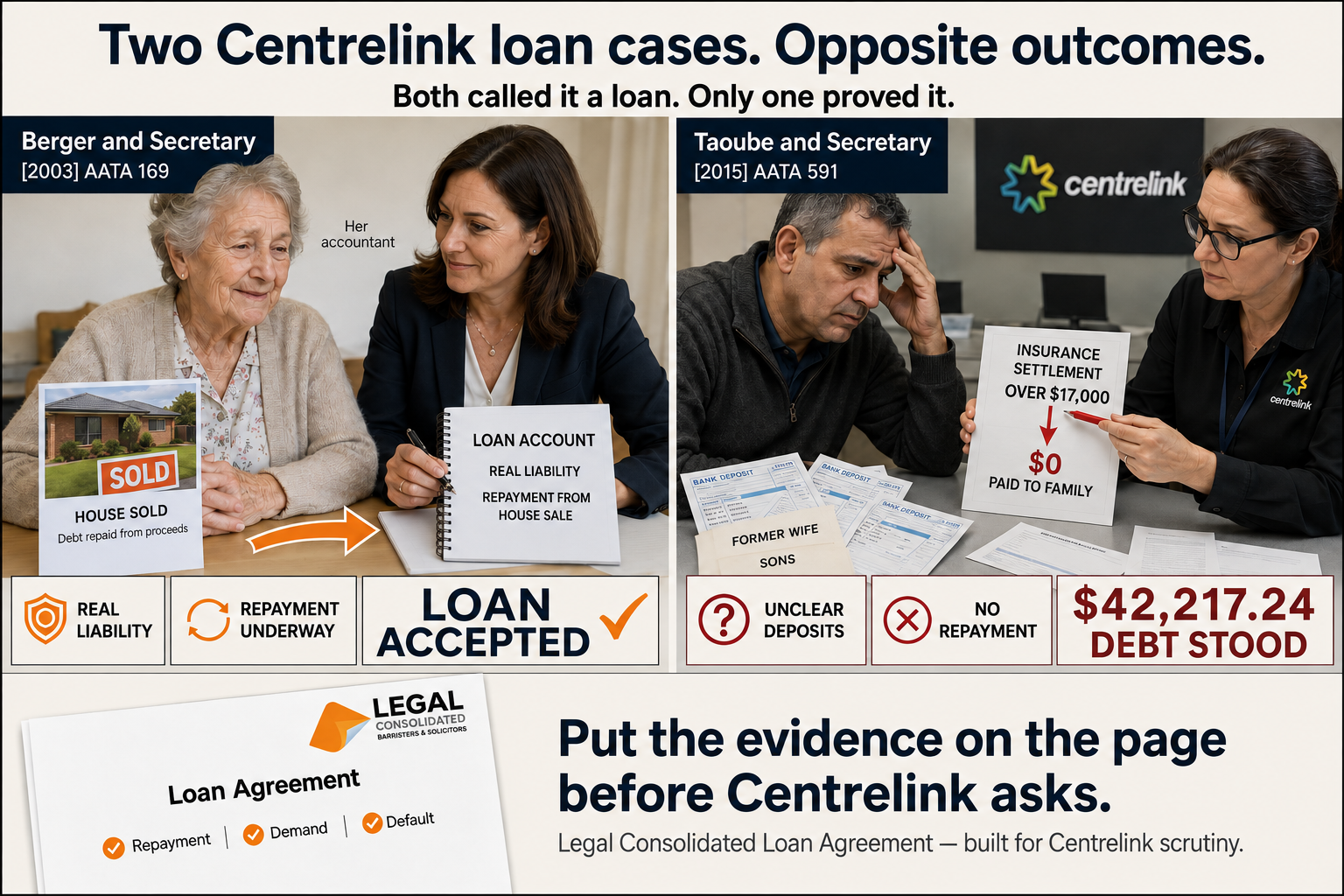
In Berger and Secretary, Department of Family and Community Services [2003] AATA 169, the loan succeeded. In Taoube and Secretary, Department of Social Services (Social services second review) [2015] AATA 591, the loan claim failed and a $42,217.24 Centrelink debt stood.
Similar family assistance. Opposite outcomes. Centrelink was not measuring love or good intentions. It examined whether a real repayment liability existed and whether the family’s conduct proved it.
Mrs Berger proved a real Centrelink loan — the hard way
Centrelink raised a debt of $36,959.45 against Mrs Berger. She was 67 and seriously ill. She had endured renal disease, dialysis and a kidney transplant. Her medication contributed to skin cancers, osteoporosis and fractures in her spine. Apart from her interest in the family arrangements, she had $800 in the bank and a 1981 Datsun.
The disputed payments came from a family trust. Some were cash drawings. Others were recorded in a loan account. There was no formal Loan Agreement. The trust owned Mrs Berger’s home. It was sold and the loan liability was being satisfied from the sale proceeds.
In Berger and Secretary, Department of Family and Community Services [2003] AATA 169, [1], [4]–[6], [10]–[18], the Tribunal accepted that the loans were genuine. They produced ‘a real liability to repay’. The liability was not family theatre. Repayment was underway.
Mrs Berger won the loan argument. But look at the price of that victory. She needed a Tribunal hearing, oral evidence, medical evidence and her accountant appearing on her behalf. The sale of the house then demonstrated that the debt was real.
Berger is not permission to rely on accounting entries and family memories. It is a warning about the cost of doing so. A properly prepared Loan Agreement puts the liability on the page before Centrelink raises the debt.
Mr Taoube promised to repay. Centrelink wanted evidence
Mr Taoube received the Disability Support Pension. Centrelink found large deposits moving through his bank accounts and raised an overpayment debt of $42,217.24. He said the money came from his former wife and sons as loans.
His family supplied written statements. Mr Taoube told the Tribunal:
‘When I have it, I have to pay them.’
When challenged about whether his family would ever see the money again, he answered:
‘I will. I’d like to.’
The words sound sincere. Centrelink does not assess good intentions. It examines whether there is a real debt supported by evidence.
In Taoube and Secretary, Department of Social Services (Social services second review) [2015] AATA 591, [30]–[36], Mr Taoube failed that examination. He had received an insurance settlement exceeding $17,000. He paid none of it to his family — not even a small amount. He also failed to identify which deposits came from which relative.
The Tribunal described his explanations as ‘unhelpful generality’ and ‘not at all convincing’. Centrelink won. The $42,217.24 debt stood.
Mr Taoube’s problem was not a lack of affection. It was a lack of legal machinery and reliable evidence. ‘I will repay when I can’ did not identify the lender, the amount advanced, the repayment obligation or the consequences of default.
Berger and Taoube compared
| Issue | Mrs Berger | Mr Taoube |
|---|---|---|
| Source of money | Payments from a family trust | Deposits said to come from his former wife and sons |
| Repayment liability | A real liability recorded in the loan account | A general promise to repay when he had the money |
| Repayment conduct | The debt was being satisfied from the house sale proceeds | A $17,000 insurance payment arrived. The family received nothing |
| Evidence | Loan records, oral evidence, her accountant and the house sale | Unclear amounts, unclear sources and broad family statements |
| Centrelink outcome | The loans were accepted as genuine and not income | The loan explanation was rejected. The $42,217.24 debt stood |
Both recipients had sympathetic stories. Only Mrs Berger proved a real repayment liability. Mr Taoube had family assurances, but his records and conduct did not support them.
That is the dividing line. Centrelink does not accept affection or hopeful promises as a substitute for legal machinery. A properly prepared Loan Agreement puts the debt, repayment obligation and enforcement rights on the page before Centrelink asks.
Calayini: can repayments rescue a Centrelink loan with no Loan Deed?
Centrelink saw a $21,000 deposit in Mr Calayini’s bank account. It did not see a Loan Deed. Centrelink treated the money as income. Mr Calayini said it was an interest-free loan from a friend. The money allowed him to visit his sick mother in Lebanon and obtain medical treatment for her.
The loan had a serious proof problem. There was no Loan Agreement. The lender had kept a record of the payments and outstanding balance, but that record had been lost or destroyed. No interest was charged. Years later, Mr Calayini was left proving the loan through witnesses and conduct.
What rescued him was repayment. His friend gave evidence. Mr Calayini repaid $5,000 around 2010. He then made periodic repayments until the entire loan was repaid in 2013 or 2014. The Tribunal stated that “corroboration for it is found in the fact that the amount provided was repaid”: Calayini and Secretary, Department of Social Services (Social services second review) [2021] AATA 4664, [41]–[49].
Do not mistake a lucky escape for good planning. Many Centrelink loans are still outstanding when Centrelink starts asking questions. Without a Loan Deed, you may need the lender to appear before the Tribunal. You then hope that memories agree, records survive and Centrelink believes both of you.
A Legal Consolidated Loan Agreement puts the evidence in place at the beginning. It records the debt, purpose, repayment obligation, demand rights, default provisions and enforcement machinery. Repayments should support your Loan Deed. They should not have to rescue an undocumented loan years later.
Family love does not erase a debt
In Berghan v Berghan [2017] QCA 236, [24]–[31], parents recovered $286,471.09 advanced to their son. The express condition to repay made it a loan. The parents’ wish to help their son did not erase his legal obligation.
The case was not a Centrelink appeal. It still destroys a common myth. Love explains why the money moved. It does not decide whether the transfer is a gift or an enforceable debt.
Put the Centrelink loan on the page before Centrelink asks
A genuine family loan deserves proper documentation. The Legal Consolidated Loan Agreement records the lender, borrower, principal, repayment obligation, demand rights, default, acceleration and enforcement machinery.
This gives Centrelink the evidence at the start. It reduces the need to reconstruct the loan years later through bank deposits, family statements and witness evidence. Mrs Berger proved her loan the hard way. Mr Taoube failed to prove his. Your family does not need to repeat either fight.
Why does a Centrelink Loan Deed give the lender strong powers?
The lender parts with the money. All the lender has left is the Loan Deed. The lender is entitled to strong repayment and enforcement rights. Once the Deed is signed, those rights are real. You must understand them.
Default, demand and acceleration clauses are not legal decoration. They show that the lender can require repayment and enforce the debt. A toothless Deed does not look kind. It looks contrived.
Legal Consolidated has refined its Loan Deed over decades of use. The drafting follows published Centrelink policy. It also reflects feedback from Centrelink assessments of hundreds of Legal Consolidated Loan Deeds. We have used materially similar enforcement machinery since 1994.
Are you borrowing the money or lending it?
If you receive a Centrelink payment and your child lends money to you, you are the borrower. The bona fide borrowing rule helps you. Use the Loan to Parent Agreement, including when your children help you enter retirement accommodation.
If your parents lend money to you, you are still the borrower. The Loan to Child Agreement records that direction of lending. Do not reverse the parties merely because the website heading sounds more familiar.
If you receive Centrelink and lend your money to somebody else, you own the debt. The unpaid amount remains your financial asset under s 1122 of the Social Security Act 1991 (Cth). A Loan Deed proves the debt. It does not make your asset disappear.
If you give the money away instead, Centrelink does not politely forget it. The deprivation rules allow $10,000 in one financial year and $30,000 over five rolling financial years. Centrelink keeps the excess in your assets for five years. The Loan Deed protects your right to repayment and stops a genuine loan being mistaken for a gift.
What Loan Agreement records should you keep for Centrelink?
Keep one coherent evidence file. Do not build a second contract through emails or a home-made summary. Centrelink should be able to follow the money and read the legal obligation without guessing.
- the complete signed Loan Deed and Legal Consolidated cover letter;
- bank records for every advance and repayment;
- a loan account recording the date, amount and source of each advance;
- signed variations, demands and repayment arrangements;
- receipts and acknowledgements for repayments; and
- a final signed acknowledgement when you repay the debt in full.
Repayment and forgiveness are not the same. Repayment discharges the debt because you pay it. Forgiveness means the lender abandons the unpaid balance. That is a different transaction with separate Centrelink and tax consequences. See debt forgiveness.
Can several children lend money to you under one Loan Deed?
Yes. One Loan Deed can name several lenders and you as the borrower. This works when several children help you enter retirement accommodation. The Deed records your enforceable obligation to them.
While this is not generally relevant to Centrelink, the records must still show who advanced each amount. If six children contribute different amounts, keep a separate balance for each child. The lenders should document their private arrangement, including their shares and decision-making rights. Legal Consolidated does not advise on that side arrangement through your Loan Deed.
Do not assume that a family email chain settles everybody’s rights. The Loan Deed governs what you owe. The lenders’ private arrangement governs their position between themselves. Those are different legal relationships.
What happens to a child’s loan when the parent dies?
A Refundable Accommodation Deposit (RAD) is the lump sum paid for your accommodation in an aged care home. Suppose your child lends you the money for the RAD. When you die, the refundable deposit becomes an estate asset. Your child is not repaid because everybody remembers the family meeting. Your child must prove the debt.
A signed Loan Deed records your child as a creditor. A solvent estate pays proved debts before the residue passes under your Will or the intestacy rules. The Deed strengthens the claim. It makes it harder for an executor or sibling to rewrite the advance as a gift.
Without the Loan Deed, your child is left proving conversations, bank transfers and intention after you are no longer there to give evidence. That is litigation bait.
Which Legal Consolidated Loan Deed do you need?
Choose the document that matches the parties and the reason for the advance.
- General Loan Deed — for a loan between individuals or entities.
- Loan to Child — your parent or another relative lends money to you.
- Loan to Parent — your child or several children lend money to you.
- Spouse Loan — one spouse lends to the other.
- Company Loan — an individual or entity lends to a company.
- Commercial Loan — for a business or commercial advance.
- SMSF Loan — an SMSF lends where superannuation law permits the transaction.
- Division 7A — a private company loan governed by Division 7A tax rules.
- Recognition Deed — records and confirms an existing debt where the original evidence needs attention.
Each page addresses a different transaction. The legal objective remains the same. Record a genuine debt before Centrelink gets the opportunity to call the money something else.
Who prepares your Centrelink Loan Agreement?
Legal Consolidated is an Australian law firm. We author your Loan Deed and accept responsibility for it. This is confirmed in the cover letter that comes with the Loan Agreement. We do not sell you an anonymous template and leave you alone with Centrelink.
We prepare Loan Deeds for clients in New South Wales, Victoria, Queensland, Western Australia, South Australia, Tasmania, the Australian Capital Territory and the Northern Territory. The document is built for Centrelink, the ATO, the Family Court and the Bankruptcy Court.
Free Centrelink legal tool kit
Centrelink does not read your Loan Deed in splendid isolation. It looks at the whole arrangement. Your Will, Family Trust, SMSF and Power of Attorney may tell a different story. These Legal Consolidated guides help you, your accountant and financial planner put the legal evidence in place before Centrelink asks questions.
Loans, gifts and debts
- Loan to Parent — a child or several children lend money for a home, living costs or a Refundable Accommodation Deposit.
- Loan to Child — a parent advances money without surrendering it as a gift.
- Forgive a debt — check the Centrelink deprivation rules before cancelling a genuine loan.
- Abandon a gift under a Will — refusing an inheritance does not necessarily make it disappear for Centrelink.
Estate planning
- Enduring Power of Attorney — appoint the people who act if you lose decision-making capacity.
- 3-Generation Testamentary Trust Will — plan a Will gift for a beneficiary who receives Centrelink.
- Special Disability Trust — work within the Centrelink rules for a vulnerable beneficiary.
Family Trusts
- Centrelink attacks grandparents — see how an old Family Trust role creates a new Centrelink problem.
- Change the Appointor or Trustee — update succession and control with proper legal evidence.
- Company as trustee — understand when a corporate trustee is appropriate.
- Wind up a Family Trust — close an unwanted trust properly.
- Disclaim a trust distribution — understand what a beneficiary can refuse and the consequences.
SMSFs and Unit Trusts
- SMSF Trustee and Member Update — update the fund when membership or control changes.
- Reversionary Pension — plan what happens to super when your spouse dies.
- Wind up an SMSF — formally close an unused fund.
- Wind up a Unit Trust — finish the structure and preserve the evidence.
Centrelink reads the documents and the conduct. It is unmoved by explanations delivered after the event. Choose the guide that matches the asset before money moves, control changes or somebody signs.