

Why change the Unit Trust Name?
QUESTION: If the Unit Trust name does not do anything, why change it? It is not registered anywhere. It is just a nickname to help the Accountant, who may be looking after 100s of other Unit Trusts, identify mine a bit quicker. Why change the Unit Trust Name?
ANSWER: There are many reasons why you may want to update or change your Unit Trust Name:
- Correct spelling errors in the Unit Trust name (e.g. Smith Unit Trust)
- Unit Trust business partner, Tim Crowe, has died (e.g. Tan & Crowe Unit Trust)
- You got rid of your Unit Trust business partner Fred Tan (e.g. Lee and Tan Unit Trust)
- The Unit Trust name is not as clever as you first thought (e.g. Scrooge McDuck Unit Trust)
- Unit Trust name may upset the ATO or other regulators (e.g. Get out of Tax Unit Trust)
- You may not want to be so obvious that the Unit Trust is also a ‘Service Trust‘ for your main business (e.g. Williams Service Trust)
Why do I need a “Deed” to update the name of the Unit Trust Deed?
The answer is in your question. Your Unit Trust was started by a Deed. To update a Deed, you need to build a Deed of Variation of the Unit Trust Name. This is the document you are building.
Who to notify when I change the name of my Unit Trust
Once you have signed the Deed of Variation, you must notify specific organisations to ensure your Unit Trust can continue to operate smoothly.
-
Australian Taxation Office: Your accountant should contact the ATO to update the Trust’s name on the Australian Business Register. While your Australian Business Number remains the same, the registered name associated with it must be updated.
-
Banks and Financial Institutions: Banks are very strict. You must present the original signed Deed of Variation to your branch to update the account name. If you do not do this, you may face difficulties banking cheques or receiving funds in the new name.
-
Unit Holders: You must notify all Unit Holders so they can update their personal records and family law planning.
-
Investment Bodies: If the Unit Trust owns shares or managed funds, notify the share registries to update the owner’s name.
Stamp Duty on a Unit Trust Name Change
The Good News: No “Ad Valorem” Duty Because this Deed of Variation is drafted to reduce the chance of a resettlement (see the Clark case), it does not usually trigger “Ad Valorem” stamp duty. You do not pay duty on the market value of the Trust’s assets.
However, depending on where your Legal Consoldiated Trust Deed is signed or where the assets are located, you may need to pay a small “fixed duty” (often called “nominal duty”) and lodge the Deed with the relevant State Revenue Office.
State-by-State Guide – when you update a Unit Trust to change the name
If you have a Legal Consolidated Deed of Variation then these are the rules:
-
New South Wales: You must generally lodge the Deed with Revenue New South Wales. A fixed duty (usually $50 or similar) is payable.
-
Victoria: You generally lodge with the State Revenue Office of Victoria. A fixed duty (usually $200) may apply.
-
Tasmania and Northern Territory: Lodgment is generally required, and a nominal fee applies.
-
Western Australia: generally, no duty is payable and no lodgment is required for a simple change of name.
-
Queensland: generally, no duty is payable.
-
South Australia and Australian Capital Territory: generally, this Deed is exempt from duty and does not require lodgment.
Note: State revenue laws are complex and change frequently. The above is a general guide only. Your accountant will advise you on the specific lodging requirements for your jurisdiction when you sign the Deed.
Do I need to get a new Australian Business Number (ABN) when the Unit Trust name changes?
No. The Australian Business Number (ABN) belongs to the trust entity. Since the trust remains the same entity (just with a new name), you keep the same ABN, Tax File Number (TFN), and GST registration.
Do I need to re-register the name with ASIC?
Generally, no. Unit Trust names are not registered with the Australian Securities and Investments Commission (ASIC) unless you are also using it as a “Business Name” (trading name). If you have registered the old name as a Business Name, you should update that registration separately.
Can I backdate the name change of my Unit Trust?
No. You cannot backdate a Deed. It is a criminal offence to falsify the date of a legal document. However, Legal Consolidated gives you the power to nominate another date, but the Deed of Variation must be signed on the day it is actually signed.
Australia’s only law firm providing a Unit Trust Name Update Deed online. Benefits:
1. Legal Consolidated is responsible for the Unit Trust Change of Name Deed
2. Legal professional privilege
3. Free legal advice as you build the Unit Trust Change Name Deed online
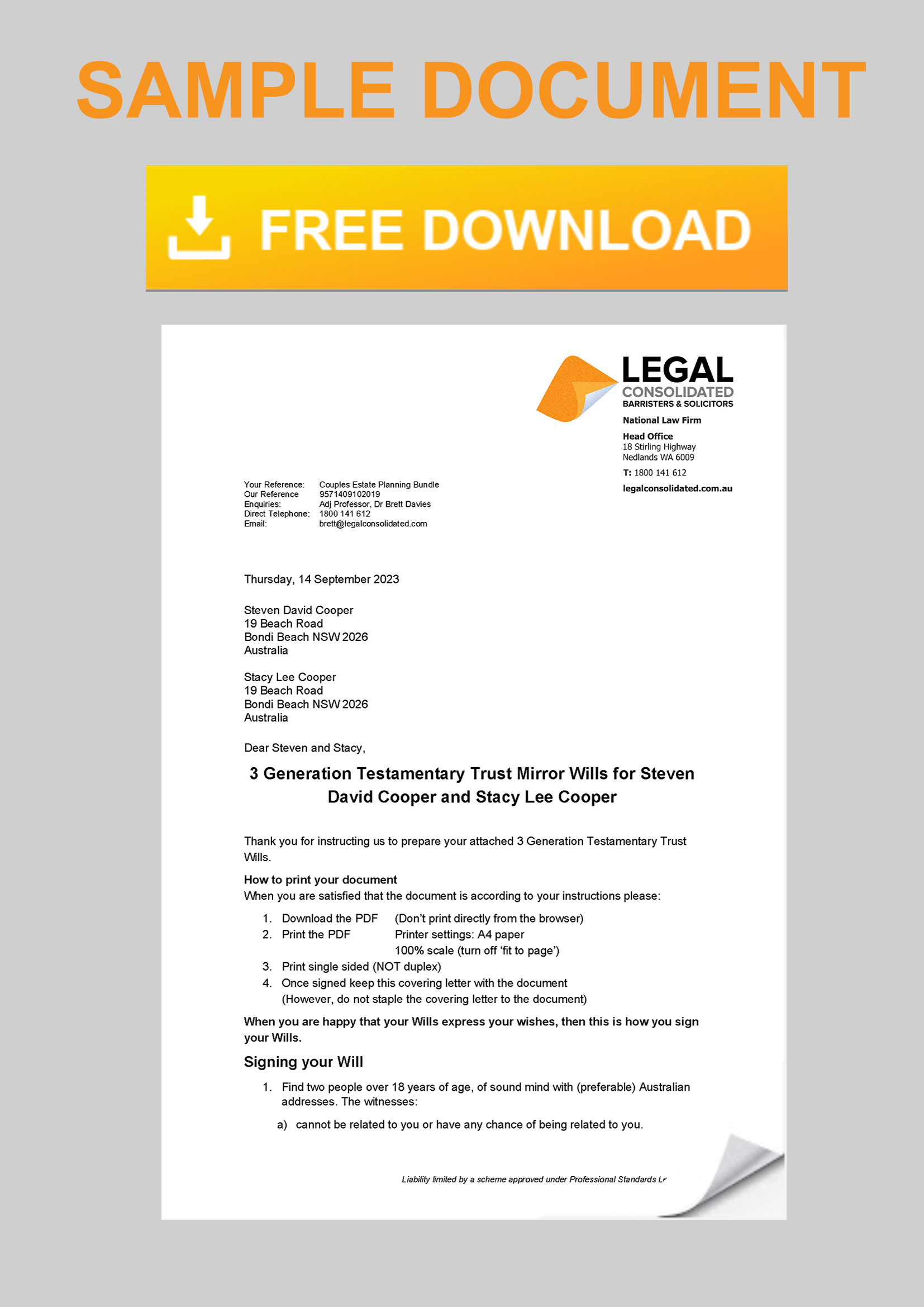
4. Full sample with explanatory notes of the Unit Trust Change Name Deed (see above)
5. Law firm letter confirming Legal Consolidated authored the Unit Trust Deed to Update the Unit Trust Name
To update your Unit Trust Deed or change the trustee see here.
Free legal advice to help you build the Change of Trustee of a Unit Trust
- On the top right-hand side of this page, press CLICK TO DOWNLOAD to see a full free sample of our cover letter, minutes and Deed to update your Trustee.
- Your Education and Empowerment starts by pressing START FOR FREE. Answer the questions and read the hints. Every question, since 1988, about updating a Trustee for a Unit Trust is answered in the hints.
- Answer as many questions as you can. Read the hints. Then you are welcome to telephone the law firm. Together, a lawyer reviews the answers with you. This is a free service. But start building the Unit Trust Update of a Trustee first, as the building process answers most questions.
Unit Trust |
|
| Unit Trust Deed – with both pre-emptive rights and Unitholder asset protection | |
| Vesting Deed – to wind up your Unit Trust | |
| Company to be trustee of a Unit Trust – corporate trustee for asset protection | |
| Update the Trustees of the Unit Trust – remove and replace the trustee of your Unit Trust | |
| Unitholders Agreement – the Unitholders’ set of rules that also protects them from litigation |
Business Structures v Unit Trust
Family trust
- Family Trust Deed – watch the free training course
- Family Trust Updates:
- Everything – Appointor, Trustee & Deed Update
- Deed ONLY – only update the Deed for tax
- Guardian and Appointor – only update the Guardian & Appointor
- Change the Trustee – change human Trustees and Company Trustees
- The company as Trustee of Family Trust – only for assets protection?
- Bucket Company for Family Trust – tax advantages of a corporate beneficiary
Unit trust
- Unit Trust
- Unit Trust Vesting Deed – wind up your Unit Trust
- Change Unit Trust Trustee – replace the trustee of your Unit Trust
- Company as Trustee of Unit Trust – how to build a company designed to be a trustee of a Unit Trust
Corporate structures
- Partnership Agreement – but what about joint liability?
- Incorporate an Australian Company – best practice with the Constitution
- Upgrade the old Company Constitution – this is why
- Replace lost Company Constitution – about to get an ATO Audit?
- Independent Contractor Agreement – make sure the person is NOT an employee
- Service Trust Agreement – operate a second business to move income and wealth
- Law firm Service Trust Agreement – how a law firm runs the backend of its practice
- Medical Doctor Service Trust Agreement – complies with all State rules, including New South Wales
- Dentist Service Trust Agreement – how dentists move income to their family
- Engineering Service Trust Agreement – commonly engineers set up the wrong structure
- Accountants Service Trust Agreement – complies with ATO’s new view on the Phillips case