Many parents want to include their children in wealth creation. But Australian corporate law is strict.
If you are setting up an Australian Pty Ltd company on Legal Consolidated's website, you might want to issue shares to an underage child. You must do this correctly.
You must issue the shares to an adult. That adult holds the shares beneficially for the child. You must never put a minor's name directly on the ASIC register.
Here is how you protect your company and stay compliant.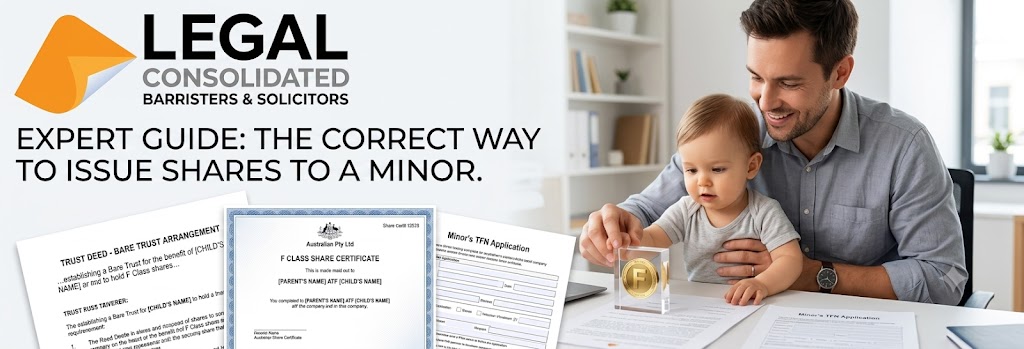
Why Children Cannot Hold Shares Directly
A minor is anyone under 18 years of age. Underaged children lack the legal capacity to sign contracts.
When you own a company share, you agree to a contract. You are legally bound by the company Constitution. A child cannot legally agree to this contract.
If you put the share directly in the child's name, you create a legal disaster. The child cannot vote. The child cannot sign shareholder resolutions. You cannot easily sell the company later.
The Legal Consolidated Solution: The Bare Trust
We make ASIC compliance easy. Build this bare trust structure.
An adult (usually a parent or grandparent) acts as the trustee. The adult holds the legal title. The child becomes the "beneficial owner".
When you build your company on our law firm's website, you fill out the shareholder register like this:
Shareholder Name: Enter the adult's name (e.g., John Smith). ASIC only accepts adults with legal capacity.
Beneficially Held: Select No.
Selecting "No" tells ASIC and the Australian Taxation Office (ATO) the truth. The adult owns the share on paper. But the adult gets no financial benefit. The dividends and capital belong strictly to the child.
Watch Out for ATO Tax Traps: Division 6AA
The ATO watches children's shares closely. Because the child owns the share beneficially, you trigger specific tax rules.
Prepare for these ATO requirements:
Tax File Numbers (TFN): Get your child a TFN. Give it to the company. If you fail to quote a TFN, the company must withhold tax at the highest marginal rate.
Division 6AA Penalty Tax Rates:
The ATO hates parents funnelling income through children to minimise tax. Under Division 6AA, minors face severe penalty tax rates on passive income. Company dividends are passive income. These harsh penalty rates apply if the minor's passive income exceeds just $416 in a financial year.
Follow the Money
You must pay the dividend directly into a bank account held for the child. You must declare the money on the child's personal tax return.
H class shares come with no income, capital or votes
Some shares, such as Legal Consolidated H class shares, do not pay income. Therefore, they may be recommended by your accountant or lawyer. While they virtually have no value or rights, you still need to have a Declaration of Trust in place.
Build Your Company with a Law Firm
Do not risk your family's wealth with non-lawyer templates. Build your Pty Ltd company on Legal Consolidated's website.
You get full legal protection. You get a law firm's guarantee. You get a fully compliant company Constitution that properly supports different share classes and trust structures.
Build these company documents online |
|
|---|---|
| Superannuation Trustee Company (Special Purpose) – Includes ASIC fees | |
| New company – Includes ASIC fees, minutes & Constitution | |
| Shareholders Agreement | |
| Deed of Debt Forgiveness | |
| Deed of Gift | |
| Power of Attorney for a Company – Corporate POA | |
| Division 7A Loan Deed – Lending money to a company (revolving; never needs updating) | |
| Loan to a Company – to prove a loan (escape Debt/Equity rules) | |
Upgrade company rules |
|
| Upgrade Company Constitution – also allows for single director company | |
| Replace Old Memo and Articles of Association – upgrade from Replaceable Rules | |
| Replace Lost Company Constitution | |
| Replace Replaceable Rules |
Free Materials and articles |
|
|---|---|
| How to fix new companies with ASIC | |
| How to display your Australian Company Number | |
| What happens to a company when you die? | |
| Different classes of shares explained |