


Nicknames and alias names in Wills
Names change. People move. Identity documents disagree. None of that should make your executor play detective.
A nickname, former surname or spelling error does not automatically invalidate a Legal Consolidated Will or destroy a gift. But unclear identification creates affidavits, Court requisitions, delay and cost. Use the name that identifies the person now. Add another name only when it helps prove that identity.
Wife still uses her maiden name. How do I deal with alias names in a Will?
Q: As an accountant, I am build the Couple’s Estate Planning bundle on your website. The wife is legally married but still uses her maiden name. She intends to change everything to her married name in the next 6–12 months. How do I enter the data for her Will now while allowing for the future name change?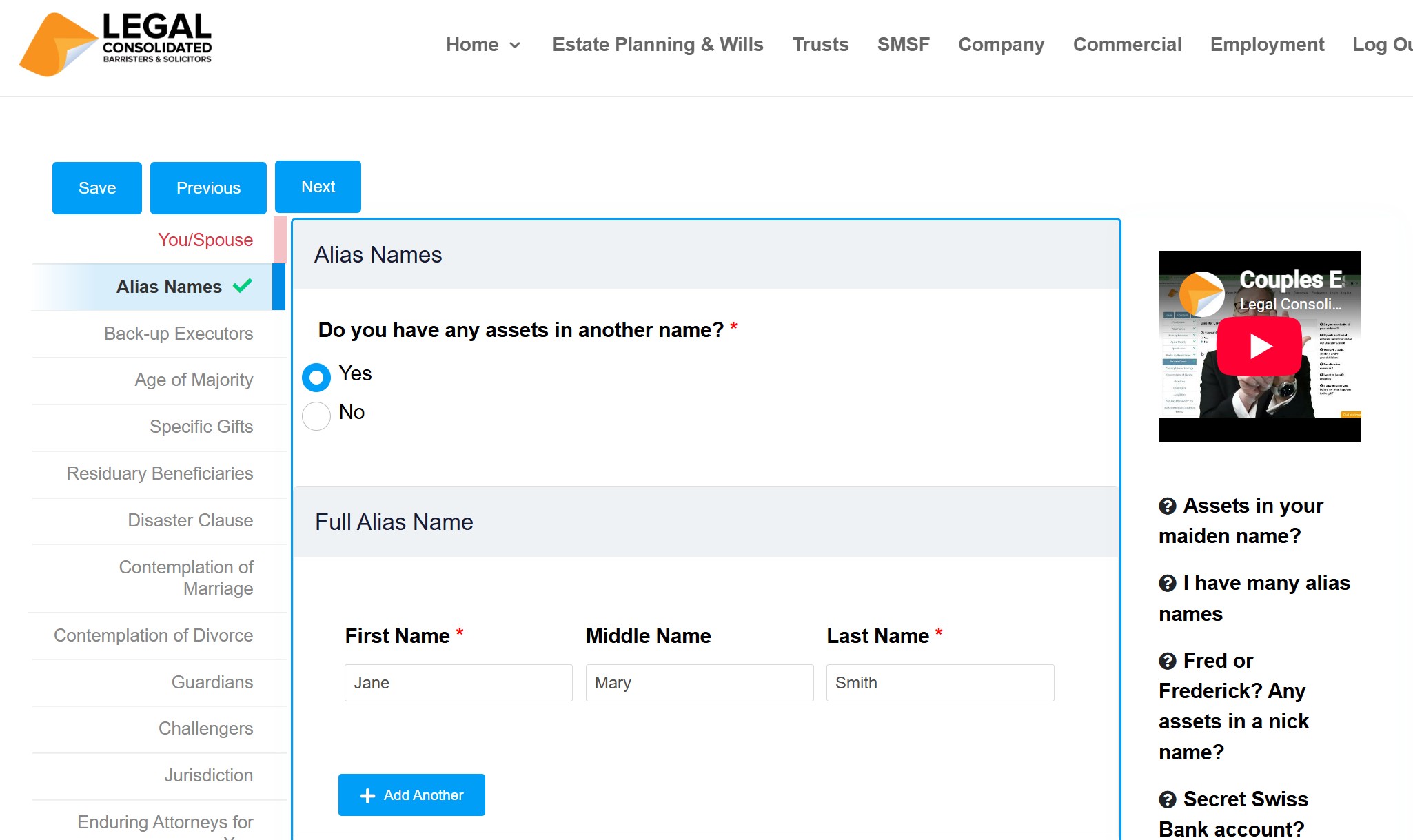
A: Enter her present full name. Use the name she currently uses and can support with her current identity documents.
Add in her married name.
If she genuinely uses both surnames now, identify her once in this form:
Jane Mary Brown (also known as Jane Mary Smith)
The maiden name may be the main name or the additional name. The correct order depends on which name she presently uses as her principal name. Consistency across the Will, Enduring Power of Attorney and identity records is more useful than guessing which name she may prefer next year.
A later change of surname does not, by itself, revoke or invalidate a Will. However, updating the Legal Consolidated Will after the change is sensible. It is free to update Legal Consolidated Wills and POAs. It reduces the evidence the executor may later need to connect the name in the Will with the name on the death certificate and asset records.
This is different from the effect of marriage or divorce on a Will. Those events may alter the Will’s operation under State or Territory legislation and require a separate review.

Which name goes into a Will?
This is the order to put names in Last Wills and Testaments:
- the person’s present, complete name;
- an actual alias or nickname, if the person genuinely uses it;
- a former name, if it helps establish identity; and
- a documentary variation, if an official record contains a material spelling or abbreviation difference.
Do not use a nickname alone when the person has a complete name. “Bill” may be William, Wilfred or someone else entirely. Better wording is:
William John Smith (also known as Bill Smith)
Passport, birth certificate and driver’s licence show different names
Q: A client has advised us of discrepancies across his identity documents:
- passport: Jonathan Michael Harrington, which he confirms is correct;
- birth certificate: the surname is recorded as Harington; and
- driver’s licence: Jonathan is shortened to Jon because of character limits.
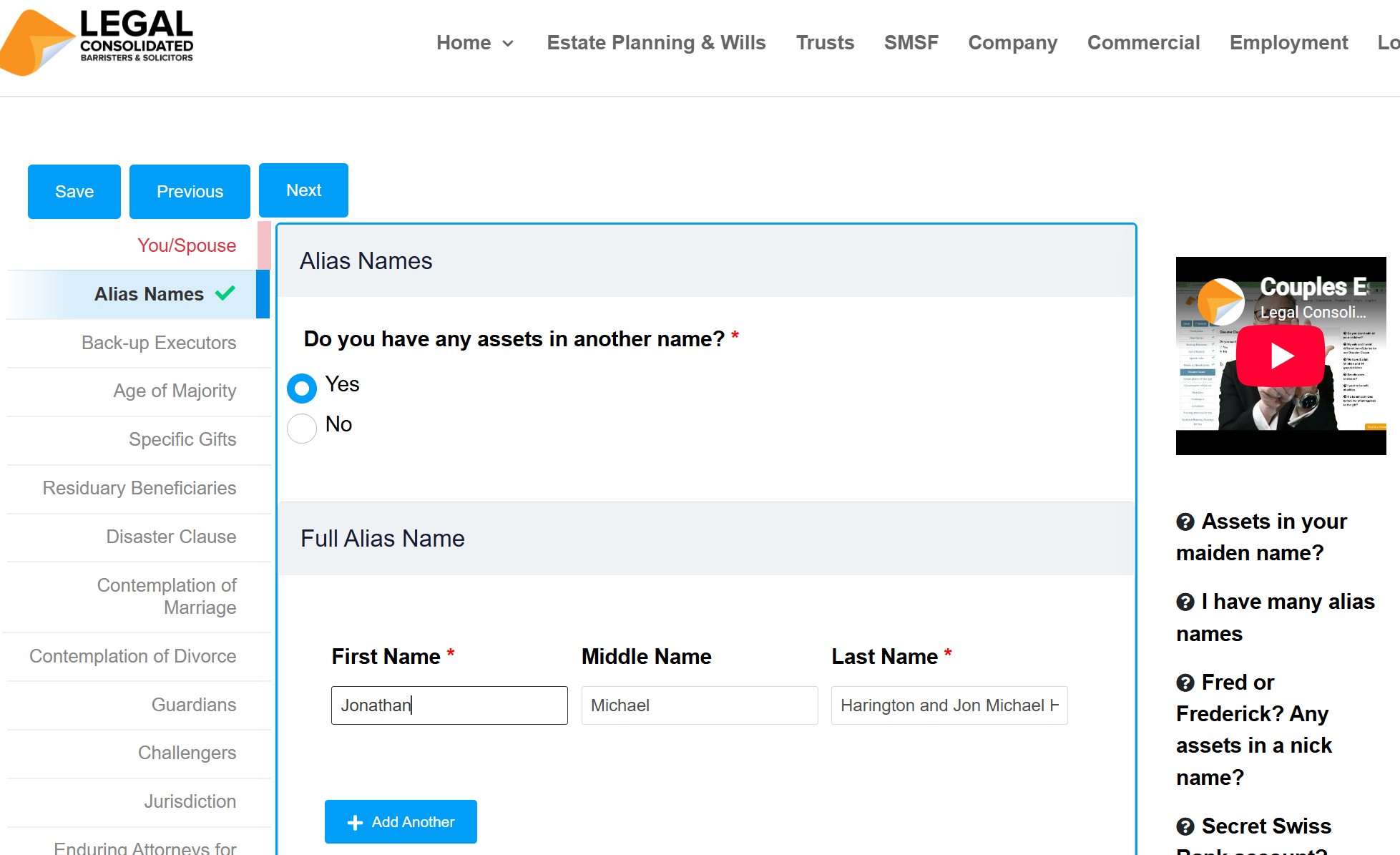
What name should be used in his Legal Consolidated Estate Planning documents?
A: On the facts supplied, and after confirming that the passport spelling is the correct name, use this as the principal name:
Jonathan Michael Harrington
Then record the two documentary variants:
Jonathan Michael Harrington (also known as Jonathan Michael Harington and Jon Michael Harrington)
Jonathan should also ask the relevant Registry of Births, Deaths and Marriages whether the birth entry can be corrected. He should ask the driver licensing authority to correct or formally confirm the shortened given name. A correction is not the same as adopting a new name. Keep the registry response and any replacement identity document with the Legal Consolidated Estate Planning records.
Do not delay a time-sensitive Will merely because a registry correction is pending. Use the confirmed principal name, disclose the variants and obtain specific legal advice where the evidence of identity is not clear.

What if the Will and POAs are not yet signed?
You can update Legal Consolidated Wills and POAs for free. You must do so before signing.
What if the Will has already been signed?
Do not write on the signed Legal Consolidated Will. Do not use correction fluid. Do not detach and replace a page.
If the Legal Consolidated Will was signed using an incomplete or inaccurate version of the name, build and sign an updated Will. It is free to update Legal Consolidated Wills and POAs. The existing Legal Consolidated Will is not necessarily invalid if the Will maker can still be identified. Legal Consolidated provides free legal advice to your executors and beneficiaries after you are dead. But there is no benefit in preserving an avoidable probate problem.
My daughter’s name and address have changed. Do I need to update my Will?
Usually, no.
People move. Beneficiaries and executors marry, separate, divorce or otherwise change their names. A change of address or surname does not turn the person into somebody else.
In a properly drafted Legal Consolidated Will, an address helps identify the person. It is not a condition of the gift or appointment. Therefore:
- a beneficiary does not lose a gift merely because the beneficiary moves;
- an executor does not lose the appointment merely because the executor changes address; and
- a beneficiary does not lose a gift merely because her surname changes.
The executor may need a marriage certificate, change-of-name certificate or other evidence linking the two names. Updating the Will is prudent where:
- two people could answer the description;
- the person has a common name and there is little other identifying information;
- several inconsistent names appear across the Estate Planning documents;
- an organisation, charity, trustee or company has changed identity, amalgamated or ceased to exist; or
- the relationship described in the Will is no longer accurate and may create doubt.
Legal Consolidated Wills and powers of attorney can be updated for free. A changed address alone does not normally require a new Will. But there is no reason to leave a material identity problem unresolved.
What if the Will maker changes their own name?
A change of the Will maker’s name does not, by itself, revoke the Legal Consolidated Will. The Will remains the Will of the same human being.
However, the executor later applies for probate using the death certificate and the name in the Will. If those names differ, the probate application may need to state both names and provide evidence connecting them.
The Supreme Court of New South Wales Probate Checklist gives the practical example of showing another name in brackets as an alias. The Supreme Court of the Australian Capital Territory likewise warns that name variations must be addressed in the application or grant and may require evidence of the change.
The better course is simple. After the Will maker actually changes name:
- update the Will and Powers of Attorney;
- sign the updated documents;
- retain the marriage certificate, change-of-name certificate or correction record; and
- never hand-amend the signed original.
Does a wrong name invalidate a Will or gift?
Not automatically. The Court’s task is to identify and give effect to the intention expressed by the Will, using only evidence the law permits. The Court may resolve a misdescription. It cannot invent a different Will.
The leading principles include:
- In Fell v Fell (1922) 31 CLR 268, 273–76 (Isaacs J), the High Court explained that a Will is construed from its language read as a whole and against admissible surrounding circumstances. Construction may resolve inaccuracy. It does not authorise the Court to write a new Will.
- In the Will of Loughlin; Acheson v O’Meara [1906] VLR 597, 601 (Hood J) concerned the misnomer of a legatee. A wrong name did not end the inquiry where the description and admissible evidence identified the intended person.
- In Public Trustee v Herbert [2009] NSWSC 366, [27] (Macready AsJ), surrounding circumstances assisted the Court to identify the person intended by a description that no candidate answered perfectly.
- Re the Will of William Ian Southey [2025] VSC 801, [25], [31], [33] (Goulden AsJ) supplies the modern warning. The residue was gifted to a supposed online partner who could not be established to exist as the Will maker understood him, or at all. The primary gift failed. The Court then had to construe the gift-over clause.
The lesson is not that mistakes are harmless. The lesson is that a Court case may sometimes repair an identification problem after the Will maker has died. Litigation is an expensive substitute for correct data entry.
The technical rule on outside evidence
Most Australian jurisdictions expressly permit extrinsic evidence to assist with construing a Will where the statutory conditions are met:
- Wills Act 1968 (ACT) s 12B;
- Succession Act 2006 (NSW) s 32;
- Wills Act 2000 (NT) s 31;
- Succession Act 1981 (Qld) s 33C;
- Wills Act 2008 (Tas) s 46;
- Wills Act 1997 (Vic) s 36; and
- Wills Act 1970 (WA) s 28A.
Where is South Australia and alias names?
South Australia’s Succession Act 2023 (SA) does not reproduce that equivalent statutory construction provision. Common law construction principles remain important. Section 22 separately gives the South Australian Supreme Court power to rectify a Will in the circumstances stated in that section.
But it is best to insert the alias names in the Will
Do not rely on these statutory provisions. They are not permission to ignore accurate drafting. The admissibility and use of evidence depend on the particular ambiguity and jurisdiction. A file note of “what the Will maker really meant” is not a guaranteed cure. See the Supreme Court of New South Wales paper, Use of Extrinsic Evidence to Construe Wills.
The practical rule for lawyers, accountants and financial planners building Wills and POAs on Legal Consolidated’s website
Advisers are not expected to fix government identity records. They are expected to disclose inconsistencies rather than choose silently between them.
Before pressing Lock and Build:
- ask the client which complete name is correct;
- sight consistent current identity evidence;
- record every material variant and why it exists;
- distinguish an alias from a former name and a documentary error;
- use the same description throughout the Estate Planning bundle; and
- refer a genuine identity dispute to the law firm before the documents are built.
Clear names today save the estate from proving identity tomorrow. Telephone Legal Consolidated and speak to one of our taxation/estate planning lawyers.
Missing a middle name in the Will
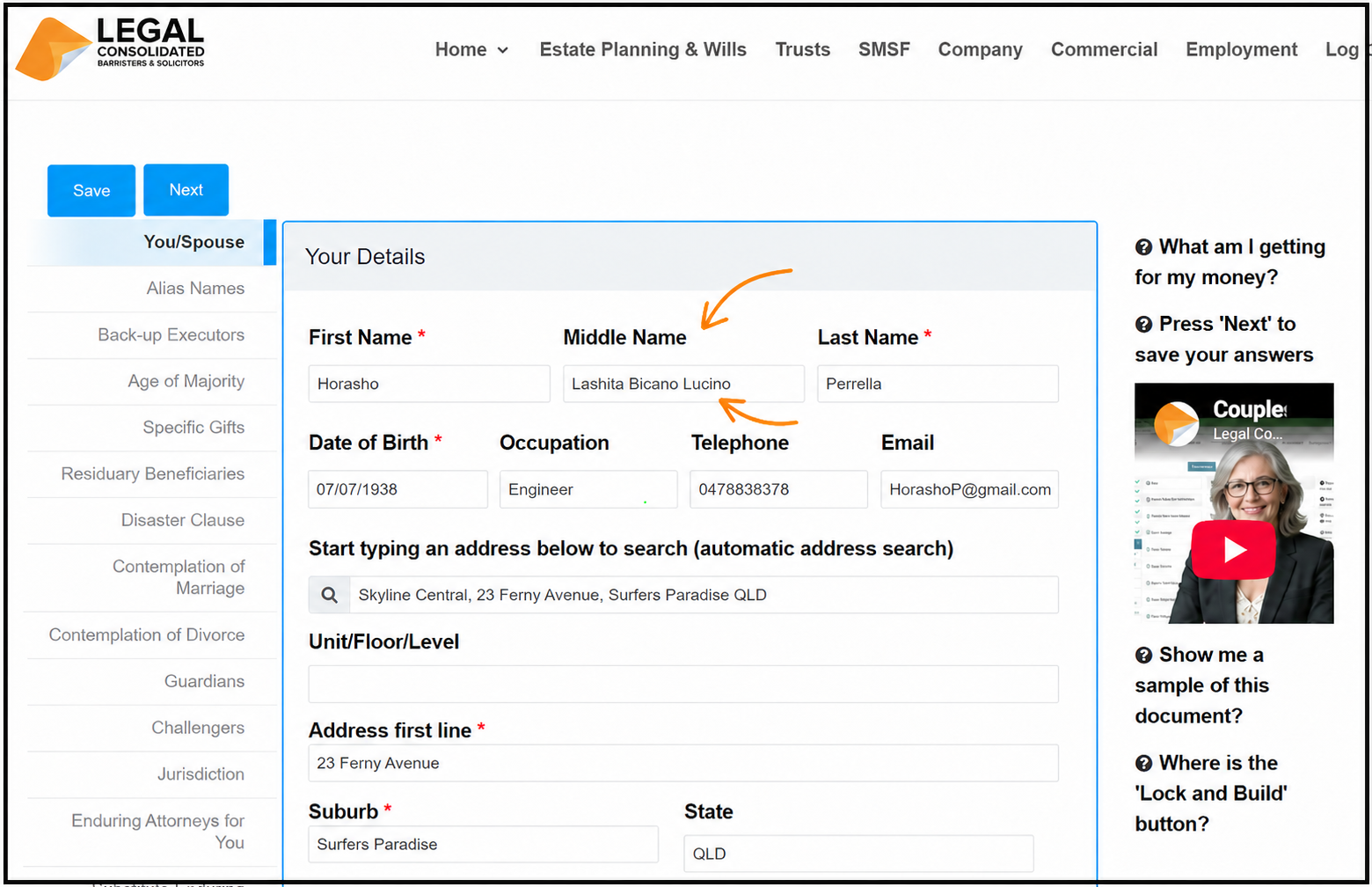
If you have one or more middle names, include all of them in your Will. Use your complete name exactly as it appears on your primary identity documents. Do not omit a middle name merely because you do not use it socially. Do not replace middle names with initials.
The same rule applies to executors, substitute executors, guardians and beneficiaries. A complete name helps identify the correct person. This is important where family members share similar names or the person has a common first name and surname.
Omitting a middle name does not automatically invalidate the Will, an appointment or a gift. The question is whether the correct person can still be identified. However, the omission leads to legal complications. It may require affidavits, additional identity evidence and an explanation to the Probate Registry. The Australian Capital Territory Supreme Court states that names must be spelt correctly and that full names should be used.
The Legal Consolidated rule is blunt: include every middle name. If identity documents record the name differently, disclose the difference rather than guessing. If the Will has not been signed, correct it before signing. If it has already been signed, never write the missing name onto the Will by hand. Update and sign a replacement Will.
Start building your Wills and POAs for free
We have been preparing tax-effective Wills since 1988. They also protect your beneficiaries if they divorce or go bankrupt. The online building process is free and educational. As you answer the questions, the legal education is built into the document-building process.
Start the Couples Tax Effective Estate Planning Bundle or the Singles Tax Effective Estate Planning Bundle. If a name later changes, update the Legal Consolidated Will and powers of attorney for free.
Protects from death duties, divorcing and bankrupt children and a 32% tax on super.
Build online with free lifetime updates:
Couples Bundle
includes 3-Generation Testamentary Trust Wills and 4 POAs
Singles Bundle
includes 3-Generation Testamentary Trust Will and 2 POAs
Death Taxes
- Australia’s four death duties
- 32% tax on superannuation to children
- Selling a dead person’s home tax-free
- HECs debt at death
- CGT on dead wife’s wedding ring
- Extra tax on Charities
Vulnerable children and spend-thrifts
- Your Will includes:
- Divorce Protection Trust if children divorce
- Bankruptcy Trusts
- Special Disability Trust (free vulnerable children in Wills Training Video)

- Guardians for under 18-year-old children
- Considered person clause to stop Will challenges
Second Marriages & Challenging Will
- Contractual Will Agreement for second marriages
- Wills for blended families
- Do Marriages and Divorce revoke my Will?
- Can my lover challenge my Will?
- Make my Will fair: hotchpot clauses v Equalisation?
What if I:
- have assets or beneficiaries overseas?

- lack mental capacity to sign my Will?
- sign my Will in hospital or isolating?
- lose my Will or my home burns down?
- have addresses changed in my Will?
- have nicknames and alias names?
- want free storage of my Wills and POAs?
- put Specific Gifts in Wills
- build my parent’s Wills?
- leave money to my pets?
- want my adviser or accountant to build the Will for me?
Assets not in your Will
- Joint tenancy assets and the family home
- Loans to children, parents or company
- Gifts and forgiving a debt before you die
- Who controls my Company at death?
- Family Trusts:
- Changing control with Backup Appointors
- losing Centrelink and winding up Family Trust
- Does my Family Trust go in my Will?
Power of Attorney
 Money POAs: NSW, VIC, QLD, WA, SA, TAS, ACT & NT
- be used to steal my money?
- act as trustee of my trust?
- change my Superannuation binding nomination?
- be witnessed by my financial planner witness?
- be signed if I lack mental capacity?
- Medical, Lifestyle, Guardianships, and Care Directives:
- Company POA when directors go missing, insane or die
After death
- Free Wish List to be kept with your Will
- Burial arrangements
- How to amend a Testamentary Trust after you die
- What happens to mortgages when I die?
- Family Court looks at dead Dad’s Will