

Enduring Power of Attorney
$128 includes GST
-
Build your NSW Enduring Power of Attorney deed on a law firm's website.
✓ Prepared to satisfy banks and NSW Land Registry Services
✓ Free updates for life
✓ Free advice for you and the people you appoint
✓ Monitored for changes in the law
NSW Enduring POA
An NSW Enduring Power of Attorney lets a person you trust deal with your money and property if you cannot. That person is your Attorney. You choose them.
Your Attorney deals with your bank accounts, shares, real estate, bills and other financial affairs. Your NSW Enduring Power of Attorney is your financial safety switch. It is the deed your family needs when the bank, aged care provider or NSW Land Registry Services asks: “Who has authority to act?”
The issue is not whether another document exists somewhere else. The issue is whether your NSW POA works when your family needs it. Banks and title offices are strict. They do not like taking chances with an NSW POA that has a blemish.
From what Legal Consolidated is seeing, over 30% of NSW POAs built away from a law firm do not work properly when tested. You usually find out too late. Mum has lost capacity. Dad is in aged care. The home must be sold. The bank refuses to act on the POA. The family is now trapped.
Build your NSW Enduring Power of Attorney deed online on Legal Consolidated’s law firm website. Press START FOR FREE. Read the hints as you answer the questions. Telephone us if you want to review your answers before you Lock and Build.
Your NSW POA and your Wills can be updated for free, as often as you wish. They also come with free advice for you and the people you appoint.
Why build your NSW Enduring Power of Attorney deed on a law firm’s website?
A Power of Attorney is not mere paper. It is a deed that gives another person control over your money and property. Any defects become apparent too late. This is when you lack capacity and cannot sign a new one.
You want the bank, aged care provider and NSW Land Registry Services to act without delay or doubt.
Common failures we see in both government- and lawyer-prepared POAs are ordinary yet fatal. They include:
- The witness certificate was not completed properly.
- The wrong Attorney structure was chosen.
- The replacement Attorney clause fails.
- The family assumes the POA covers medical decisions.
- The family assumes the POA authorises the Attorney to act as trustee or to sign for a company.
- Extra clauses to help the Attorneys that the bank rejects as ‘exotic‘.
- Thinking that an out-of-state, such as a Victorian POA, works.
Legal Consolidated authors your NSW Enduring Power of Attorney. You build the deed online. The questions educate you as you go. You read the hints. You can telephone us before you Lock and Build and pay for the POA.
Why do Banks reject many POAs?
Banks are conservative for a good reason. They are asked to release money and accept instructions from someone who is not the account holder. If the NSW POA appears to be incorrect, incomplete, or unusual, the bank rejects it.
This is not the bank being difficult. It is the bank protecting itself. If it accepts an unusual-looking POA, it risks being sued.
The Legal Consolidated Advantage for NSW Powers of Attorney
Legal Consolidated POAs include a cost-saving option. They are valid whether you lodge them with NSW Land Registry Services or not.
Advantages of a Legal Consolidated POA for Land Registry Services:
-
No Immediate Registration Required: With Legal Consolidated, your POA is fully operative the moment it is signed. You only need to lodge it with Land Registry Services when your Attorney is signing a land dealing.
-
Total Timing Flexibility: You can register our POA at the LRS any time — even many years after it is signed. You simply keep it safe and lodge it when a property transaction occurs.
-
Avoid Unnecessary Government Fees: Legal Consolidated allows you to update your POA for free, as often as you wish. If you register a POA too early and later need to make a change, the Land Registry Services charges you a fee to remove the old POA, plus another fee to lodge the new POA. By using a Legal Consolidated POA and waiting to register it until it is actually needed, you protect yourself from these frustrating title office fees while keeping your document completely up to date.
Exotic NSW POA clauses often make things worse
Some people want to add loving and clever clauses to a POA. That makes the POA harder to use, or it fails absolutely.
What does an NSW Enduring Power of Attorney let your Attorney do?
An NSW Enduring Power of Attorney appoints your Attorney to make legal and financial decisions for you. It continues to work if you later lose mental capacity.
Your Attorney may deal with your bank accounts, bills, debts, shares, managed funds, real estate, rent, leases, tax records, accountant and financial planning communications and aged care money. The power is broad because financial life is broad. Someone may need to pay the electricity bill, sell shares, talk to the bank, sign a contract, or sell the home to fund aged care.
Most couples appoint each other first. They then appoint one or two adult children as backups.
Can your NSW Attorney deal with bank accounts?
Yes. Your Attorney may operate your bank accounts if the NSW POA is accepted by the bank and the Attorney acts within authority.
The Attorney may pay bills, transfer money between accounts, close accounts, open new accounts, and manage direct debits. But the Attorney must keep your money separate from their money. Every transaction needs a clear explanation.
Can your NSW Attorney sell your home?
Yes, if the NSW POA gives that authority. This is one of the main reasons to build an NSW Enduring Power of Attorney deed.
If you lose capacity and move into aged care, someone may need to sell or lease your home, deal with the bank, pay the refundable accommodation deposit, or manage the sale proceeds. The Attorney should keep valuations, agent advice, aged care fee records, accountant advice and family communications.
Land dealings are strict. Section 51 of the Powers of Attorney Act 2003 (NSW) provides that a conveyance or other deed affecting land signed under a power of attorney has no effect unless the instrument creating the power has been registered. But a Legal Consolided POA is drafted so that it does not need to be lodged until the POA is needed.
The Attorney should never sell your home cheaply to themselves, their spouse or their own company. That is a criminal event.
Can your NSW Attorney pay aged care costs?
Yes. Your Attorney may pay aged care costs and manage the financial side of aged care.
But an NSW POA does not decide where you live for care purposes. That is a personal, lifestyle and accommodation decision. For that, you need an NSW Enduring Guardian document (also called Medical Power of Attorney or Power of Guardian).
The Enduring POA deals with your money and wealth. The Enduring Guardianship deals with your physical body.
What decisions does an NSW Enduring Power of Attorney not cover?
Your NSW Attorney cannot:
-
vote in an election for you;
-
make your Will;
-
sign another NSW Enduring Power of Attorney for you;
-
make medical treatment decisions for you;
-
decide where you live for care purposes;
-
control your body;
- replace your employment duties;
-
act as trustee in your place;
This catches many families. A human NSW Enduring Power of Attorney is not a Company Power of Attorney. It also does not automatically let your Attorney act as trustee of a Family Trust, Unit Trust or SMSF.
NSW POA does not let your Attorney act as trustee
As per the list above, a human NSW POA does not let your Attorney stand in your shoes and act as trustee of a trust. Section 10 of the Powers of Attorney Act 2003 (NSW) says a prescribed power of attorney does not confer authority to exercise a trustee function conferred or imposed on the Principal. Like being an employee, being a trustee is a personal obligation that can not be outsourced to a person holding your POA.
This matters for Family Trusts, Unit Trusts and SMSFs. Your Attorney may control your bank account. But that does not mean they control your trustee role.
The trust deed may have its own rules. A company trustee may need director changes. An SMSF may need its own deed and superannuation review. Legal Consolidated has a separate article on why a POA does not automatically allow a person to act for a trustee.
See Legal Consolidated’s article: Can a POA act for a trustee?.
NSW POA does not let your Attorney sign for your company
Your personal NSW POA belongs to you as a human. It does not belong to your company.
A company is a separate legal person. If your company needs someone to sign for it when a director is overseas, sick, missing or unable to act, the company needs its own Company Power of Attorney.
Legal Consolidated builds Company POAs as a separate document. This is not an upsell trick. It is a different legal problem. Human POAs and Company POAs do different jobs.
See Legal Consolidated’s article: How to create a Company Power of Attorney.
NSW Enduring Power of Attorney v NSW Enduring Guardian
Do not confuse the financial deed with the body-and-care document.
An NSW Enduring Power of Attorney deals with legal and financial decisions. It covers money, property, banks, bills, shares and land. An NSW Enduring Guardian deals with medical, health, lifestyle and accommodation decisions.
This is not theory. Our client’s wife was trapped in a high-end NSW retirement home. She had Alzheimer’s Disease. He wanted to get her out. The retirement home said he had no right to touch or move her. Not even as her husband. He rang me in tears.
The document he needed was not the NSW Enduring Power of Attorney. He needed the NSW Medical Power of Attorney, also called the NSW Power of Guardian.
That example proves the point. Your NSW POA protects your money and property. It does not control your body. Many people need both documents, but this page builds your NSW Enduring Power of Attorney.
When does an NSW Enduring Power of Attorney start?
Your NSW Enduring Power of Attorney starts on how you answer that question. You may choose whether it starts immediately (most common) or only when you lose mental capacity.
But your Attorney must also accept the appointment. Under the Powers of Attorney Act 2003 (NSW), an enduring power of attorney does not give authority to an Attorney until the Attorney accepts the appointment by signing the instrument. Legal Conoslidated POAs are drafted so that the person getting the POA can sign many years later. But, until signed it has no force.
Why NSW POA ‘benefit’ and ‘uncommon’ clauses create danger
An NSW Enduring Power of Attorney may expressly authorise gifts or benefits. That sounds harmless. It is not.
Sections 11 and 12 of the Powers of Attorney Act 2003 (NSW) say a prescribed power of attorney does not generally authorise gifts or benefits to the Attorney unless the instrument expressly authorises them. That means the words matter.
This is where families get hurt. A son uses Mum’s POA to transfer money to himself. He says the document allowed benefits. His siblings say he stole the money. The bank says it relied on the POA. The estate later sues.
The NSW Court of Appeal decision in Taheri v Vitek (2014) 87 NSWLR 403 shows why benefit wording is dangerous. The case concerned a power of attorney containing a benefits clause and the question of whether a third party could rely on it. Justice Lindsay later described benefits clauses in enduring powers of attorney as giving rise to “difficulties”.
Taheri v Vitek: loving POA clauses end up in court![Taheri v Vitek [2014] NSWCA 209 uncommon clauses in POA upset the bank and LRS](https://legalconsolidated.com.au/wp-content/uploads/Taheri-v-Vitek-2014-NSWCA-209-uncommon-clauses-in-POA-upset-the-bank-and-LRS.png)
Some legal documents invite negotiation. A lease does. A loan agreement does. A shareholders’ agreement does. The parties are alive, commercial, and available to explain what they thought they had agreed to.
An Enduring Power of Attorney is different. It is tested when the Principal has lost capacity. Wills are the same. The person who signed the document is often mentally incapable or dead. Dead men tell no tales.
That is why banks and Land Registry Services prefer ordinary, recognisable POAs. They do not want a clever clause that needs a barrister, a senior counsel’s opinion or a Court of Appeal decision to explain it.
The facts in Taheri v Vitek
In Taheri v Vitek (2014) 87 NSWLR 403, Mrs Taheri gave her husband a power of attorney. He used it to sign a guarantee and other documents related to a property transaction. Mrs Taheri later said she had not personally signed the guarantee and disputed liability.
The power of attorney contained language that permitted the Attorney to act even when a benefit was conferred on the Attorney. She thought she was doing the right thing, but she just created confusion. That unusual wording mattered. The NSW Court of Appeal had to consider the effect of the power of attorney, the authority it gave, and whether the transaction could stand.
The exotic POA did not quietly do its job. It became part of an expensive litigation.
An unusual POA fails the bank test and goes to court
A POA clause may be legally clever and loving. However, at best, it only works after a court has interpreted it. Banks and the titles office do not want to be involved.
Banks and title offices do not like taking risks. If the POA is unusual, they stop. They ask questions. They refer it to legal. They refuse to act on the POA. The family is then trapped at the exact moment the POA is needed.
A Legal Consolidated NSW POA is drafted to satisfy the banks. Legal Consolidated’s approach is to build a deed that is legally sound, bank-friendly, and title-office-acceptable.
POAs and Wills are different from commercial agreements
With a commercial agreement, both parties can often explain the bargain. If a lease clause is unclear, the landlord and tenant may still give instructions. If a loan term is disputed, the borrower and lender may still be alive and available.
A POA is different. The Principal may have Alzheimer’s Disease, dementia, stroke damage or other loss of capacity. They may be unable to explain what they intended. With a Will, the Will maker has died.
That is why unusual clauses are dangerous in protective documents. They invite a fight when the only person who could explain the document is silent.
The Legal Consolidated lesson from Taheri v Vitek
Taheri v Vitek is not a reason to add more exotic clauses to an NSW POA. It is a reason to avoid them.
The lesson is simple. Build a Legal Consolidated POA that does not require litigation to work. Build a deed that banks, NSW Land Registry Services, aged care providers and government agencies easily recognise and accept.
Legal Consolidated prepares NSW Enduring Power of Attorney deeds through a law firm’s website. We keep the deed practical. We keep it recognisable. We avoid clever clauses that create litigation bait.
Six promises your NSW Attorney must keep
Your Attorney does not receive a blank cheque. The Attorney receives a duty.
1. Act in your best interests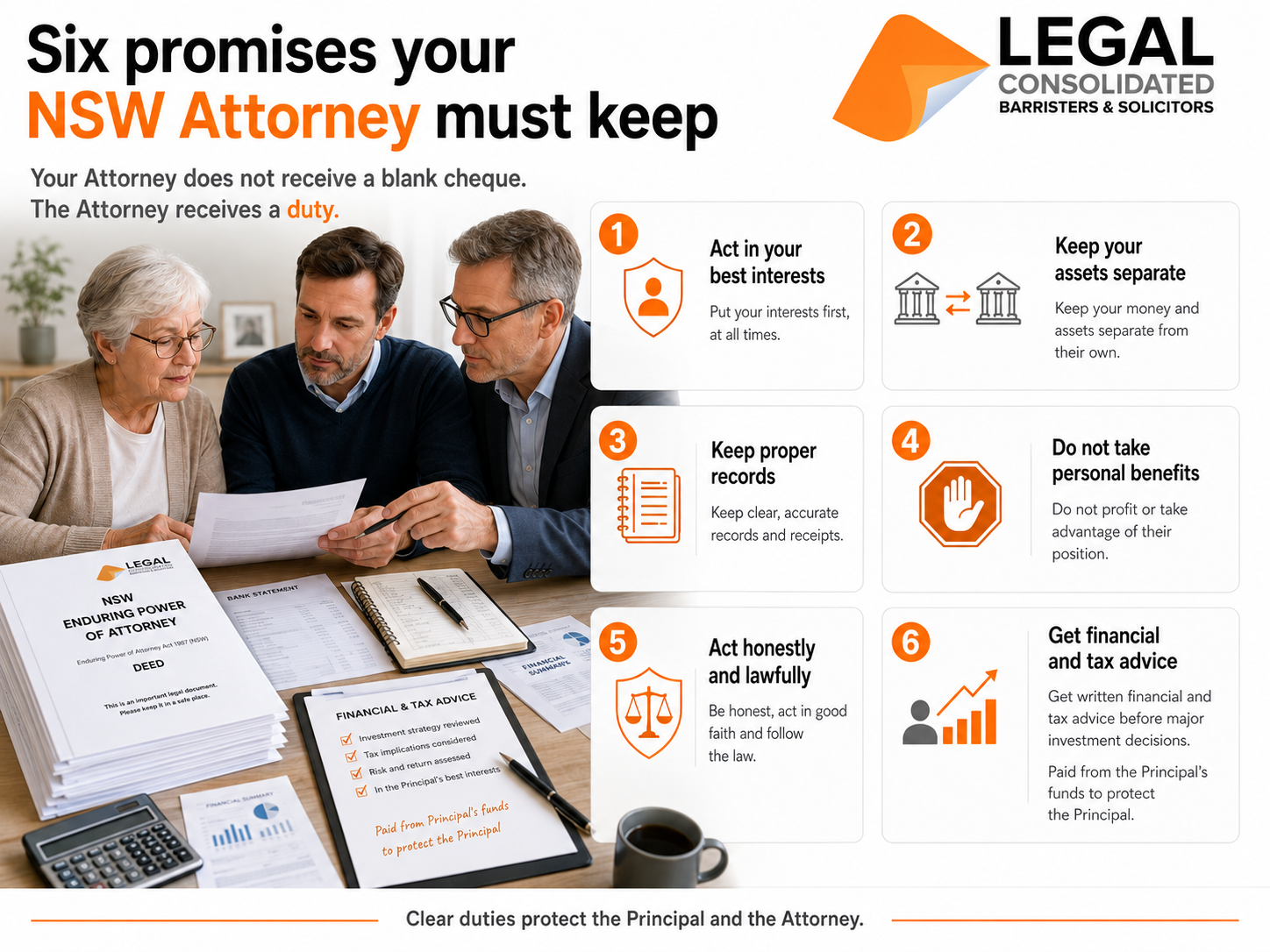
Your Attorney must act for you, not for themselves. While you have capacity, your wishes guide the decision. If you later lose capacity, your Attorney must make careful decisions based on your interests, your assets and your known wishes.
The hard cases are practical. Should the Attorney sell Mum’s home? Should Dad’s shares be sold? Should money be moved to pay aged care fees? For major decisions, get written sign-off from the accountant, financial planner or other adviser.
2. Keep your assets separate
Your Attorney must keep your money and property separate from their own. There should never be confusion about what belongs to you and what belongs to the Attorney.
This is not just about theft. It is also about proof. If money passes through the Attorney’s personal account, the ATO, a bankruptcy trustee, the Family Court or disappointed beneficiaries may later say the money belongs to the Attorney. Poor records lead to legal complications.
3. Keep proper records
Your Attorney should keep records as if a hostile barrister will read them later.
Keep bank statements, receipts, invoices, emails, file notes, accountant advice, financial planner advice, real estate appraisals, aged care records and tax records. Record major decisions. Explain why the decision helped the Principal.
This protects you. It also protects the Attorney.
4. Do not take personal benefits
The Attorney should not use the NSW POA to help themselves. A small “gift” may later look like theft. A reimbursement may later look like self-dealing. An early inheritance may later look like abuse.
If the Attorney or the Attorney’s family benefits in any way, stop and get written advice. The number one cause of attacks against Attorneys is the appearance that the Attorney used the POA for themselves.
5. Act honestly and lawfully
Your Attorney must act honestly in your legal and financial affairs. That includes obeying the law, dealing properly with banks, paying taxes, and not misleading family members, advisers or institutions.
Sometimes the legal answer and the family pressure point go in different directions. That is when the Attorney needs advice. Do not let family convenience become legal misconduct.
6. Do not pretend to be a financial planner or accountant
Your Attorney may need to handle investment and tax issues. That does not make the Attorney a licensed financial planner or tax accountant.
If the Attorney sells shares, changes investments, puts money into term deposits or restructures assets, beneficiaries may later attack the decision. They may say the return was too low, the risk was too high, or the tax result was poor.
The defence is evidence. Get written financial advice before making investment decisions. Keep the advice with the POA records.
NSW Civil and Administrative Tribunal reviews POAs
The Civil and Administrative Tribunal can review an NSW Enduring Power of Attorney.
The Civil and Administrative Tribunal can vary or revoke an Enduring Power of Attorney, appoint a substitute Attorney, and make findings about whether the Principal was competent. That is the safety net when the family is fighting, the Attorney is misusing power, or the POA itself is attacked.
But the Civil and Administrative Tribunal is not where you want your family to be. Tribunal proceedings are stressful. They cost time. They expose family conflict. They often start when the Principal is already vulnerable.
The better strategy is to build the NSW POA properly at the start. Use a law firm. Our free building process helps you follow the best structure. We ensure that the deed is fit for banks, title offices and aged care providers.
Why do NSW Powers of Attorney fail when families need them?
From what we see, non-Legal Consolidated POAs fail for many different reasons.
The prescribed witness certificate is missing or defective. The wrong Attorney structure was chosen. Replacement Attorneys do not work. The family thinks the POA covers medical decisions. The family believes the POA covers the trustee’s decisions. The family thinks the POA lets someone sign for a company.
Then the pressure hits. Mum cannot sign. Dad is in care. The bank refuses to act on the POA. NSW Land Registry Services asks for registration or proper authority. The aged care provider wants money. The family starts blaming each other.
Build your NSW Enduring Power of Attorney deed online with Legal Consolidated
Build your NSW Enduring Power of Attorney deed on a law firm’s website. Press START FOR FREE. Read the hints. Watch the training material. Answer the questions. Telephone Legal Consolidated, if you want to review your answers before you Lock and Build.
Your NSW POA and Wills can be updated for free, as often as you wish. They also come with free advice for you and the people you appoint.
Protects from death duties, divorcing and bankrupt children and a 32% tax on super. Build online with free lifetime updates:
Couples Bundle
includes 3-Generation Testamentary Trust Wills and 4 POAs
Singles Bundle
includes 3-Generation Testamentary Trust Will and 2 POAs
Death Taxes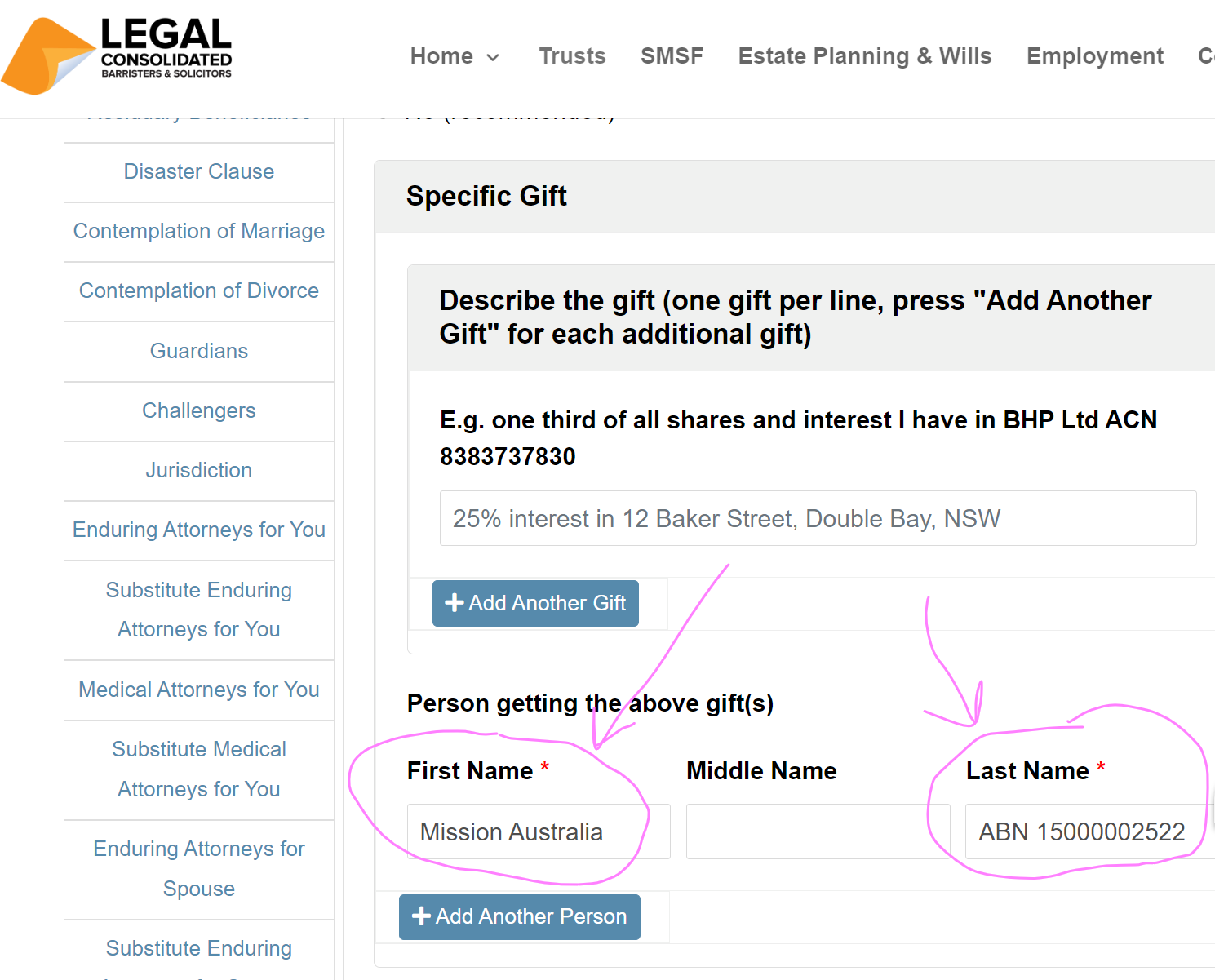
- Australia’s four death duties
- 32% tax on superannuation to children
- Selling a dead person’s home tax-free
- HEC’s debt at death
- CGT on the dead wife’s wedding ring
- Extra tax on Charities
Vulnerable children and spendthrifts
- Your Will includes:
- Divorce Protection Trust if children divorce
- Bankruptcy Trusts
- Special Disability Trust (free vulnerable children in Wills Training Video)

- Guardians for under-18-year-old children
- Considered person clause to stop Will challenges
Second Marriages & Challenging Will
- Contractual Will Agreement for second marriages
- Wills for blended families
- Do Marriages and Divorce revoke my Will?
- Can my lover challenge my Will?
- Make my Will fair: hotchpot clauses v Equalisation?
What if I:
- have assets or beneficiaries overseas?

- lack mental capacity to sign my Will?
- sign my Will in hospital or isolating?
- lose my Will or my home burns down?
- have addresses changed in my Will?
- have nicknames and alias names?
- want free storage of my Wills and POAs?
- put Specific Gifts in Wills
- build my parent’s Wills?
- leave money to my pets?
- want my adviser or accountant to build the Will for me?
Assets not in your Will
- Joint tenancy assets and the family home
- Loans to children, parents or the company
- Gifts and forgiving a debt before you die
- Who controls my Company at death?
- Family Trusts:
- Changing control with Backup Appointors
- losing Centrelink and winding up Family Trust
- Does my Family Trust go in my Will?
Power of Attorney
 Money POAs: NSW, VIC, QLD, WA, SA, TAS, ACT & NT
- be used to steal my money?
- act as trustee of my trust?
- change my Superannuation binding nomination?
- be witnessed by my financial planner witness?
- be signed if I lack mental capacity?
- Medical, Lifestyle, Guardianships, and Care Directives:
- Company POA when directors go missing, insane or die
After death
- Free Wish List to be kept with your Will
- Burial arrangements
- How to amend a Testamentary Trust after you die
- What happens to mortgages when I die?
- Family Court looks at dead Dad’s Will