


Family Trust and Wills
Can my Will control my Family Trust and trust loans (UPEs)?
Family Trusts have nothing to do with Wills. And Wills have nothing to do with Family Trusts. They have separate laws and tax rules. A Will gives away what you own. In contrast, you do not ‘own’ the assets in your Family Trust; you merely control the assets. To put in place a succession plan for a Family Trust, build a “Deed of Variation to update the Appointor“.
When planning your estate with a Family Trust, it is crucial to understand that the assets within the trust are separate from your personal holdings. Therefore, any attempt to distribute these trust assets through your Will fails.
1. Di Trapani v Di Trapani Part One: Can I Leave Family Trust Assets in my Will?
If you need proof that mixing your Family Trust with your Will is a recipe for disaster, look no further than the Supreme Court case, Di Trapani v Di Trapani [2026] QSC 20.
This case is a textbook example of what happens when you try to rule your Family Trust from the grave using a Will.
Gifting Trust Property in a Will: Why You Can’t Give Away What You Don’t Own
Mrs Elizabeth Di Trapani died in 2023. Back in 2010, she had a non-lawyer draft her Will.
In her Will, she specifically gifted a property in Kedron and three units in Chermside, QLD to her children and grandchildren. It sounded like a straightforward, loving gesture. There was just one legal problem:
Mrs Di Trapani did not personally own those properties.
The real estate was legally owned by a company called Glutolo Pty Ltd, acting as the corporate trustee for the Mario Di Trapani Discretionary Family Trust.
The Supreme Court Ruling: Why Gifts of Family Trust Assets Fail
The judge had to determine if Mrs Di Trapani could force the Family Trust to hand over the properties simply because she wrote it in her Will.
The Court ruled a definitive no.
The gifts of the real estate failed entirely. The Court reiterated the golden rule of estate planning: you can only give away what you personally own. Because the properties belonged to the Family Trust, Mrs Di Trapani had no legal authority to distribute them unilaterally under her Will. The fact that she was a director and shareholder of the corporate trustee company did not matter. A Will cannot bypass Australian Trust laws.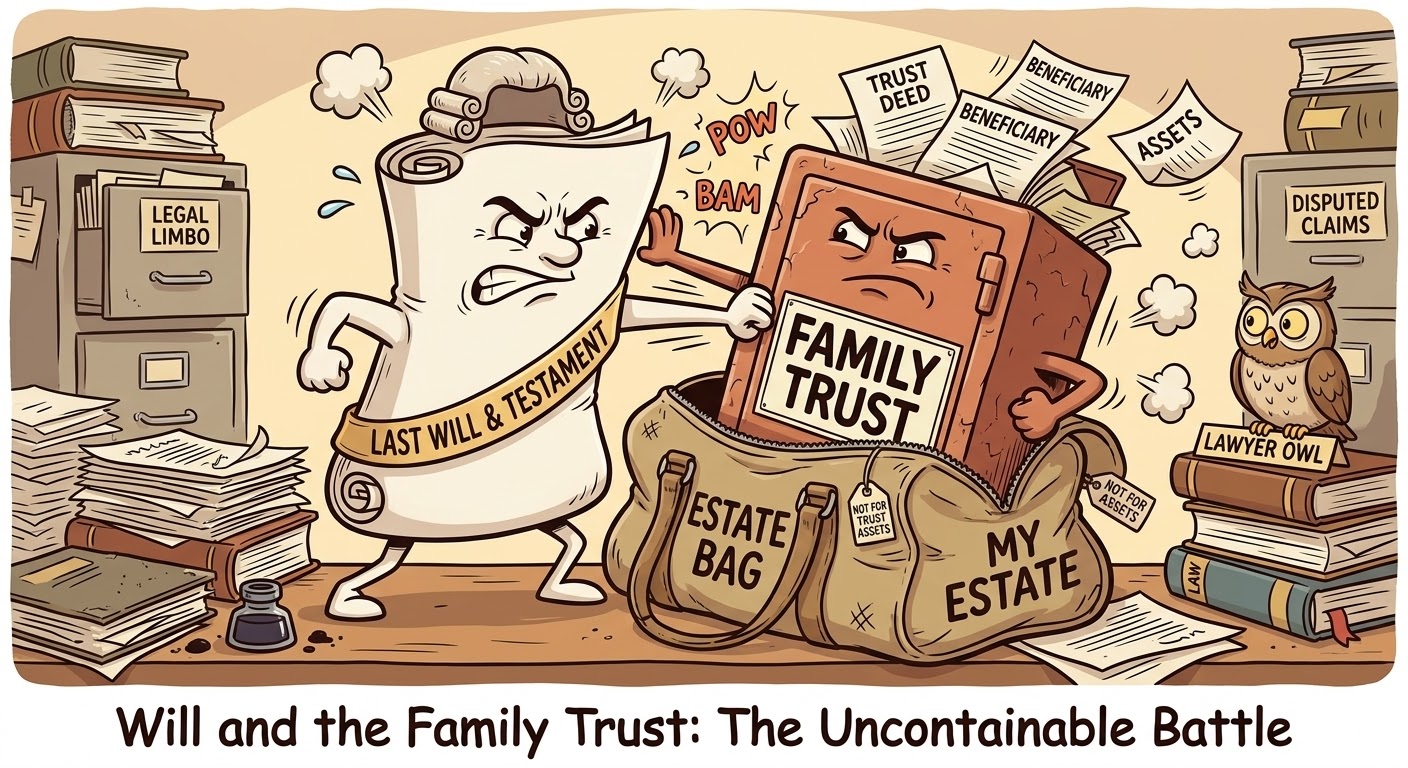
2. Di Trapani v Di Trapani Part Two: Can you forgive Family Trust Loans (UPEs) in a Will?
The Di Trapani case highlights another common estate planning trap. Mrs Di Trapani’s Will also included a clause instructing her family companies to forgive over $1.1 million in intercompany loans.
Again, the Supreme Court struck this down. The Court ruled that you cannot use a personal Will to “lift the corporate veil” and force distinct corporate entities to forgive debts. A company is a separate legal person; your Will cannot dictate its financial management or debt forgiveness. Instead, she should have built Deeds of Debt Forgiveness to get rid of loans and UPEs owed to the Family Trust.
3. Di Trapani v Di Trapani Part Three: Giving shares in the Corporate Trustee
Mrs Di Trapani successfully gifted her shares in the corporate trustee company (Glutolo Pty Ltd) to her executors. Because she personally owned those shares, they were validly passed through her Will. But does the Trustee control the Family Trust? Or is it the Appointor?
However, as the Court noted, owning shares in the corporate trustee does not give you the power to distribute the Trust’s capital to whoever you want. The Trust must still be run according to the rules set out in the original Trust Deed.
The Appointor and Guardian control the Trustee. They sack the corporate trustee irrespective of who owns the shares.
Di Trapani v Di Trapani [2026] QSC 20: How to Correctly Pass Control of Your Family Trust When You Die
The Di Trapani case perfectly illustrates why Family Trusts and Wills must be treated as completely separate legal structures.
-
Do not list Family Trust assets in your Will. The gifts legally fail.
-
Do not try to forgive company or Trust debts in your Will. It is legally unenforceable. You need a Deed of Forgiveness.
-
Do pass control of your Family Trust the correct way: by updating the Appointor via a legally drafted Deed of Variation to the Trust.
Relying on a poorly drafted Will to manage your Family Trust doesn’t just fail—it forces your family into expensive, stressful, and entirely avoidable Supreme Court litigation.
Most of my assets are in my Family Trust. Can they go into my Will?
Q: My understanding is that the beneficiary’s spouse can claim the assets in my Family Trust. This is after I am dead and my child divorces. This is because such assets are not held by the trustees of the 3-Generation Testamentary trusts contained in my Will. And therefore are not protected by the Divorce Protection Trust.
It is difficult to move my assets from the Family Trust into my name or into my deceased estate. This is because of stamp duty, CGT, Unpaid Present Entitlements and Division 7A. It is also not good for asset protection.
Also, if you distribute the assets of the Family Trust into my deceased estate after I am dead, then my Testamentary Trust loses its tax-favourable status for minor children. This is under section 102AG Income Tax Assessment Act.
However, in my case, the Family Trust has a company as the corporate Trustee. I own the shares in that corporate trustee. And, therefore, obviously, the shares in the company go into the Will. This is when I die. But that does not help me, either. This is because the Appointor in the Family Trust can sack the corporate trustee.
My last option is to have my children’s spouses, as they come and go, sign Binding Financial Agreements. Obviously, that only works while I am of sound mind and can keep changing my Will. Also, it seems that Binding Financial Agreements do not work anyway.
A: You are correct. It is almost impossible to fight the Family Court. Consider:
- somehow getting your wealth out of the Family Trust into your name, before death. Then it goes into your 3-Generation Testamentary Trust Will. And is then protected by the Divorce Protection Trust.
- changing the Appointor clause in the Family Trust.
And do not forget the Unpaid Present Entitlements. This is money owed by the Family Trust to a beneficiary. If you are owed money by the Family Trust, then this money belongs to you. It obviously then gets into your 3-Generation Testamentary Trust Will.
Protects from death duties, divorcing and bankrupt children and a 32% tax on super.
Build online with free lifetime updates:
Couples Bundle
includes 3-Generation Testamentary Trust Wills and 4 POAs
Singles Bundle
includes 3-Generation Testamentary Trust Will and 2 POAs
Death Taxes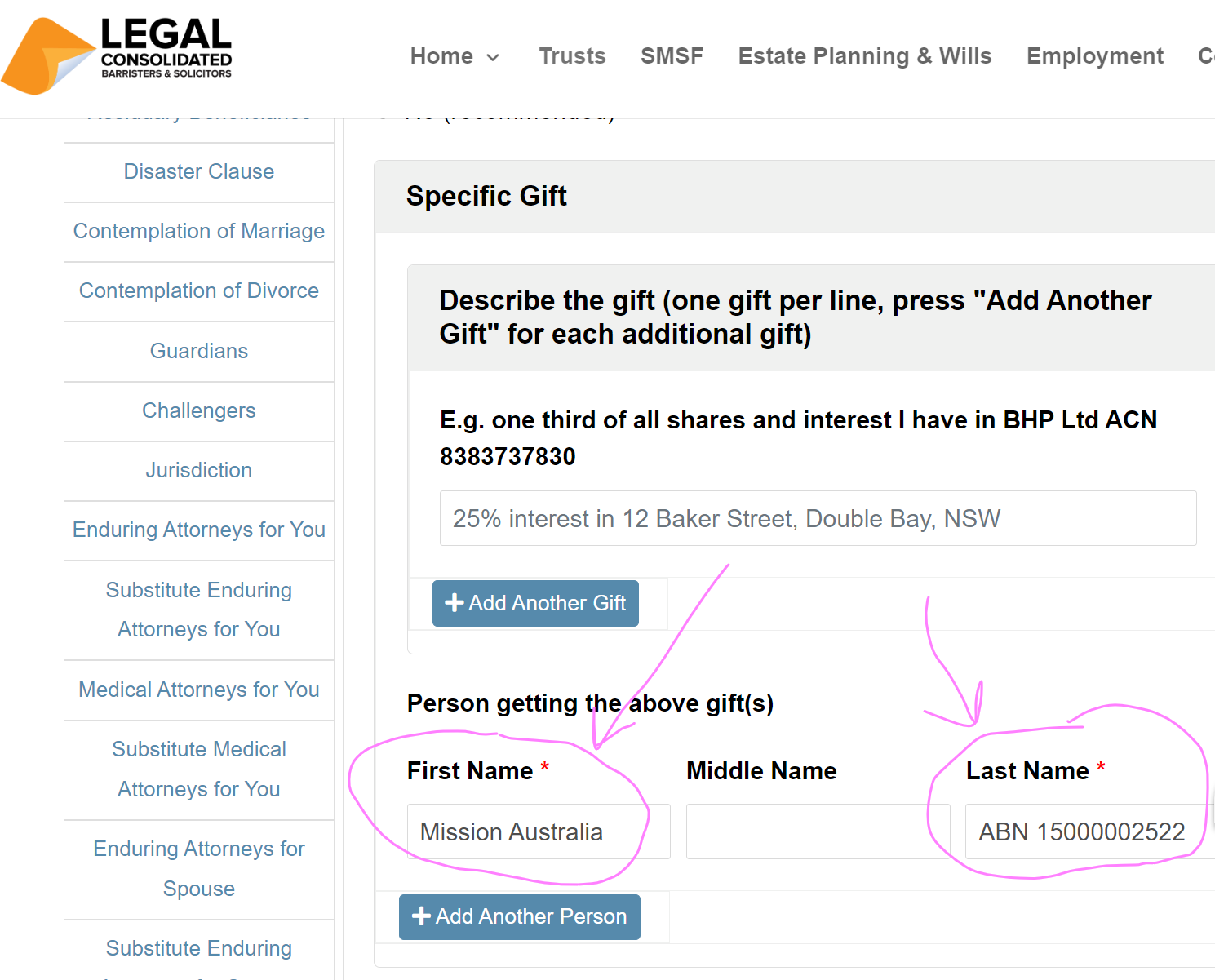
- Australia’s four death duties
- 32% tax on superannuation to children
- Selling a dead person’s home tax-free
- HECs debt at death
- CGT on dead wife’s wedding ring
- Extra tax on Charities
Vulnerable children and spend-thrifts
- Your Will includes:
- Divorce Protection Trust if children divorce
- Bankruptcy Trusts
- Special Disability Trust (free vulnerable children in Wills Training Video)

- Guardians for under 18-year-old children
- Considered person clause to stop Will challenges
Second Marriages & Challenging Will
- Contractual Will Agreement for second marriages
- Wills for blended families
- Do Marriages and Divorce revoke my Will?
- Can my lover challenge my Will?
- Make my Will fair: hotchpot clauses v Equalisation?
What if I:
- have assets or beneficiaries overseas?

- lack mental capacity to sign my Will?
- sign my Will in hospital or isolating?
- lose my Will or my home burns down?
- have addresses changed in my Will?
- have nicknames and alias names?
- want free storage of my Wills and POAs?
- put Specific Gifts in Wills
- build my parent’s Wills?
- leave money to my pets?
- want my adviser or accountant to build the Will for me?
Assets not in your Will
- Joint tenancy assets and the family home
- Loans to children, parents or company
- Gifts and forgiving a debt before you die
- Who controls my Company at death?
- Family Trusts:
- Changing control with Backup Appointors
- losing Centrelink and winding up Family Trust
- Does my Family Trust go in my Will?
Power of Attorney
 Money POAs: NSW, VIC, QLD, WA, SA, TAS, ACT & NT
- be used to steal my money?
- act as trustee of my trust?
- change my Superannuation binding nomination?
- be witnessed by my financial planner witness?
- be signed if I lack mental capacity?
- Medical, Lifestyle, Guardianships, and Care Directives:
- Company POA when directors go missing, insane or die
After death
- Free Wish List to be kept with your Will
- Burial arrangements
- How to amend a Testamentary Trust after you die
- What happens to mortgages when I die?
- Family Court looks at dead Dad’s Will