Can a Will clause force my child to divorce? The Public Policy Rule
No. A Will is not a remote control. You cannot use it to control your child’s marriage from the grave. But you can protect your estate. That is the difference.
Many Will makers ask the wrong question. They ask:
“Can I make my daughter divorce her husband before she gets my estate?”
That is the wrong question. The better question is:
“How do I stop my estate passing into the hands of a financially dangerous spouse?”
That is estate planning.
The first question smells of control. The second question smells of asset protection. Courts understand asset protection.
Public Policy restricts conditions on gifts in Wills
The courts dislike spite, religious punishment, racial control and clauses that encourage divorce. This is called public policy. Public policy overrides what you want to achieve in your Will.
Why does Public Policy ignore my wishes in my Will?
A requirement or condition in your Will fails if it offends public policy. Public policy is the court’s way of saying:
“A person may give away their property. But the court does not enforce every condition attached to that gift.”
A Will maker has broad freedom. You can leave your estate to one child and not another. You can favour grandchildren. You can exclude a person. You can use a 3-Generation Testamentary Trust Will to protect wealth from death duties, bankruptcy and divorce.
But there are limits.
On the grounds of public policy, courts reject conditions in your Will that:
- encourages divorce — gets the gift if she divorces John Kenneth Smith;
- restrains marriage — gets the gift only if he remains unmarried;
- attacks religion — gets nothing if she marries a Catholic;
- attacks race — inherits only if he marries a Greek person;
- rewards illegal conduct — gets $50,000 if he votes for the communist party;
- requires sexual conduct — keeps the house only while she lives a chaste life;
- imposes degrading personal control — inherits only if she weighs under 70 kilograms;
- is uncertain — all my personal belongings; or
- is so offensive that the court refuses to enforce it — inherits only if he disowns his disabled child.
That is why relationship clauses in Wills are dangerous.
“My child gets the gift only if they divorce”
This wording is litigation bait:
“I gift $1,500,000 to my daughter, Annabelle Grace Whitmore, only if she divorces her husband, Marnus James Cornelias.”
That reads like a divorce bounty. The court then asks whether the Will is protecting the estate, or trying to induce divorce.
That is the public policy trap. Your concern may be genuine. Marnus James Cornelias may be bankrupt, violent, coercive, a gambler or a predator. But the Will must be built around the risk, not the hatred.
Use the 3-Generation Testamentary Trust Will to protect the inheritance. Do not write: “divorce and get paid.”
Divorce Protection Trusts are safer than crude divorce conditions
A crude clause says:
“My daughter gets this gift if she divorces her husband.”
That clause is contrary to public policy. It is not enforced. The daughter still gets the gift whether she divorces or not. The gift is sound. The gift is still valid. But the condition of divorce is ignored.
A Divorce Protection Trust in your Will is different. It does not reward divorce. It protects the inheritance if divorce or separation creates risk. The beneficiary and bloodline are protected.
The dangerous spouse and the spouse's friend, the Family Court never got control. This is because your daughter never got control.
Rather than risk clauses in your Will being ignored due to public policy, build a 3-Generation Testamentary Trust Will which contains:
- Divorce Protection Trust machinery;
- careful trustee control provisions;
- a Considered Person Clause where a person receives less or nothing; and
- a Specific Gift condition only in a narrow case.
Can I put a relationship condition on a Specific Gift?
Sometimes. But it high risk.
A Specific Gift gives a particular asset to a particular person. For example:
“I gift my shares in Cornelias Holdings Pty Ltd to my daughter, Annabelle Grace Whitmore.”
A relationship condition adds a trap:
“I gift my shares in Cornelias Holdings Pty Ltd to my daughter, Annabelle Grace Whitmore, but only if she is no longer living with Marnus James Cornelias when I die.”
That may work. Or it may be challenged on public policy grounds.
The condition is narrower than poisoning the whole Will. But it is still dangerous. It must be tied to a real asset protection concern. It must not read like revenge. Use a relationship condition like a scalpel. Not a chainsaw.
Example of Will clauses that are ignored under public policy
| Safer Will clause | Risky Will clause | Likely public policy problem |
|---|---|---|
| “I gift my jewellery to my daughter, Annabelle Grace Whitmore.” | “I gift my jewellery to Annabelle Grace Whitmore if she is not living with Marnus James Cornelias at my death.” | “Annabelle gets my jewellery only if she divorces Marnus James Cornelias.” |
| “I gift $50,000 to my son, Hugo Alexander Pembroke.” | “I gift $50,000 to Hugo Alexander Pembroke if he is not bankrupt at my death.” | “Hugo gets nothing unless he leaves that useless woman, Isabella Rose Vandenberg.” |
| “I gift my shares to my grandchildren equally.” | “I gift my shares to Annabelle Grace Whitmore if she is not living with her financially abusive spouse at my death.” | “Annabelle gets nothing while she remains married.” |
| “I gift my piano to my niece, Claudia Seraphina Hartwell.” | “I gift my piano to Claudia Seraphina Hartwell if she is not in a de facto relationship with Peregrine Thomas Lockhart at my death.” | “Claudia gets the piano only if she ends that relationship.” |
| “I gift $20,000 to my grandson, Jasper Edmund Vale.” | “I gift $20,000 to Jasper Edmund Vale if he is not under the financial control of his partner at my death.” | “Jasper must never marry a Catholic.” |
| “I gift my watch to my nephew, Tobias Frederick Mallory.” | “I gift my watch to Tobias Frederick Mallory if he is not married to a bankrupt person at my death.” | “Tobias loses the watch if he marries an Anglican.” |
| “I gift my books to my daughter, Celeste Marian Ashbury.” | “I gift my books to Celeste Marian Ashbury if she is not living with a person subject to a violence restraining order at my death.” | “Celeste must marry a Presbyterian to inherit.” |
| “I gift my caravan to my son, Rupert Elias Fairchild.” | “I gift my caravan to Rupert Elias Fairchild if he is not living with a person who took money from me.” | “Rupert gets nothing if he becomes a Jehovah’s Witness.” |
| “I gift $10,000 to each grandchild.” | “I gift $10,000 to each grandchild if they are not in prison at my death.” | “My child only inherits if they marry within our race.” |
| “I gift a painting to my sister, Vivienne Margot Wetherby.” | “I gift the painting to Vivienne Margot Wetherby if she is not living with a person who assaulted a family member or me.” | “Vivienne gets the painting only if she lives a chaste life.” |
The first column, Specific Gift, is not subject to moral control.
The second column may have a genuine risk-management purpose. It needs care.
The third column is where public policy attacks begin. It writes anger, religion, race, sex or moral judgment into the Will.
Do not give the challenger that weapon.
Ramsay v Trustees Executors and Agency Co Ltd - dead dad didn't like his son's wife
In Ramsay v Trustees Executors and Agency Co Ltd (1948) 77 CLR 321 the High Court considered a Will clause that looked dangerous. The Will maker did not want his son’s wife to get the capital. So he drew a line.
His son, George, received income while he remained married to his wife, Irene. But the son George did not receive the capital while that marriage continued. He only received the capital when the marriage ended. That could happen by Irene’s death. Or by divorce. The clause said the trustees were:
“to pay the income of my estate to my son George Binnie Ramsay for such period and so long as he shall remain married to his present wife Irene Ramsay and on the termination of such period in trust for my said son absolutely.”
At first glance, this smells bad. It looks like the father is saying:
“George, stay married and you get income. Get out of the marriage and you get the capital.”
That sounds like a divorce bounty. But the High Court upheld the clause.
Why? Because the Court did not treat the clause as a crude inducement to divorce. It treated it as a protective structure. The father was not cutting George off during the marriage. George still received income. The father was protecting the corpus of the estate from Irene. Latham CJ said the intention was:
“to secure an income to the son during the marriage, and to prevent his wife obtaining any interest, either directly under the father’s will, or indirectly through her husband’s will, in the corpus.”
His Honour then made the key point:
“There is nothing illegal in such an intention. It is simply a case of a testator [Will maker] choosing his beneficiaries.”
That is the justice in Ramsay. The Court did not force the father to enrich a person he did not want to enrich. The Court respected the Will maker’s choice. But only because the clause was structured as protection, not punishment. Of course, this case dates back to the 1940s, as we know public policy changes, so the decision may now be different.
In any event, Ramsay does not bless this:
“My daughter, Annabelle Grace Whitmore, gets $1,500,000 if she divorces Marnus James Cornelias.”
That is dangerous. It reads like a bribe. Ramsay supports something more careful:
“My child may be supported. But capital is not placed under the practical control of a relationship risk.”
That is asset protection. This is the lesson.
A 3-Generation Testamentary Will protects capital. It allows the choice of beneficiaries. It can delay control by increasing the Age of Majority. It can separate income from capital. It keeps wealth away from a person the Will maker does not trust.
But a Will should not say:
“Divorce and get paid.”
That gives the challenger the weapon.
Better:
“I want to protect Annabelle Grace Whitmore’s inheritance from relationship, creditor and coercive control risk.”
Worse:
“Annabelle Grace Whitmore gets paid if she divorces Marnus James Cornelias.”
The first is estate planning. The second is a court case waiting to happen.
That is why Legal Consolidated’s 3-Generation Testamentary Trust Will is stronger than a homemade divorce condition. It does not use the Will as a remote control. It uses structure. It controls who holds power. It protects capital. It keeps the inheritance away from the wrong hands.
Ramsay is not a blank cheque. It is a warning. Public policy does not kill every clause that touches divorce. But the clause must look like protection. Not revenge. Not moral policing. Not a cash prize for leaving a spouse.
Divorce Protection Trusts are safer than copying Jones v Krawczyk
Good drafting avoids the public policy trap by separating benefit from control. That is the useful lesson from Jones v Krawczyk [2011] NSWSC 139. In Jones, the Will made a daughter ineligible to act as trustee of certain Testamentary Trusts while she remained married to, or lived with, Grant Jones. She was not necessarily cut out as a beneficiary. The clause attacked control. Not a benefit. That is smarter than saying:
“Leave Grant Jones and get paid.”

But it is still litigation bait. It names the relationship. It points to the person the Will maker dislikes. It invites the disappointed child or spouse to say:
“This is about punishment. This is about control. This is against public policy.”
That is why Legal Consolidated’s 3-Generation Testamentary Trust Will is safer. It does not rely on one brittle clause. It has protective machinery sitting ready to use. The Divorce Protection Trust shifts control away from an exposed beneficiary. The Age of Majority clause can delay control. The Bankruptcy Trust can protect capital from creditors. The trustee control provisions keep the wrong hands away from the inheritance.
The 3-Generation Testamentary Trust Will supports the child, and it protects the bloodline. But the risky spouse does not get the control levers.
Can a Will delay inheritance until divorce or death?
Sometimes. For example, in Ellaway v Lawson [2006] QSC 170, a Will delayed a daughter’s inheritance until her husband died or she divorced him. The clause was challenged. The challenge failed. The Court did not strike down the clause on public policy grounds.
But Ellaway turns on its facts. It is not a blank cheque. A clause may survive where the Court sees protection. It is more vulnerable where it smells of punishment, spite or social control.
Public policy changes with society
Public policy and ethics are like fashion and change with the social mores of the day.
A clause that seemed acceptable in the 1990s may be offensive today. Old cases about chastity, religion and marriage must be treated carefully. Do not write:
“My widow keeps the house only while she lives a chaste life.”
Do not write:
“My son inherits only if he marries within our faith.”
Do not write:
“My daughter inherits only if she marries within our race.”
A modern court is likely to ask:
“Is this clause protecting property? Or is the Will maker trying to control sex, religion, marriage or identity?”
The law is patient with asset protection. The law is much less patient with moral policing.
Can my Will stop my child from marrying a Jew, Catholic or Anglican?
Do not draft that clause. A Will is not a pulpit. Do not draft:
“My daughter, Celeste Marian Ashbury, must marry a Presbyterian to inherit.”
Do not draft:
“My son, Rupert Elias Fairchild, loses the gift if he marries a Hindu.”
Do not draft:
“My grandson, Jasper Edmund Vale, gets nothing if he becomes a Jehovah’s Witness.”
That is not asset protection. That is religious punishment. If the real concern is conduct, name the conduct. But even then, be careful. Bad:
“Rupert Elias Fairchild gets nothing if he marries a Catholic.”
While a terribly uncertain clause in a Will that we would never recommend, it would have been better if true and properly advised:
“This Specific Gift does not take effect if Rupert Elias Fairchild is living with a person who has taken money from me, threatened me, or placed someone under financial pressure.”
Focus on conduct. Not religion. Not race. Not moral lectures.
Can my Will end my spouse’s life interest if they remarry?
Life estates are often put in the Will to allow the young, silly thing that you married to live in your home until their death. Life estates are uncertain and often fail in their own right. To add further complexity, the Will maker may want the life estate to end earlier.
The Will may say that the right to live in the family home ends when the spouse remarries, enters a de facto relationship, leaves the home or stops using it as their main residence.
These are rare in first marriages. But common in second marriages.
Example:
“My second spouse may live in the home after I die. When she dies, remarries, enters a de facto relationship or leaves the home, the house goes to my children.”
That protects the spouse. It also protects the children.
But life interests and rights to reside are technical. They create tax, land tax, insurance, repair, Centrelink and family dispute issues.
Can a rich old man pay for sex from the grave?
Ashton v Pratt (No 2) [2012] NSWSC 3 is not a Will case. But it shows how public policy intrudes on your rights over your assets.
The facts concern a rich old man and an attractive young girl, a former escort. There were alleged promises of millions. Madison Ashton said Richard Pratt promised her a financial package if she stayed out of the escort industry and became his mistress when he was in Sydney.
She said she performed her side of the arrangement. After Pratt died, she wanted the money. The Court refused to enforce it.
That is the point for Will makers. You may think your money is yours. You may think you can attach whatever condition you like. But public policy can still step in and say: “No. The court will not enforce that condition.”
The lesson is not about sex. The lesson is control. A Will maker may gift property. A Will maker may protect property. A Will maker may exclude people. But a Will should not reward sexual conduct, punish religion, attack race, encourage illegal conduct or humiliate a beneficiary.
Once the Will reads like a private bargain for sex, revenge or moral punishment, you invite the court in. That is the danger. The Will maker tries to control the family from the grave. The court takes back control.
Live in the house until she remarries - an illegal restraint on marriage
In Staal v Cox [2026] NSWSC 944, the Will stated:
May live in the house and have use of the furniture and furnishings therein as long as she wishes until she may marry or enter into a de facto relationship.
This is a conditional right of occupation.
The Judge stated:
-
It has long been the case that clauses that are a restraint on marriage in general have been questioned by Courts. For instance, the Court (per Gibson J) in Re Hartman [1960] TASStRp 3; [1960] Tas SR 16 (a will construction case) held that a condition requiring a beneficiary to not remarry or become a de facto wife for her to receive a property, was void, as it showed “a clear intention to restrain the plaintiff altogether both from marriage and from sharing the bed and board of a man in an illicit relationship, and so to promote a celibate and chaste mode of living”.
-
In White v Barton [1980] HCA 14; (1980) 144 CLR 431, a will that gave a wife a $5,200 annuity during her lifetime, or until her remarriage, was considered insufficient provision. Justice Mason, as his Honour then was, noted (in the majority) that “community attitudes have so altered that it is now generally accepted that a widow should be maintained for life, rather than during widowhood” (444). Similarly, Stephen J noted that courts should be encouraged to view with disfavour, at least in the case of substantial estates, that restriction upon remarriage which an annuity confined to widowhood involves. It is evident from the date of these cases that these community standards are not novel.
Protects from death duties, divorcing and bankrupt children and a 32% tax on super. Build online with free lifetime updates:
Couples Bundle
includes 3-Generation Testamentary Trust Wills and 4 POAs
Singles Bundle
includes 3-Generation Testamentary Trust Will and 2 POAs
Death Taxes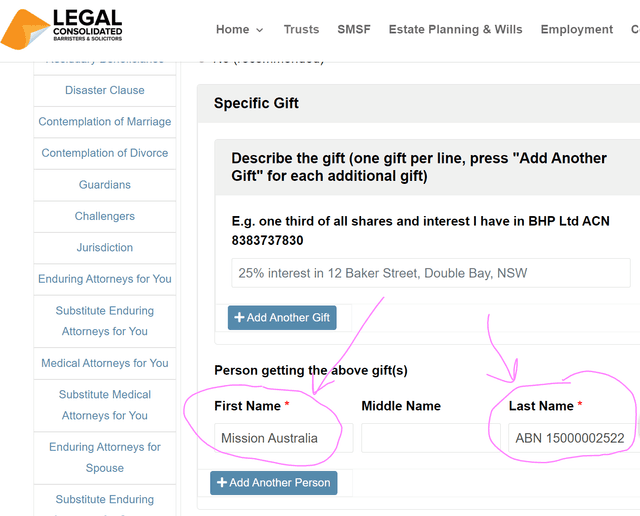
- Australia's four death duties
- 32% tax on superannuation to children
- Selling a dead person's home tax-free
- HECs debt at death
- CGT on dead wife’s wedding ring
- Extra tax on Charities
Vulnerable children and spendthrifts
- Your Will includes:
- Divorce Protection Trust if children divorce
- Bankruptcy Trusts
- Special Disability Trust (free vulnerable children in Wills Training Video)
- Guardians for under-18-year-old children
- Considered person clause: stop Will challenges
- right to live in a home for life - life estates and rights to reside
Second Marriages & Challenging Will

- Contractual Will Agreement for second marriages
- Wills for blended families
- Do Marriages and Divorce revoke my Will?
- Can my lover challenge my Will?
- Make my Will fair: hotchpot clauses v Equalisation?
What if I:
- want to update my Will and POA for free?
- have assets or beneficiaries overseas?
- lack mental capacity to sign my Will?
- sign my Will in hospital or isolating?
- lose my Will or my home burns down?
- have addresses changed in my Will?
- have nicknames and alias names?
- want free storage of my Wills and POAs?

- put Specific Gifts in Wills
- build my parent's Wills?
- leave money to my pets?
- want my adviser or accountant to build the Will for me?
Assets not in your Will
- Joint tenancy assets and the family home
- Loans to children, parents or company
- Gifts and forgiving a debt before you die
- Who controls my Company at death?
- Family Trusts:
- Changing control with Backup Appointors
- losing Centrelink and winding up Family Trust
- Does my Family Trust go in my Will?
Power of Attorney
- Money POAs: NSW, VIC, QLD, WA, SA, TAS, ACT & NT
- be used to steal my money?
- act as trustee of my trust?
- change my Superannuation binding nomination?
- be witnessed by my financial planner witness?
- be signed if I lack mental capacity?
- work out of your home state?
- can I add more clauses to my POA?
- do all attorneys need to accept now?
- Medical, Lifestyle, Guardianships, and Care Directives:
- Company POA when directors go missing, insane or die
After death
- Free Wish List to be kept with your Will
- Burial arrangements
- How to amend a Testamentary Trust after you die
- How to use a Testamentary Trust after you die
- What happens to mortgages when I die?
- What happens if a child dies before you?
- Family Court looks at dead Dad's Will