
A Legal Consolidated 3-Generation Testamentary Trust Will is full of choices. The Will maker does not know what the beneficiaries, assets, tax laws or family circumstances are on the day they die. A spouse who is financially secure today may face different risks tomorrow. A beneficiary may start a high-risk business, separate, face bankruptcy, develop a disability or need protection from receiving too much capital too early.
Trying to predict the future at the time of signing the Will makes the Will brittle. The Legal Consolidated 3-Generation Testamentary Trust Will provides a safer approach. It puts tax, superannuation, asset protection and control machinery into the Will while the Will maker is alive. After death, the Executor, beneficiaries and their professional advisers have flexibility. Each beneficiary is free to determine which trusts suit their circumstances.
The 3-Generation Testamentary Trust Will opens doors. You do not have to walk through every door.
How do I use this information about the 3-Generation Testamentary Trust?
This guide is comprehensive. Scroll to the issues that affect the estate or a particular beneficiary. If nobody faces relationship trouble, skip the Divorce Protection Trust section. If nobody faces bankruptcy, move on. If no beneficiary has a severe disability, the Special Disability Trust section is unlikely to affect the estate strategy.
Different beneficiaries make different choices. A surviving spouse has different needs from another beneficiary. One beneficiary activates no 3-Generation Testamentary Trust. Another activates one. Another uses many because different assets or risks deserve separate structures.
The Will maker already put the machinery in place when Legal Consolidated prepared their Will. The professional team decides which trusts, if any, to use.
Are the Testamentary Trusts already built into the Will?
Yes. The terms of the trusts are already built into the Legal Consolidated 3-Generation Testamentary Trust Will. You do not need to buy another trust deed after the Will maker dies.
The many different trusts sit dormant until needed. After death, each beneficiary works with their deceased estate lawyer, accountant and financial planner to decide which trusts to activate. One beneficiary activates none. Another activates one. Another may activate several.
Non-required trusts can remain dormant. This gives each beneficiary independence and flexibility.
Flexibility is the goal of Estate Planning. The 3-Generation Testamentary Trust Will provides maximum flexibility.
The power of the Primary Beneficiaries
The Will uses the expression ‘Primary Beneficiary’ for the person around whom a particular 3-Generation Testamentary Trust is structured.
This matters because beneficiaries have different lives and needs. A surviving spouse, a business owner, a person facing divorce, a young beneficiary, and a vulnerable beneficiary need different solutions. The 3-Generation Testamentary Trust Will gives each of them more choices.
3-Generation Testamentary Trust vs a standard Testamentary Trust?
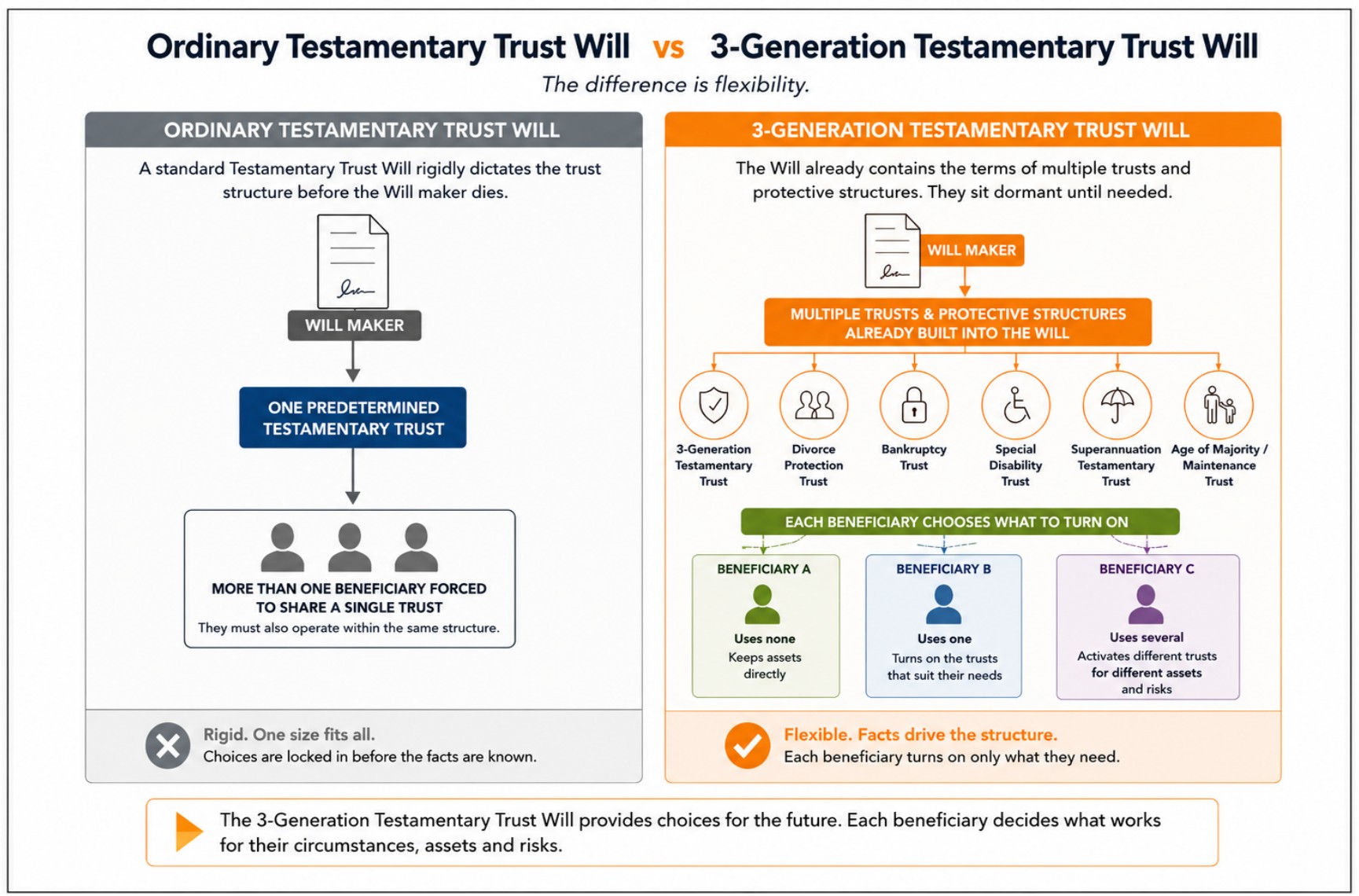
A standard Testamentary Trust Will rigidly dictates the trust structure before the Will maker dies. The Will forces the beneficiary’s share into a predetermined Testamentary Trust. Some standard Wills provide one trust for each beneficiary. Others force several beneficiaries to share one trust. Either way, the structure is fixed before the future facts are known.
The Legal Consolidated 3-Generation Testamentary Trust Will increases flexibility. Each Primary Beneficiary independently decides how to use the machinery available to their share. For example, one beneficiary may take assets directly. Another uses one trust. Another uses several trusts for different assets or risks.
The 3-Generation Testamentary Trust avoids forcing every asset into the same structure. The deceased’s home raises special CGT issues. A trading business creates different risks from a share portfolio. Superannuation requires separate tax analysis. The professional team considers each asset before deciding where it goes.
The benefit is flexibility. A standard Testamentary Trust sets the future in stone. The 3-Generation Testamentary Trust Will gives each beneficiary choices after the Will maker’s death.
What should the Executor do first?
Do not rush the distribution. First, talk with your deceased estate lawyer, accountant and financial adviser. Second, identify the estate assets, liabilities and beneficiaries. Separately identify superannuation, jointly owned assets, Family Trust assets and other property that does not automatically form part of the estate.
A sensible order is:
- locate the original Will and estate planning documents;
- identify the estate assets and liabilities;
- identify assets sitting outside the estate;
- retain the deceased estate lawyer and involve the accountant and financial planner;
- obtain probate where required;
- identify the trust machinery available for each beneficiary;
- examine each beneficiary’s tax, asset protection and control position;
- decide which assets pass directly and which enter a trust;
- establish the appropriate trustee, Appointor, banking and tax arrangements; and
- complete the estate distributions.
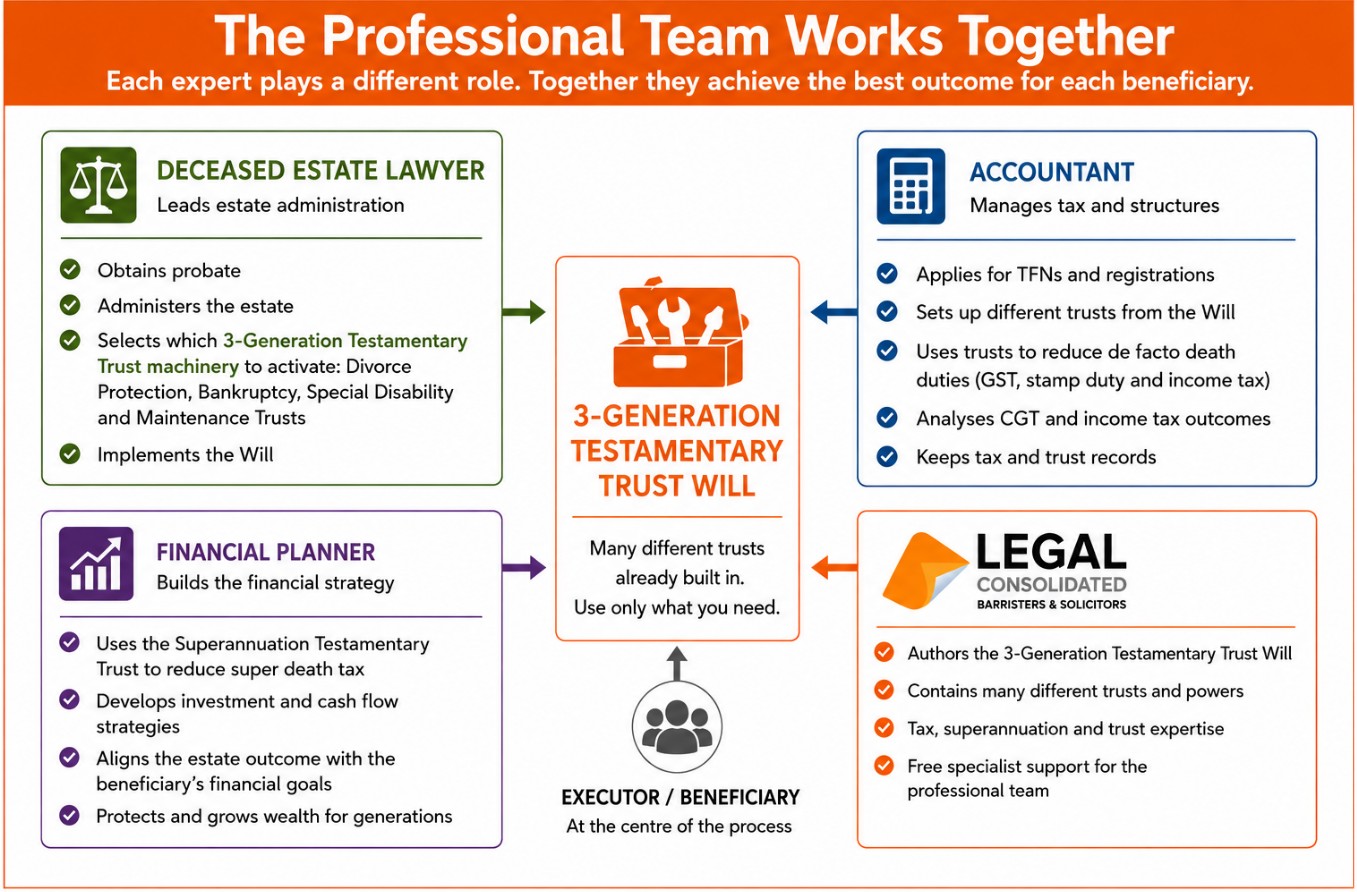
Work with the deceased estate lawyer, accountant and financial planner
The deceased estate lawyer deals with probate, liabilities, title transfers and implementation of the Will. The deceased estate lawyer also protects the integrity of the estate administration if somebody challenges the Will. As tax and superannuation lawyers, Legal Consolidated does not undertake deceased estate administration.
The accountant deals with tax. The financial planner considers superannuation, investments and the beneficiary’s broader financial strategy. These advisers understand the beneficiary’s existing structures, assets and objectives.
Legal Consolidated supports the deceased estate lawyer, accountant and financial planner when they need help understanding the tax, superannuation and trust machinery that Legal Consolidated authored in the Will.
Each adviser brings different expertise. The best result comes from using that expertise together.
What does probate do?
Probate does not create the trust terms. The Will already contains them. Probate proves the Will and confirms the Executor’s authority to administer the estate. The deceased estate lawyer manages that process and determines when the estate is ready for distribution.
The Executor and beneficiaries then use the Testamentary Trust machinery already sitting in the Will.
Does the 3-Generation Testamentary Trust need another trust deed?
No. The terms of the trusts are already built into the Will. The Will is not limited to one type of Testamentary Trust. It contains broad machinery that gives each Primary Beneficiary flexibility to use different trust structures for different assets and circumstances.
The Will also contains powers that allow the Testamentary Trusts to adapt after the Will maker dies. This helps the trusts respond to changes in the law, tax rules, control and family circumstances. Your lawyer works with the accountant and financial planner to use those powers when required. The exact machinery is governed by the Will that the Will maker signed.
Does every beneficiary have to use a 3-Generation Testamentary Trust?
No. That flexibility is one of its strengths. There is no requirement to set up a testamentary trust for any asset.
One beneficiary takes the inheritance directly. Another activates one 3-Generation Testamentary Trust. Another uses several. Each Primary Beneficiary makes their own decision with their professional advisers.
There is no benefit in activating extra trusts merely because they are available. Every operating trust involves accounting, tax, and administrative work. You activate one of the many trusts in the Will to solve a death tax, CGT, income tax, investment, succession, control or asset-protection challenge.
Why use more than one 3-Generation Testamentary Trust?
Different assets carry different risks. Suppose a beneficiary receives a trading business, investment property, shares and cash. There is no reason to assume that all four belong in the same trust structure.
A high-risk business carries different risks from passive investments. Property brings different financing and tax issues than cash. Overseas assets raise another set of questions. Separate structures also support different succession strategies.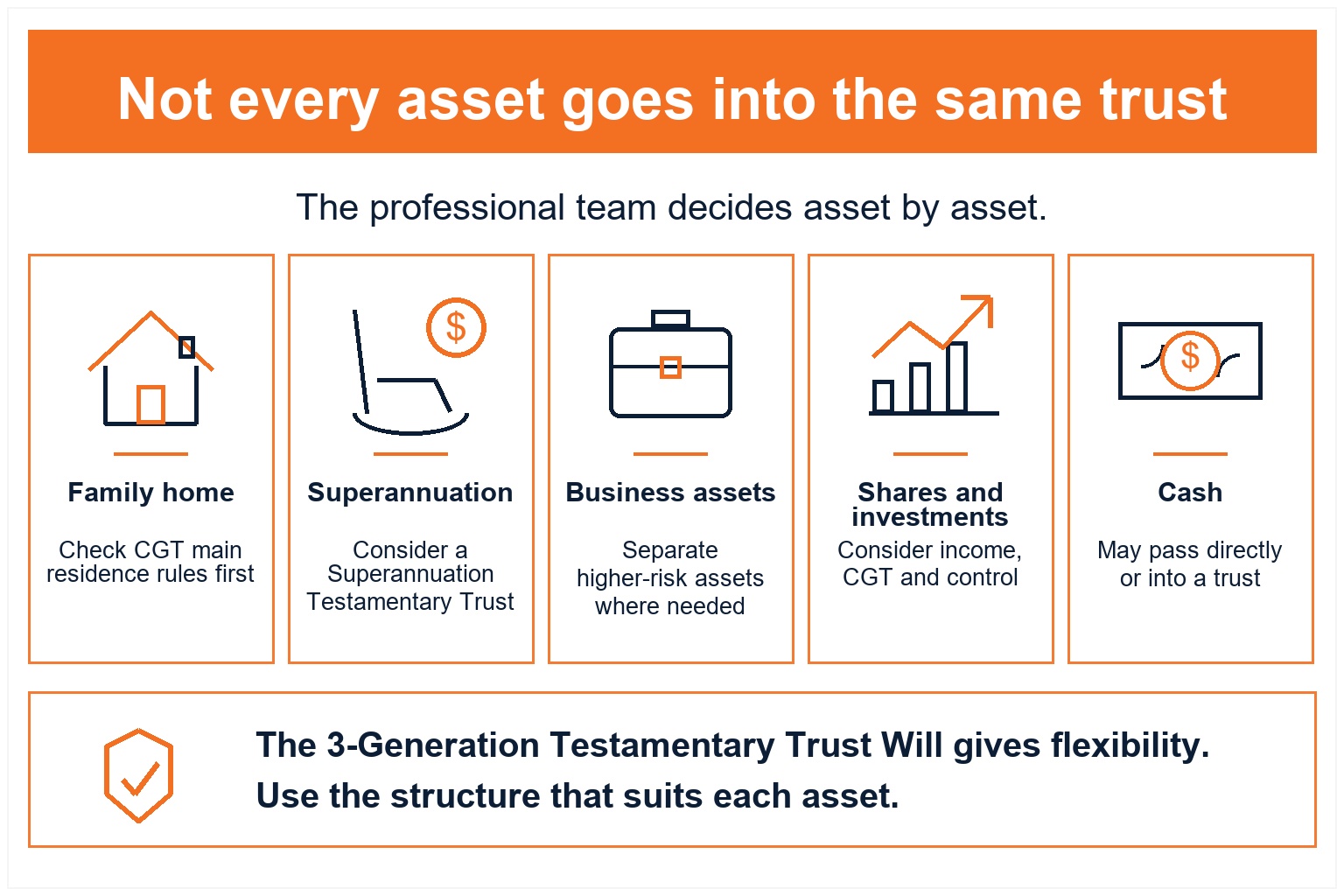
The Will allows the professional team to separate assets where the benefit justifies the additional administration. See Legal Consolidated’s Asset Protection strategies for the wider principles.
The Trustee controls the trust assets. The Appointor controls who serves as Trustee. These are important control levers. Each beneficiary works with their professional team to determine the appropriate Trustee and Appointor. Divorce, bankruptcy, business risk and vulnerability affect that decision. The Will also contains succession machinery for future Trustees and Appointors.
Change the Testamentary Trust’s control and administration after death?
The Will contains powers designed to allow the trust structure to adapt over time. Those powers support changes to trustees, Appointors, and other aspects of administration where the Will and applicable law permit such changes.
Your lawyer works within those powers. The lawyer also considers the tax, duty and trust law consequences before changing the structure. Where a proposed change falls outside the available powers, the lawyer determines what further legal process is required.
This flexibility matters because a trust designed to operate for decades needs to respond to deaths, incapacity, changing family circumstances and new tax or commercial needs.
However, nobody has the unrestricted power to rewrite the Will after the Will maker dies. The available power comes from the Will and the law.
Legal Consolidated explains this further in Amending a Testamentary Trust after the Will maker dies.
What assets should go into the trust?
Do not assume every estate asset belongs in a 3-Generation Testamentary Trust. Cash, shares, investment property, businesses and the family home have different tax and commercial characteristics.
Each beneficiary also has their own tax position, relationships, existing entities and exposure to risk. The professional team considers CGT, transfer duty, asset protection, control and investment strategy before deciding where an asset goes.
An asset goes directly to the beneficiary, into one 3-Generation Testamentary Trust or into a separate trust where the Will permits it. Make that decision before the transfer.
Should the deceased’s home go into a 3-Generation Testamentary Trust?
Treat the deceased’s home separately. Do not automatically transfer it into a Testamentary Trust.
Section 118-195 of the Income Tax Assessment Act 1997 (Cth) provides important CGT relief for a dwelling acquired from a deceased estate where the statutory requirements are satisfied. The familiar two-year rule is only part of the legislation. Occupation and other conditions also affect the outcome.
Legal Consolidated explains the issue further in You get a 2-year period to sell a dead person’s home tax-free.
Have the deceased estate lawyer and accountant work through the CGT position before transferring the home. The Will gives them that flexibility.
What tax advantages apply to beneficiaries under 18?
A 3-Generation Testamentary Trust provides a tax advantage for beneficiaries under 18. Division 6AA of the Income Tax Assessment Act 1936 (Cth) applies a 66% tax rate to a minor’s unearned income. Thankfully, Section 102AG contains the ‘excepted trust income’ rules.
The tax concession is tied to assets coming from the deceased estate and qualifying accumulations derived from those assets. Section 102AG(2AA) focuses the treatment on qualifying income from property transferred from the deceased estate and qualifying accumulations derived from that property. Adding unrelated family wealth does not make all subsequent income excepted trust income.
Good records matter. The accountant needs to identify what came from the estate and trace the income and later property derived from it.
How does CGT work in a 3-Generation Testamentary Trust?
A Testamentary Trust operates under the normal trust and CGT rules. Where the statutory requirements are satisfied, qualifying gains receive the CGT discount.
The discretionary structure also gives the trustee and accountant choices when dealing with income and capital gains under the Will and tax law. Those decisions need to happen before the relevant trustee resolutions and distributions.
The Will provides the structure. The accountant applies the tax law.
What happens to superannuation when the Will maker dies?
Superannuation is not automatically part of the deceased estate. The first question is therefore not ‘Which Testamentary Trust gets the super?’
The professional team first determines where the superannuation death benefit is legally payable. The answer depends on the fund rules, trustee powers and any effective death benefit nomination.
Then look at tax. Legal Consolidated explains the issue in detail in Superannuation Death Tax.
How does superannuation get into the Will?
Superannuation enters the deceased estate when the death benefit is paid to the deceased’s legal personal representative. Where there is a Will, the Executor administers that payment as part of the estate.
The Executor does not decide after death that the superannuation belongs to the estate. The superannuation arrangements already in place determine the available pathway.
Where the death benefit enters the estate, the 3-Generation Testamentary Trust Will opens further planning opportunities. Section 302-10 of the Income Tax Assessment Act 1997 (Cth) deals with superannuation death benefits paid to a deceased estate and looks through to the beneficiaries who receive the benefit.
The deceased estate lawyer, accountant and financial planner then consider which structure gives the beneficiary the better tax, asset-protection and investment outcome.
Who is a tax dependant for superannuation?
This question has a large tax impact. Superannuation law and tax law use different dependant tests.
A person entitled to receive a superannuation death benefit does not automatically receive the favourable tax treatment given to a ‘death benefits dependant’. Section 302-195 of the Income Tax Assessment Act 1997 (Cth) includes a spouse or former spouse, a child under 18, a person in an interdependency relationship with the deceased and another person who was a dependant immediately before death.
An independent adult child therefore sits in a different tax position from a surviving spouse. The tax-free and taxable components of the death benefit also matter.
Determine the tax-dependant position before deciding where the superannuation flows. See Superannuation Death Tax for the detailed rules.
What is the Superannuation Testamentary Trust?
The Legal Consolidated Will already contains Superannuation Testamentary Trust machinery. It sits ready for use where superannuation enters the estate and the structure improves the outcome.
Do not turn it on merely because it exists. The accountant examines the tax components and who ultimately benefits. The financial planner considers the superannuation and investment strategy. The deceased estate lawyer deals with the estate administration.
The professional team then decides whether to use the Superannuation Testamentary Trust.
What happens if a beneficiary is separating or divorcing?
If nobody faces relationship trouble, skip this section.
Where separation, divorce or serious relationship risk exists, stop before making a direct distribution. A direct inheritance puts the inherited wealth into the beneficiary’s personal financial world.
The Divorce Protection Trust is already built into the Will. The professional team decides whether to turn on that machinery before the Executor distributes the beneficiary’s share.
No trust removes the Family Court’s jurisdiction. But the source of the property, trust terms, control and the way inherited wealth is held all matter.
Why include Divorce Protection Trust machinery if nobody is divorcing?
Because the Will maker does not know which relationships survive. A secure marriage today may look very different 15 years later.
If no relationship risk exists, leave the Divorce Protection Trust dormant. If a beneficiary faces trouble, the machinery is already sitting in the Will.
This is stronger than trying to build protection after the dispute begins.
What happens if a beneficiary is bankrupt?
Stop before distributing the inheritance directly. Bankruptcy changes what happens to property acquired by the beneficiary.
The Bankruptcy Trust machinery is already built into the Will. Tell the deceased estate lawyer if a beneficiary is bankrupt, faces insolvency proceedings or has serious creditor exposure.
The professional team then determines whether to activate the Bankruptcy Trust for that beneficiary. The other beneficiaries continue to make their own choices.
What if a beneficiary runs a high-risk business?
Asset protection matters before bankruptcy arrives. Business owners, directors, guarantors and professionals face risks that other beneficiaries do not share.
Putting a large inheritance directly into that person’s name adds the inheritance to the same personal risk pool. A 3-Generation Testamentary Trust helps keep inherited wealth separate and provides additional control.
The beneficiary also has the option of using separate trusts for higher-risk assets and passive investments where the additional structure produces a real benefit. See Asset Protection strategies for the wider approach.
What if a beneficiary has a disability?
Do not automatically turn on the Special Disability Trust merely because the Will contains one.
A Special Disability Trust is a specialised social-security structure. It provides valuable concessions where the beneficiary and circumstances satisfy the statutory rules. It also carries restrictions and administration requirements.
The 3-Generation Testamentary Trust and Maintenance Trust provide more flexible alternatives. The professional team compares the structures and turns on the Special Disability Trust only where its benefits justify the restrictions.
The Will provides the opportunity. It does not force the result.
What does the Special Disability Trust achieve?
A Special Disability Trust centres on one principal beneficiary who satisfies the statutory severe disability requirements. Services Australia publishes the eligibility, gifting, asset-test and expenditure rules.
The concessions are valuable where they solve a real Centrelink problem. The restrictions also matter.
The accountant, financial planner and deceased estate lawyer compare those benefits and restrictions before deciding whether to activate the trust. Legal Consolidated explains the structure further in Special Disability Trusts: avoiding Centrelink deprivation rules.
Vulnerable beneficiary
A beneficiary needs protection for many reasons. Financial immaturity, loss of capacity, addiction, outside influence or an inability to manage money create different problems.
The Legal Consolidated Will already contains the Maintenance Trust and other protective mechanisms. The professional team identifies the risk and selects machinery to address it without unnecessary restrictions.
See Protecting Vulnerable Beneficiaries in Wills for more detail.
What happens if a beneficiary is under the Age of Majority?
A young beneficiary needs capital protection and control. Turning 18 does not produce financial wisdom.
The Legal Consolidated Will includes Age of Majority and Maintenance Trust provisions. These control access to capital while allowing the trustee to support the beneficiary’s maintenance, education and welfare under the Will.
The deceased estate lawyer works through the provisions. The accountant and financial planner manage the tax, investments and financial strategy.
How do you set up a trust in practice?
Once the beneficiary and professional team decide to activate a particular trust, keep the implementation clean.
Give the trust a clear name. The accountant obtains the required Tax File Number and determines whether the trust needs an Australian Business Number, GST registration or another registration. Open separate banking and investment accounts where required.
Record the assets transferred from the estate. Keep trust money separate from personal money. Retain the Will, probate documents, tax records, financial statements, trustee decisions and important professional advice.
Good administration protects the machinery.
Can you turn a trust off later?
A trust that has never been activated simply remains dormant.
Once a trust holds assets and operates, bringing it to an end is a legal and tax event. The trustee and professional advisers work within the Will, trust law and tax law to determine how and when the trust ends.
Do not treat an operating trust like a switch that can simply be flicked off. The flexibility comes from having strong powers built into the Will and using those powers properly.
Why do trust records matter?
A 3-Generation Testamentary Trust is designed to last. The records need to last with it.
Trustees die. Accountants retire. Financial planners change firms. Banks merge. Keep evidence showing which property came from the estate, what happened to it and what decisions the trustee made.
This is particularly important for s 102AG of the Income Tax Assessment Act 1936. The tax treatment of income distributed to beneficiaries under 18 depends in part on the source of the relevant property.
Do not leave the next generation to reconstruct the trust from memory.
What should the Executor avoid doing?
Do not treat a sophisticated 3-Generation Testamentary Trust Will like a simple Will containing direct gifts.
Do not force every asset into one trust. Do not keep every asset outside the trusts by reflex. Do not ignore superannuation. Do not transfer the deceased’s home without checking the CGT consequences. Do not distribute directly to a bankrupt beneficiary. Do not activate a Special Disability Trust merely because it exists.
Most importantly, do not destroy a choice before the professional team considers it.
Once an asset goes to the wrong place, fixing the problem is harder than making the right decision before distribution.
Why does Legal Consolidated put so much machinery into the Will?
Because nobody knows the future. The Will maker does not know when they die, what they own at death, which beneficiaries face divorce or bankruptcy, who develops a disability or what the tax and superannuation laws look like at that time.
The Legal Consolidated Estate Planning Manual explains the answer: flexibility.
Legal Consolidated builds the terms of the trusts into the Will while the Will maker is alive. The trusts then sit dormant until needed. After death, each beneficiary and their professional team turn on the machinery that helps and leave the rest alone.
That is deliberate flexibility, not uncertainty.
How does the Will help the deceased estate lawyer?
A flexible Will gives the deceased estate lawyer useful choices. The lawyer deals with the actual estate, beneficiaries and law at the time of administration.
The lawyer then works with the accountant and financial planner before implementing the relevant distributions. Legal Consolidated does not practise in deceased estate administration. We practise in tax and superannuation and support professional colleagues who need help understanding the machinery that we authored.
The Will is there to help the professional team.
How does the Will help accountants and financial planners?
Accountants and financial planners are trusted advisers. They understand the client’s tax position, structures, investments, superannuation and financial objectives.
A rigid Will limits their choices. The 3-Generation Testamentary Trust Will gives them legal machinery that supports the tax and financial strategy they develop with the beneficiary.
Legal Consolidated’s Estate Planning Standards explain how advisers, accountants and lawyers work with the Legal Consolidated law firm to build estate planning documents for clients.
Who builds a Legal Consolidated 3-Generation Testamentary Trust Will?
Advisers, accountants and lawyers build 3-Generation Testamentary Trust Wills for their clients through the Legal Consolidated law firm’s website. They remain at the centre of the client relationship. Legal Consolidated authors the legal document.
Legal Consolidated controls the legal logic, questions, hints, training material and finished document. The client receives the document with a covering letter confirming Legal Consolidated’s authorship and responsibility.
That differs from a non-law firm website selling legal templates. A lawyer may have prepared the master template used by such a website. The website itself is not the law firm authoring and accepting responsibility for the client’s finished legal document.
Legal Consolidated is the law firm.
Does Legal Consolidated operate throughout Australia?
Yes. Legal Consolidated is a national Australian law firm operating across New South Wales, Victoria, Queensland, Western Australia, South Australia, Tasmania, the Australian Capital Territory and the Northern Territory.
Families do not stay neatly inside State borders. Beneficiaries move. Trusts own assets in several jurisdictions. State and Territory laws differ on probate, property, duty and trust duration.
Legal Consolidated authors the document nationally. The professional team then deals with the jurisdiction-specific issues that arise during administration.
What help does Legal Consolidated provide after death?
Legal Consolidated authored the 3-Generation Testamentary Trust Will. We remain available to help Executors, beneficiaries, deceased estate lawyers, accountants and financial planners understand the tax, superannuation and structural machinery in our document.
Legal Consolidated does not undertake probate or deceased estate administration. Retain a deceased estate lawyer for that work.
Where the professional team wants to understand why a provision is there or how the Legal Consolidated tax and superannuation machinery operates, contact us. We want the machinery used properly.
Why build the 3-Generation Testamentary Trust machinery while you are alive?
You do not know which new death taxes the state or federal government will introduce. You do not know which beneficiary divorces. You do not know who faces bankruptcy. You do not know whether a beneficiary needs a Special Disability Trust. You do not know the value or destination of your superannuation at death.
You do not need to try to predict the future.
The 3-Generation Testamentary Trusts are already built into the Will. After death, each beneficiary works with the deceased estate lawyer, accountant and financial planner. They turn on the trusts that suit the circumstances and leave the others dormant.
Some beneficiaries use no 3-Generation Testamentary Trust. Some use one. Others use several.
The Will maker builds the machinery. The professional team decides how to use it.
Protects from death duties, divorcing and bankrupt children and a 32% tax on super.
Build online with free lifetime updates:
Couples Bundle
includes 3-Generation Testamentary Trust Wills and 4 POAs
Singles Bundle
includes 3-Generation Testamentary Trust Will and 2 POAs
Death Taxes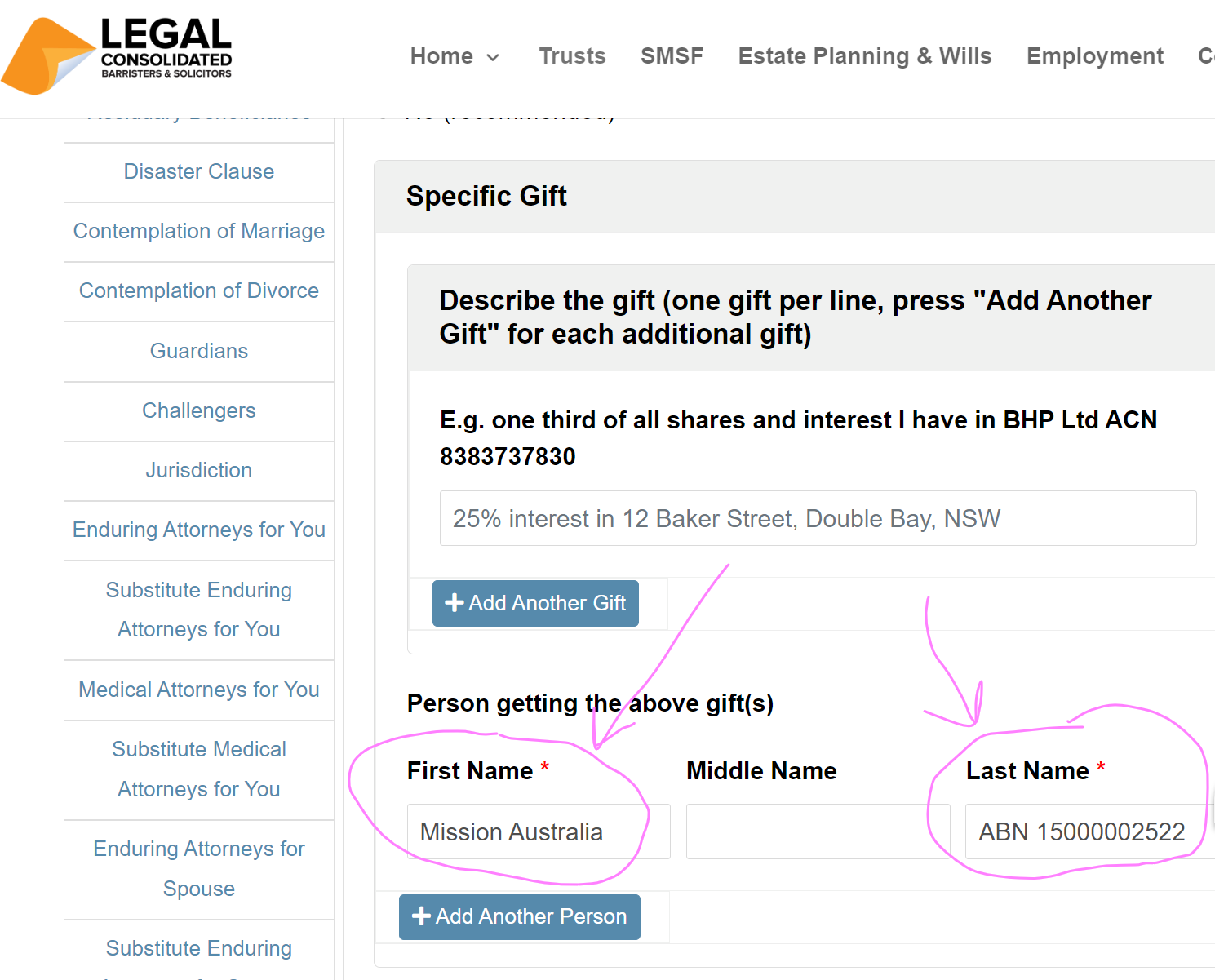
- Australia’s four death duties
- 32% tax on superannuation to children
- Selling a dead person’s home tax-free
- HECs debt at death
- CGT on dead wife’s wedding ring
- Extra tax on Charities
Vulnerable children and spendthrifts
- Your Will includes:
- Divorce Protection Trust if children divorce
- Bankruptcy Trusts
- Special Disability Trust (free vulnerable children in Wills Training Video)
- Guardians for under-18-year-old children
- Considered person clause: stop Will challenges
- right to live in a home for life – life estates and rights to reside
Second Marriages & Challenging Will

- Contractual Will Agreement for second marriages
- Wills for blended families
- Do Marriages and Divorce revoke my Will?
- Can my lover challenge my Will?
- Make my Will fair: hotchpot clauses v Equalisation?
What if I:
- want to update my Will and POA for free?
- have assets or beneficiaries overseas?
- lack mental capacity to sign my Will?
- sign my Will in hospital or isolating?
- lose my Will or my home burns down?
- have addresses changed in my Will?
- have nicknames and alias names?
- want free storage of my Wills and POAs?

- put Specific Gifts in Wills
- build my parent’s Wills?
- leave money to my pets?
- want my adviser or accountant to build the Will for me?
Assets not in your Will
- Joint tenancy assets and the family home
- Loans to children, parents or company
- Gifts and forgiving a debt before you die
- Who controls my Company at death?
- Family Trusts:
- Changing control with Backup Appointors
- losing Centrelink and winding up Family Trust
- Does my Family Trust go in my Will?
Power of Attorney
- Money POAs: NSW, VIC, QLD, WA, SA, TAS, ACT & NT
- be used to steal my money?
- act as trustee of my trust?
- change my Superannuation binding nomination?
- be witnessed by my financial planner witness?
- be signed if I lack mental capacity?
- work out of your home state?
- can I add more clauses to my POA?
- do all attorneys need to accept now?
- Medical, Lifestyle, Guardianships, and Care Directives:
- Company POA when directors go missing, insane or die
After death
- Free Wish List to be kept with your Will
- Burial arrangements
- How to amend a Testamentary Trust after you die
- How to use a Testamentary Trust after you die
- What happens to mortgages when I die?
- What happens if a child dies before you?
Free executor resource
Executor’s Death Kit — Probate, trusts and assets after death
Legal Consolidated 3-Generation Testamentary Trust Wills include free help for your executor, accountant and financial adviser after you die. These practical guides explain what happens next.
Get Probate
- How do I apply for a Grant of Probate myself?
- How do I get Probate outside Australia?
Put the Will’s protective trusts to work
- How do I operate a 3-Generation Testamentary Trust after the Will maker dies?
- Can I amend a Testamentary Trust after the Will maker dies?
- How do I reduce the superannuation death tax paid by adult children?
- Can a company act as Trustee or bucket company of a Testamentary Trust?
Other practical issues after death
- What happens to mortgages after death?
- Who controls a Family Trust after the Appointor dies?
- Who controls a company after a director dies?
- Are funeral wishes in a Will legally binding?