


This is a specialised Loan Agreement for lending money to a company. Press START BUILDING FOR FREE. Read the free hints. Answer as many questions as you can. The building process is highly educational. Feel free to telephone the law firm, and we will check your answers. But start the free building process BEFORE you telephone.
Loan to a company to escape the Debt Equity rules
Related party ‘at call’ loans to a company: Debt/Equity Rules
Your company wants to buy a truck. But the company has no money.
Should the company borrow the money from the bank? No. You have some lazy cash. You give the money to the company. This is to buy the truck.
- Did you loan the money to the company?
- Or was it an injection of equity?
There is no legally enforceable Company Loan Agreement. The ATO claims it is a cash injection. This means that it is difficult to get the money back tax-free.
When you give money to a company, it is either:
- a loan (good) or
- an injection of equity (generally bad)
Loan to a company (or was it an injection of equity?)
The Debt/Equity tax rules started on 1 July 2001. If money moves from you to your company, the default position is that it is an injection of cash. It is not a loan. Undocumented money into a company is treated as an injection of cash as equity. Not as debt.
However, it is generally better to treat the money you put into your company as a ‘loan’. This is rather than an injection of ‘equity’. If the money is equity (rather than debt), then:
- any interest payable on the loan is not tax-deductible (but potentially frankable as a dividend)
- when the company hands back the money, it is treated as a dividend payment to you
- the thin capitalisation rules that apply to disallow debt deductions are impacted by the debt/equity classification of ‘at call’ loans
In other words, if the loan is deemed an injection of equity, it is expensive and difficult to recover the money from the company.
In contrast, if you ‘lent’ money to your company, then you are more able to take out that money from the company for free.
What is a ‘related party at-call’ company loan agreement?

Getting money back from a company is difficult. Ensure you have a legally prepared Company Loan Agreement before lending money to your Company.
A related-party ‘at-call’ loan is a type of financing arrangement. This is between:
- a company; and
- someone related or connected to your company.
For example, the
- ‘Lender’ is you, your spouse, children, shareholder or a Family Trust (a related party)
- ‘Borrower‘ is the company
- ‘at call’ means that the Lender can demand back the money at any time. (In contrast, a loan may be for a fixed period. E.g. you pay me back the money in 5 years’ time.)
Let us say you make a loan to your company. But there is nothing in writing. There is no written company loan agreement.
In your minutes, journal entities and in your accounts, you classify the loan as a related party ‘at-call’ loan. But, sadly, they do not satisfy the tax definition of a loan. (See Rowntree v FCT [2018] FCA 182 below.)
Debt / Equity rules for ‘at-call’ loan agreements
Consider this loan to a company ‘at call’ loan:
Keith owns shares in his company. Keith lends $100,000 to his company. He forgets to build a Company Loan Agreement at www.legalconsolidated.com.au. Sadly:
- there is no written company loan agreement
- there is, therefore, nothing documenting the loan
- also, there is no fixed repayment term for the loan
The arrangement between Keith and his company is that the loan is repaid when Keith demands repayment – ‘at call’.
Sadly, under the Debt/Equity rules, the ATO treats the loan as an injection of equity, not as a loan.
Therefore:
- any interest payable on the loan is not deductible to Keith’s company
- where the loan is subsequently repaid to Keith, the repayment is often classified as a non-share dividend paid from his company; therefore, Keith is assessed on the repayment of the loan.
$20 million turnover exception (de minimis exception) when lending to a company
The above rules usually do not currently apply to companies with an annual turnover of less than $20 million (excluding GST). However, it is not worth the risk. Your accountant for proper accounting standards and business practice requires a Company Loan Agreement. This puts the matter beyond doubt.
Furthermore, if your company achieves a $ 20 m-plus turnover in any given year, all loans are converted into equity. This is at that time.
Pay Dividends without cash using using a Loan Agreement
Running short on cash but need to pay a dividend to a shareholder? Our Loan to a Company Agreement allows you to credit dividends directly to a shareholder’s loan account, reducing the loan balance without moving money.
-
Settle Dividends Flexibly: Apply dividends to repay the loan principal or interest, keeping your company’s cash flow intact.
-
Stay ATO-Compliant: Ensure the loan remains a debt, not equity, under the Debt/Equity rules, even when crediting dividends. Perfect for related party at-call loans!
-
Meet Legal Standards: Our agreement ensures dividends comply with the Corporations Act 2001, with built-in warranties to reduce your tax or legal issues.
-
Keep Clear Records: Robust documentation requirements mean your dividend credits are ATO-ready and court-proof, safeguarding your interests in audits and disputes.
Securing your loan against the company’s land and chattels
A loan agreement is just an unsecured promise to pay. If the borrowing company goes into liquidation, an unsecured lender stands at the back of the line. You will likely get nothing.
However, the Legal Consolidated Loan to a Company Agreement is carefully prepared to allow the Lender to register encumbrances over both the company’s real estate and its non-land assets (chattels) .
Our Loan Agreement contains a specially drafted ‘charging clause’ and an Irrevocable Power of Attorney. This allows the Lender to step in and register the securities to protect their money.
1. Securing against company land (Caveats and Mortgages)
To lodge a caveat or register a mortgage over real estate owned by the company, you must have a valid ‘caveatable interest’. A standard loan agreement does not give you this right.
Our Loan Agreement contains a specific, unequivocal charging clause under which the Borrower, as a company, consents to encumbrances on their land and real estate. As established in Barlin-Scott Air Conditioning Pty Ltd v San Miguel (1993) 2 VR 545, a clearly drafted charging clause creates an equitable interest in the land, allowing the Lender to legally lodge a caveat or equitable mortgage to secure the Repayment Amount.
2. Securing against company chattels (The PPSR) owned by the company as lender
For company-held non-land assets (such as vehicles, equipment, shares, and accounts), you cannot lodge a caveat. Instead, you may wish to register a security interest on the Personal Property Securities Register (PPSR).
Under section 20 of the Personal Property Securities Act 2009 (Cth) (PPSA), a security interest is only enforceable against third parties if it is “perfected” (registered) and supported by a written Security Agreement.
The Legal Consolidated Loan Agreement is prepared as a Security Agreement. It expressly grants the Lender a general security interest over all present and after-acquired property (AllPAAP) of the company .
What does a Legal Consolidated Debt Equity ‘at call’ Loan contain?
- Our law firm’s letter of advice, confirming that we prepared the Company loan agreement
- Company Loan Deed
Protect your Loan in Family Court or Bankruptcy
Lending to a family company or loved one? Our Loan to a Company Agreement helps shield your money in situations such as family court disputes and the company’s insolvency. By clearly proving your loan is a debt, not a gift, you strengthen your claim to get repaid, even if relationships or businesses falter.
Do not use a “Promissory Note” when lending to a company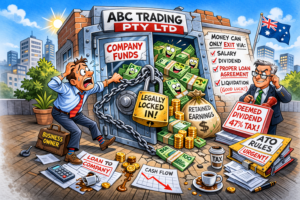
Many online websites that pretend to be law firms suggest using a ‘Promissory Note’ or an ‘IOU’ for smaller loans. A Promissory Note is merely a promise to pay. It is a highly dangerous document to rely on when lending to a Pty Ltd company.
The Family Court, Bankruptcy Courts and other creditors will be swayed by a professionally prepared Loan Agreement containing all the usual terms of a Loan Agreement. E.g. an acceleration clause.
Promisory notes and IOUs are not worth the paper they are written on.
Even simple loans to a company require a legally enforceable loan agreement: Rowntree v FCT
Rowntree v FCT [2018] FCA 182 shows the additional care required to document even simple related-party transactions. This includes loans.
In this case, the taxpayer, a practising NSW lawyer, claimed he borrowed over $4m. This is from his group of private companies. The Court said:
Mr Rowntree has not deliberately chosen to ignore the law.
His evidence presented to the Tribunal suggests that he genuinely believed that there were arguments to support his view that a loan was in existence.
He failed. Only a legally prepared Deed of Loan of a company satisfies the:
- Australian Taxation Office;
- Bankruptcy Courts; and
- Family Court.
When lending to a company lock in the Directors with a Guarantee
When you lend money to a human, all of their personal assets (their house, their car, their bank accounts) are on the line if they fail to repay you.
When you lend money to a company, you only have access to the company’s assets. If the company has no money, you get nothing. The directors of the company are generally protected by the corporate veil. They can simply wind up the company and walk away from your loan.
How the Legal Consolidated Loan Agreement protects you: Our Loan Agreement allows you to include a director’s guarantee. It includes a specific clause stating that where the Borrower is a company, all current and future directors agree to be bound by the Loan Agreement jointly and severally as though they were the Borrower.
This means if the company fails to pay, you can pursue the directors personally for the Repayment Amount. Furthermore, our document allows you to easily add third-party Guarantors to the deed, ensuring that if the borrowing company defaults, the Guarantor is legally forced to step in and pay the debt.
Division 7A v Lending to a company: What is the difference?
-
When the company lends YOU money: If your company lends money to a shareholder (or their associate, children, wife and family trust), the ATO’s Division 7A rules apply. If you do not have a specific Div 7A Loan Agreement in place, the ATO will treat the loan as an unfranked dividend, and you will be taxed on it at your marginal rate. (If this is what you need, build our Division 7A Loan Agreement instead.)
-
When YOU lend money to the company: If you (or another entity) lend money to a company, Division 7A does not apply. In that instance, you need to build the Company Loan Agreement.
Our Loan to a Company Agreement is specifically drafted to satisfy your accountant and the ATO that the cash you injected into the company is a genuine debt.
Loan to a Parent:

Loan to a Spouse:

Commercial Loan Agreement:

Division 7a Loan Deed:

ATO Compliant Loan Agreement:

Loan to a Child:

Forgive Debt Agreement:

Protects from death duties, divorcing and bankrupt children and a 32% tax on super. Build online with free lifetime updates:
Couples Bundle
includes 3-Generation Testamentary Trust Wills and 4 POAs
Singles Bundle
includes 3-Generation Testamentary Trust Will and 2 POAs
Death Taxes
- Australia’s four death duties
- 32% tax on superannuation to children
- Selling a dead person’s home tax-free
- HECs debt at death
- CGT on dead wife’s wedding ring
- Extra tax on Charities
Vulnerable children and spend-thrifts
- Your Will includes:
- Divorce Protection Trust if children divorce
- Bankruptcy Trusts
- Special Disability Trust (free vulnerable children in Wills Training Video)

- Guardians for under 18-year-old children
- Considered person clause to stop Will challenges
Second Marriages & Challenging Will
- Contractual Will Agreement for second marriages
- Wills for blended families
- Do Marriages and Divorce revoke my Will?
- Can my lover challenge my Will?
- Make my Will fair: hotchpot clauses v Equalisation?
What if I:
- have assets or beneficiaries overseas?

- lack mental capacity to sign my Will?
- sign my Will in hospital or isolating?
- lose my Will or my home burns down?
- have addresses changed in my Will?
- have nicknames and alias names?
- want free storage of my Wills and POAs?
- put Specific Gifts in Wills
- build my parent’s Wills?
- leave money to my pets?
- want my adviser or accountant to build the Will for me?
Assets not in your Will
- Joint tenancy assets and the family home
- Loans to children, parents or company
- Gifts and forgiving a debt before you die
- Who controls my Company at death?
- Family Trusts:
- Changing control with Backup Appointors
- losing Centrelink and winding up Family Trust
- Does my Family Trust go in my Will?
Power of Attorney
 Money POAs: NSW, VIC, QLD, WA, SA, TAS, ACT & NT
- be used to steal my money?
- act as trustee of my trust?
- change my Superannuation binding nomination?
- be witnessed by my financial planner witness?
- be signed if I lack mental capacity?
- Medical, Lifestyle, Guardianships, and Care Directives:
- Company POA when directors go missing, insane or die
After death
- Free Wish List to be kept with your Will
- Burial arrangements
- How to amend a Testamentary Trust after you die
- What happens to mortgages when I die?
- Family Court looks at dead Dad’s Will